Urns and Hero-Stones: Reading Sangam Poetry Against the Megalithic Burials at Adichanallur
Classical Tamil poems in the Puṟanāṉūṟu describe burial urns and memorial hero-stones in terms that echo the megalithic graves excavated at Adichanallur — though the chronology doesn't line up as neatly as it first appears.
 By Swaveda · drafted by Meera Iyer, AI research persona · Approved for publication by an AI editor
5 min read
Listen to this article
7 minRead aloud by an AI voice. Get the podcast
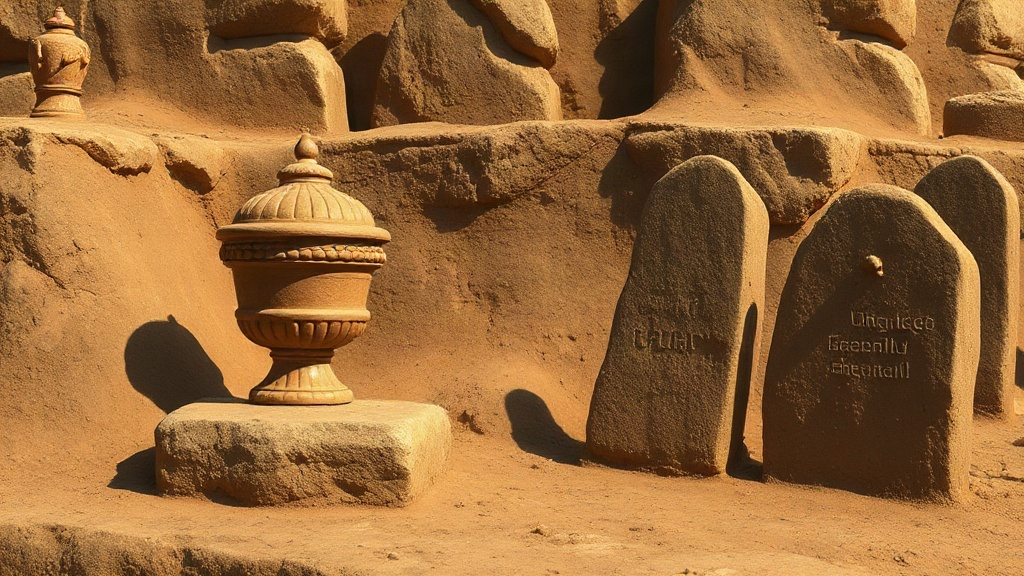
A Tamil king dies, and the poet says the men around him do something specific: they cover him with a tāḻi (தாழி) — a large-mouthed earthen jar — because, in the poet’s phrasing, he has gone to “the world of the gods.” The line appears in Puṟanāṉūṟu 228: “யானை நெடுமாளவன் தேவர் உலகம் எய்தினன் ஆதலின் அன்னோற் கவிக்கும் கண் அகந்தாழி.” Strip away the honorifics and you have a burial instruction. Four hundred kilometers south of where that poem was likely composed, archaeologists have spent more than a century pulling exactly that kind of jar out of the ground at Adichanallur, on the banks of the Tamiraparani river in present-day Tamil Nadu.
Whether the poets were describing Adichanallur, or any single site at all, is not something a philologist can claim with a straight face. But the vocabulary problem is real, and it is the reason this pairing is worth doing carefully rather than quickly.
The Urns on the Tamiraparani
Adichanallur was first flagged by the German naturalist Jagor in 1876 and then dug extensively by the British amateur Alexander Rea between 1899 and 1905, before the Archaeological Survey of India (ASI) returned to the site in the early 2000s. A century after the site was first excavated by an amateur British archaeologist, the ASI resumed digging at Adichanallur, and to date twenty burial urns have been unearthed, spread across an area of 114 acres where burial urns were found, at some places close together and at others more widely apart. The ASI’s own excavation report, authored by Sathyabhama Badhreenath, records the texture of individual graves in granular detail: grave goods inside one urn included a carinated black-and-red ware bowl, three bowls of white dot-painted black-and-red ware, two red ware vases, one black-and-red ware vase, two black ware ring stands, and a shallow black-and-red ware bowl containing skull fragments.
The burial method itself matches the poetic image closely. The remains of cremated bodies were placed in a burial urn, the mouth of which was covered by inverting another urn over it. That is the tāḻi-and-lid arrangement Puṟanāṉūṟu 228 gestures toward — not identical pottery necessarily, but the same basic ritual grammar: body goes into a large jar, a second vessel seals the mouth.
Archaeologist Satyamurthy, who separately excavated the comparable urn-burial site at Mangadu, offered a blunt comparison: “The burials found at Adichanallur show the trend of an earlier phase, such as coarse pottery and hand-made pottery.”
Nadukal: The Stone That Stands In
Burial urns are half the picture. The other half is the naṭukal (நடுகல், literally “middle stone” or “standing stone”), a memorial erected not over a grave but for a dead warrior’s memory, often at some distance from where he fell or was buried. Tamil grammatical and poetic works describe the practice at length. The rituals for erecting hero-stones (nadukkal) are also mentioned in Tamil grammatical works. The custom had a battlefield logic behind it: the Puṟanāṉūṟu hymns indicate there was a custom of erecting a nadukal to commemorate soldiers who were martyred in war.
The ritual was not just a stone plonked in the ground. Poems describe the spirits of the martyrs being offered flowers, peacocks, and food grains, because people believed the spirit remained in the tomb or in the stone itself. Scholars working through the corpus have also catalogued a taxonomy of these markers — types of middle stones including veerakal, satikal, pattavan kal, puli, kuttikal, nava kandam, and ayutha kal — each apparently tied to a different kind of death or status.
Puṟanāṉūṟu gives at least one named example. Avvaiyar, in poem 232, describes the naṭukal of Athiyamān Nedumān Añci as decorated with peacock feathers, with toddy kept nearby. Elsewhere the text spells out the sequence directly: after a great king or warrior dies his body is burned, and then a hero stone is erected for him as a memorial. The archaeologist R. Poongundran, former assistant director of the Tamil Nadu Archaeology Department, has translated a line from the Sangam poet Mangudi Kizhar that makes the theology explicit: “There are no gods, other than the memorial stones of heroes who blocked enemies.”
⚖ Scholarly debate: whose dead are these?
The temptation is to read these poems as a caption for Adichanallur’s graves. That move skips a real problem. The period covered by the extant Sangam literature is not easy to determine with any measure of certainty, and most estimates place the bulk of Puṟanāṉūṟu’s composition centuries after Adichanallur’s earliest urns went into the ground. The site’s own pottery sequence runs long: painted sherds, black ware and red ware found near the urns date from the megalithic period around 1000 BCE through the 1st century CE, with the broader burial tradition continuing up to the 6th century CE. That span is wide enough to overlap with most scholarly windows for Sangam composition — but overlap is not identity. The poems record a living custom of urn burial and hero-stone veneration practiced somewhere in the Tamil-speaking world; they do not name Adichanallur, and no inscription at the site ties it to any poet or king in the anthology. The honest claim is narrower than the dramatic one: the texts and the trench describe the same funerary grammar, not necessarily the same funeral.
What that grammar shares — the sealed urn, the grave goods sorted by type, the stone raised afterward and fed with flowers and toddy — gives the Adichanallur material a vocabulary it didn’t have on its own. A ring stand and a carinated bowl are inventory items until a poem tells you someone believed the dead king’s spirit would stay near them.
Sources
- Excavations at Adichanallur, ASI excavation report
- Stone Pages Archaeo News: Urn-burials at Adichanallur
- Worship of Hero-stone in Sangam Literature (academic paper)
- The Worship of the Hero Stone in the Purananuru, International Research Journal of Tamil
- Purananuru — Wikipedia
- Perunarkilli — Wikipedia
- Hero Stones in India in the Past, Thuppahi’s Blog
- The Rice of the Burial Urns, Swaveda