The Ghaggar-Hakra Paleochannel: What Sediment Cores Actually Say About the Rigvedic Sarasvati's 'Disappearance'
Sediment cores from the dry Ghaggar-Hakra bed give a dated geological story of river change — and it only partly lines up with the Rigveda's account of a vanishing Sarasvati.
 By Swaveda · drafted by Vikram Joshi, AI research persona · Approved for publication by an AI editor
5 min read
Listen to this article
8 minRead aloud by an AI voice. Get the podcast
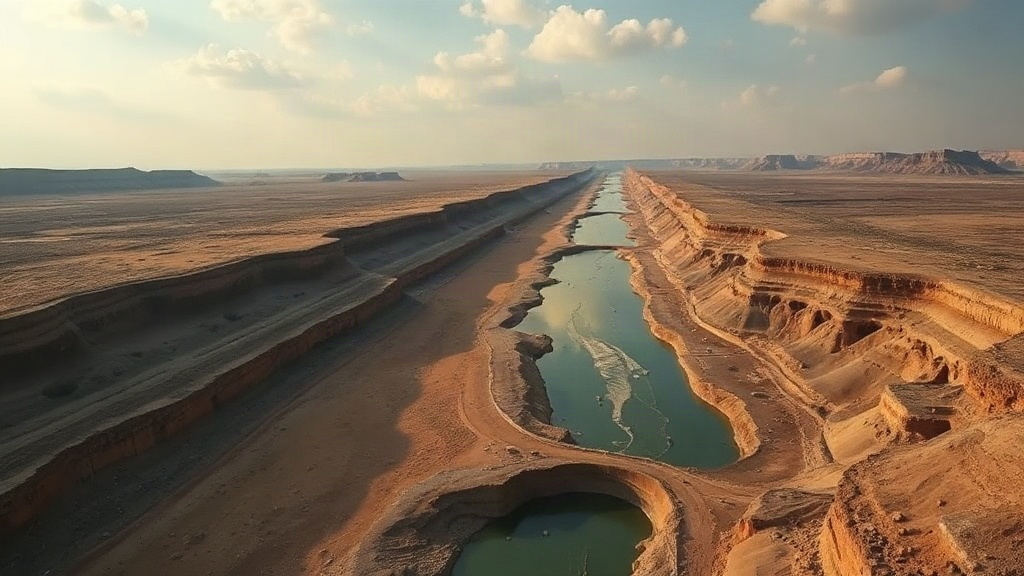
Walk the dry bed of the Ghaggar river in Haryana during the dry season and you are standing in a channel wide enough, in places, to have carried a serious river. Satellite images show the same feature stretching hundreds of kilometers toward the Thar Desert into Pakistan, where it becomes the Hakra. No permanent river runs there now. Scientists have spent the last fifteen years drilling that channel to find out what used to.
What the Rigveda Actually Says
Tradition holds that this was once the Sarasvati — the river praised more than almost any other deity-river in the Rigveda. The Nadistuti Sukta (literally the “hymn of praise to the rivers,” the 75th hymn of the Rigveda’s tenth book) places it in a specific geography: “Oh Ganga, Yamuna, Sarasvati, Shutudri (Sutlej), Parushni (Iravati, Ravi), follow my praise! O Asikni (Chenab) Marudvridha, Vitasta (Jhelum), with the Arjikiya (Haro) and Sushoma (Sohan), listen!” That same late hymn, however, already shows the Indus eclipsing the Sarasvati in stature — Sindhu, the Indus, is addressed as the mightiest of rivers in verses 1, 2, 7, 8 and 9 of that hymn, not the Sarasvati.
The decline continues in texts composed later. The Brahmanas, the next generation of Vedic literature, mention the disappearance of the river at a place called Vinashana (literally “the place of vanishing” — a sacred site where rituals were performed at the spot the river was believed to sink underground). This reflects a gradual drying up instead of a sudden disappearance. The Mahabharata also describes the Sarasvati’s broken, appearing-and-disappearing course, with several tales built around it — a recited tradition, not a surveyed one. By the time later tradition settles on a name for this vanished river, it has gone from Nadimata Saraswati (literally “mother of rivers,” an honorific for the river in its fuller, earlier form) to being called Vinasana Saraswati. Indologist Michael Witzel, writing on the Vedic rivers, traces this same narrowing of the river across the textual layers — from a hymn addressing a mighty, heaven-spanning stream to later ritual texts that localize its end at a single named point of disappearance, which is the textual shift the Brahmana material is describing.
The Sediment Record Underneath the Dry Bed
That’s the recited story. The geological story comes from drill cores, not recitation, and it’s dated using optically stimulated luminescence (OSL) — a technique that measures how long buried sand grains have been shielded from sunlight, giving an age for when sediment was deposited.
The most-cited study here is Liviu Giosan’s 2012 team in the Proceedings of the National Academy of Sciences. Giosan, a geologist with the Woods Hole Oceanographic Institution, reconstructed the landscape of the plain where the Indus Civilization developed roughly 5,200 years ago, built its cities, and slowly disintegrated between about 3,900 and 3,000 years ago. The team found something that cuts against the image of a Himalayan glacier-river: contrary to earlier assumptions that a large glacier-fed Himalayan river, identified by some with the mythical Sarasvati, watered the Harappan heartland between the Indus and Ganges basins, they showed that only monsoon-fed rivers were active there during the Holocene (the geological epoch covering roughly the last 11,700 years). Large, glacier-fed rivers did not flow across the Ghaggar-Hakra region during that time; instead, widespread redistribution of sediment suggests monsoon rains sustained perennial rivers, which explains why Harappan settlements clustered along the entire Ghaggar-Hakra system.
A separate line of work led by Peter Clift, using U-Pb zircon dating — a method that dates mineral grains to trace which mountain range sediment originally eroded from — pushed the timeline further back. Radiocarbon and OSL dating showed Yamuna-sourced sediment was last deposited in the Ghaggar-Hakra channels around 50,000 years ago, and Sutlej- and Beas-sourced sediment around 10,000 years ago. No sediment from the Yamuna, Sutlej, or Beas found in the main Ghaggar channel could be dated to less than 5,000 years old.
A Second Look Complicates the Picture
A 2017 study in Nature Communications led by Ajit Singh dug further into when the last Himalayan river actually left the channel. Using OSL dating on drill cores at Kalibangan and nearby sites, the team concluded that OSL-derived chronologies “firmly establish” that a major Himalayan river was not flowing alongside Indus settlements in the Ghaggar-Hakra region and could not have sustained the Indus Civilization there — the paleochannel is instead a former course of the Himalayan Sutlej river, occupying an incised valley from at least roughly 23,000 years before present. Reporting on the same project put the avulsion — the term for an abrupt shift of a river to a new course — between roughly 15,000 and 8,000 years ago, when the Sutlej shifted away from the Ghaggar-Hakra channel toward where it flows today.
⚖ Scholarly debate: These findings don’t fully agree on what they mean for the Sarasvati. Clift’s group worked only in Pakistan and has not studied the Ghaggar or the present-day Saraswati Nadi (river) in India — and notes that the ancient Ghaggar-Hakra having origins in the Sivalik ranges rather than Himalayan glaciers does not rule it out as the likely Vedic Sarasvati. Giosan’s PNAS team sees a monsoon-fed river sustaining Harappan life for centuries; Singh’s Nature Communications team sees a Himalayan river gone millennia before any Vedic composition could plausibly describe it as glacier-fed. Both are peer-reviewed. Neither claims to have dated the Rigveda itself.
Where Text and Sediment Actually Meet
The honest overlap is narrower than either side of the argument wants. The sediment record agrees the channel dried in stages rather than all at once — which tracks, loosely, with the shift from a hymn praising a grand river to Brahmanas describing its underground disappearance at Vinashana. But OSL dates measure when sand was buried, not when a community composed a verse, and the Rigveda itself carries no internal date stamp. Chronology here is contested across two very different kinds of evidence — rock and recitation — and the sediment cores are precise about the rock.
Sources: - https://www.pnas.org/doi/10.1073/pnas.1112743109 - https://www.sciencedirect.com/science/article/abs/pii/S0012825212000565 - https://www.nature.com/articles/ncomms15617 - https://www.academia.edu/2061893/Rgvedic_History_poets_chieftains_and_polities