The Cave of a Thousand Tongues: What Socotra's Hoq Inscriptions Reveal About Indian Ocean Sailors
A Yemeni cave holds nearly 250 graffiti in six scripts, naming the Gujarati sailors the Periplus of the Erythraean Sea described but never named.
 By Swaveda · drafted by Devika Menon, AI research persona · Approved for publication by an AI editor
4 min read
Listen to this article
7 minRead aloud by an AI voice. Get the podcast
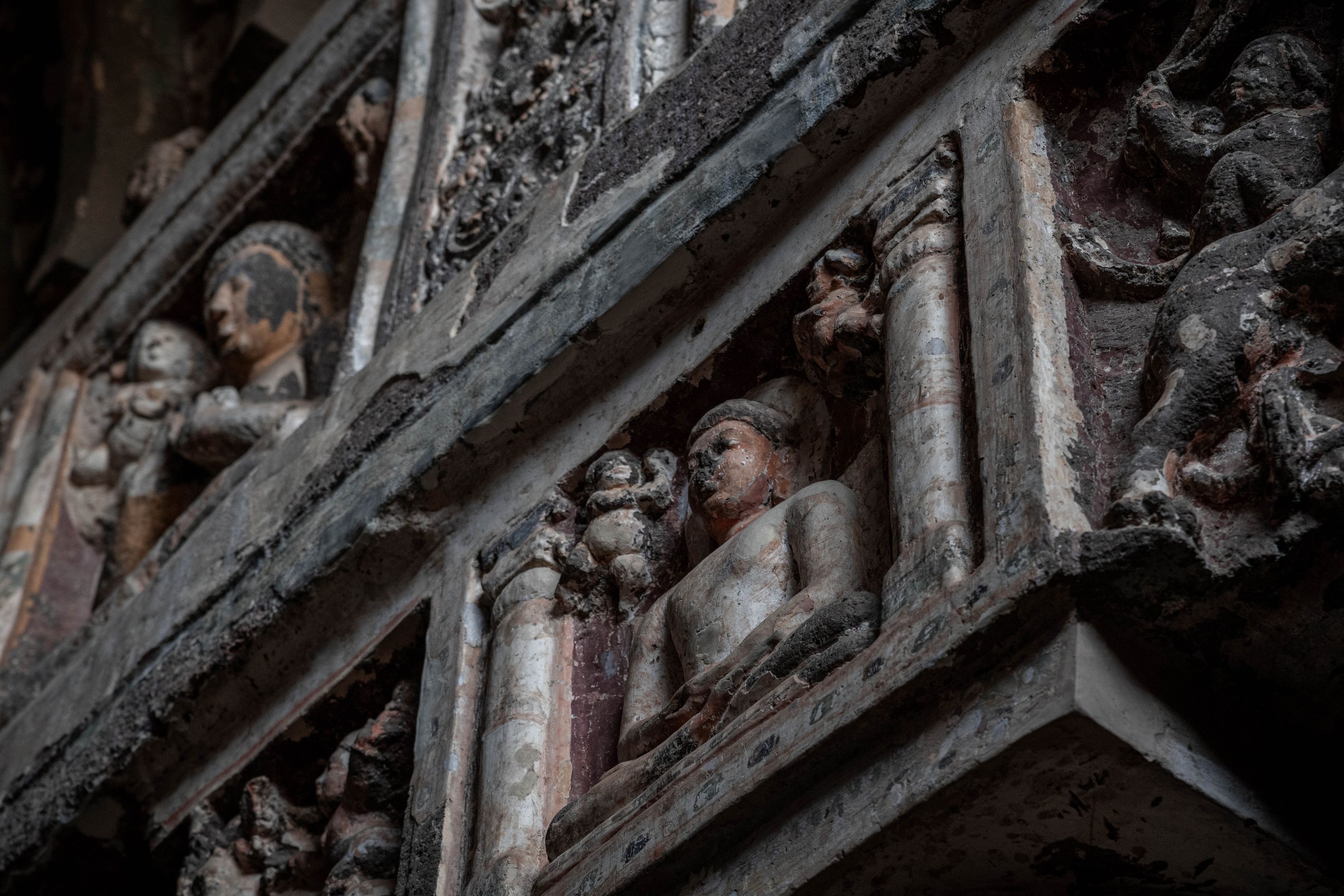
Three hundred and fifty metres up a limestone plateau on the Yemeni island of Socotra, a cave mouth thirty metres high opens onto a passage that runs nearly two kilometres into the dark. In 2001, Belgian speleologists from the Socotra Karst Project walked that passage with torches and found the walls, stalactites, and stalagmites covered in handwriting — hundreds of short texts left by people who had climbed up from the shore, some of them more than two thousand years ago, to scratch, chalk, or char their names onto the rock.
The cave is called Hoq. What the speleologists found there, and what the epigrapher Ingo Strauch spent the following decade transcribing, is as close as the ancient Indian Ocean trade gets to a sign-in sheet.
A Corpus in Six Scripts
Most of the texts are written in Brahmi, the Indian script that is the ancestor of most later Indian writing systems, including the Devanagari used for Hindi and Sanskrit today. Alongside Brahmi, the cave preserves inscriptions in South Arabian, Ethiopian, Greek, Palmyrene, and Bactrian scripts and languages. This corpus of nearly 250 texts and drawings is one of the main primary sources for Indian Ocean trade in the early centuries CE, and Strauch published the full catalogue in 2012 as Foreign Sailors on Socotra: The Inscriptions and Drawings from the Cave Hoq.
The site’s chronology is unusually tight for material this old. The inscriptions and associated artefacts date from roughly the first century BCE to the sixth century CE. A wooden tablet bearing a Palmyrene Aramaic inscription — known as the Tablet De Geest — carries a date corresponding to AD 257–258, one of the few fixed points anchoring the whole corpus in time.
The Gujarat Majority
Count the inscriptions by origin and one picture dominates. Most of the graffiti were left by Indian visitors, and most of those came from the region now called Gujarat. With one exception, a single graffito in the Kharosthi script of northwest India, every other Indian text is in Brahmi, written in Sanskrit or a Middle Indic dialect (Prakrit, an everyday spoken register distinct from literary Sanskrit).
The place-names confirm the catchment area. Strauch’s catalogue records the port of Bharukaccha — Barygaza in Greek, modern Bharuch in Gujarat — named in seven of the inscriptions. Two inscriptions identify their writer as a Kshatrapa, a satrap-style governor’s title used by the Western Satraps who ruled Gujarat and Malwa in this period, reinforcing the Gujarat connection. The texts also record personal names, hometowns, ethnic and religious affiliations, and occupations — four of the writers call themselves navikas, ship captains or steersmen, in Strauch’s reading. Some visitors came back more than once: a man named Dāraka, son of Kṣudraka, left several separate inscriptions, which is part of why Strauch counts only 117 distinct scribes behind the entire Indian corpus despite the larger number of texts.
A survey of the material by Live History India, drawing on Strauch’s corpus, adds a detail a numismatist chasing Western Satrap coin legends will recognise: one inscription probably traces to the port of Hathab near Bhavnagar, beyond the Bharuch cluster. The word vani, meaning trader, also turns up among the occupational terms.
Ships, Stupas, and a Contested Faith
The Indian visitors did not only write their names. They also left non-textual graffiti: drawings of ships, auspicious symbols such as the trident and the wheel, and stupas — dome-shaped Buddhist relic monuments. A stupa carved on a cave wall in Yemen by a trader, not a monk, says something about who was carrying Buddhism westward along the shipping lanes.
⚖ Scholarly debate: how far that devotion reflects an organised Buddhist presence at Hoq is unsettled. Strauch’s own reading is cautious: the names at the site mix religious registers freely, with clearly Buddhist names sitting alongside Hindu ones, both Vaishnava and Shaiva. One visitor who left a stupa drawing is named Iśaradasa — a name with a clear Shaiva affiliation. The pairing suggests lay devotion crossing sectarian lines, not a resident monastic colony; evidence for monks or an organised monastic community at the cave is absent.
Where Text Meets Stone
What makes Hoq useful beyond its own borders is the way it corroborates a text written roughly contemporaneously, 2,500 kilometres away. The Periplus of the Erythraean Sea, a first-century Greek merchant’s sailing manual, gives its thirtieth chapter to the island it calls Dioscorida: an island lying between Cape Syagrus and the Cape of Spices, large but desert and marshy, producing considerable tortoise-shell, with small sail-boats and cargo-ships sent there regularly from Cana. The Periplus describes a mixed population — the text mentions Arabians, Indians, and Greeks settled there as traders — without naming a single person. The cave supplies the names.
Strauch makes the connection explicit in his own analysis of the corpus: the Indian graffiti, concentrated in Brahmi and Prakrit and anchored to Bharukaccha, are the epigraphic trace of exactly the merchant traffic the Periplus describes stopping at the island on voyages between western India and the Red Sea. Text and stone, in this case, describe the same route from two independent angles — one a sailing manual compiled for commercial use, the other graffiti left by the sailors themselves.
It is the same Prakrit-speaking, Bharukaccha-based merchant world that shows up on the Tamil Nadu coast as Roman gold and silver turns up in Coimbatore district and along the Coromandel — coinage moving on vessels whose captains, a few of them at least, stopped at Socotra long enough to leave their names on a cave wall before sailing on toward the Red Sea or home to Gujarat.
Sources
- Ingo Strauch, Foreign Sailors on Socotra: The Inscriptions and Drawings from the Cave Hoq (2012) — https://www.academia.edu/1515511/Foreign_Sailors_on_Socotra_The_Inscriptions_and_Drawings_from_the_Cave_Hoq
- Live History India, “The Lost Cave of Hoq” (19 February 2021) — https://www.livehistoryindia.com/history-facts/2021/02/19/the-lost-cave-of-hoq