When the Mahabharata Remembered: The Saraswati's Drying and the Question of When Texts Preserve Real Geography
The Mahabharata describes a real river that dried around 2000 BCE. But scholars debate whether the epic preserves ancient memory or accumulated details over centuries.
Vikram Joshi for SwavedaMay 6, 2026
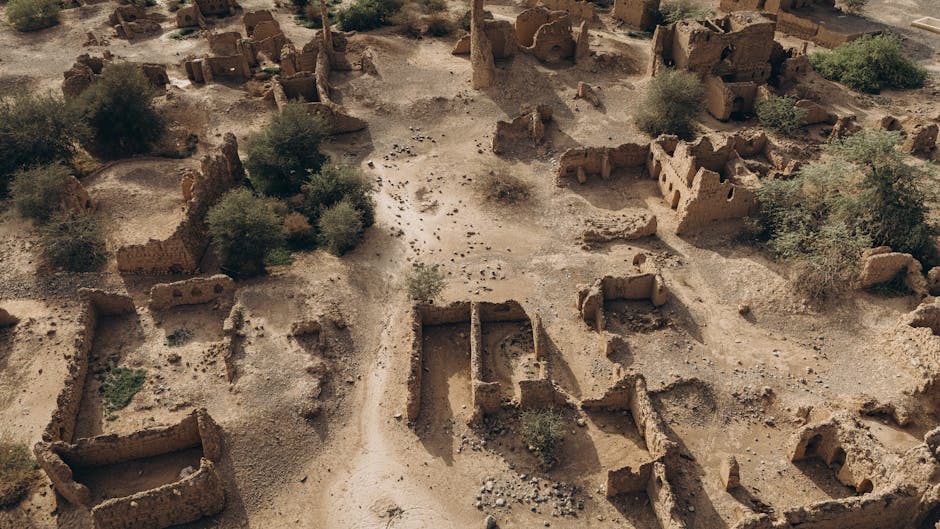
The Mahabharata describes the Saraswati River with striking geographical precision: it dried up to a desert at a place named Vinasana, and the seasonal Ghaggar River in Rajasthan and Haryana reflects the same geographical view the text preserves. What makes this remarkable is that modern science confirms the river existed—and validates the epic's memory of its loss. But the timing raises a hard question: if the Saraswati vanished around 2000 BCE, how did a text composed centuries later know what it really was?
For generations, the Saraswati seemed purely mythical. No river by that name flowed through northern India in recorded history. Then satellite imagery, geological surveys, and subsurface drilling traced a massive, dried-up river channel—a paleochannel (fossil riverbed)—across the Thar Desert region. Over 1,500 Harappan Bronze Age sites cluster along the Ghaggar-Hakra system, confirming the ancient river's central role in civilization. The buried river was real. It had shaped an entire urban culture. But when exactly did it vanish?
The River's Two Deaths
Paleoclimate (ancient climate) data now narrows the window. Scholars including hydrologist Liviu Giosan and climatologist Mark Staubwasser have traced two converging causes. Around 4,200 years ago (approximately 2200 BCE), monsoon intensity began to weaken across South Asia—a shift recorded in deep-sea sediments and ice cores. At the same time, tectonic activity shifted the courses of the Yamuna and Sutlej rivers, which fed the Saraswati from the Himalayas. Cut off from its primary water sources and starved by climate change, the river entered a slow collapse. By the early second millennium BCE, what had been a perennial river—one that flowed year-round—became seasonal, then vanished altogether.
The Harappans, whose cities like Kalibangan and Rakhigarhi had flourished on the Saraswati's banks from roughly 3300 to 1900 BCE, abandoned the region as the water failed. The river had sustained Bronze Age civilization. Then it did not.
Yet the Mahabharata, the epic text as we possess it, was not composed during Harappan times. Scholars debate its date of composition and final written form, with estimates ranging from the 3rd century BCE to the 3rd century CE—roughly a thousand years or more after the Saraswati had dried. The text describes the Saraswati as vanished and desert-bound. That is accurate. But how did the text come to know this?
The Text Problem
This opens two competing possibilities, neither simple to prove:
First: portions of the Mahabharata, especially its geographical passages on the Saraswati, preserve genuine memory from much earlier oral tradition. That tradition may have been grounded in lived experience—people who saw the river, or heard of it from their ancestors. The text describes a river that was real but no longer existed, suggesting either that those narrative layers date to when the river still flowed, or that they preserve precise geographical memory across many centuries. Oral traditions in South Asia have preserved ancient material. The Rigveda, an older text, also mentions the Saraswati. But scholars sharply disagree on how old those passages are and what they describe.
Second: the descriptions accumulated gradually over centuries of retelling and revision. Early composers may have known fragments of Saraswati lore—place names, shrine locations, stories about a vanished river. They wove these into a growing narrative. By the time the text stabilized in written form, the geographical details had calcified into epic verse, accurate in broad shape but not necessarily firsthand record.
What Scholars Actually Say
This is where certainty ends. Some scholars note that the "historical river" Saraswati was already a small seasonal trickle in the desert by the time the Hindu epics took their final form. Others, including Indologist Michel Danino, have argued that the Rigveda's descriptions of a mighty Saraswati and the geological evidence for late-third-millennium drying create a real tension: the texts cannot easily be both accurate reports of a flowing river and products of composition many centuries after it ceased to flow. That tension defines the real debate.
The archaeology, by contrast, is clearer. Harappan archaeologist Gregory Possehl and others have documented over a thousand sites clustered along the Ghaggar-Hakra paleochannel, confirming the ancient river's central role in Bronze Age urbanism between 3300 and 1900 BCE. The settlements were there. The river supported them. Then the river failed, and the settlements were abandoned or relocated. This sequence is solid.
But the Mahabharata—the specific text we have—was not written during Harappan times. It was orally composed, revised, recomposed, and eventually recorded across centuries. Some passages may be old. Others are almost certainly younger. Scholars note the fundamental difficulty of pinpointing which architectural or geographical details in texts composed centuries after events actually reflect eyewitness knowledge and which reflect later reconstruction, educated inference, or storytelling accretion. The same applies to rivers.
The Real Lesson
The Saraswati problem is not solved by declaring the epic "true" or "false." It is solved by holding two truths at once: the river was real. The text's geographical memory of its drying is accurate in outline. Yet the text as we have it was assembled long after the river vanished, and we cannot yet pinpoint which passages preserve ancient knowledge and which are later addition.
What paleoclimate and geological data have done is narrow the river's final phase to a few centuries around 2000 BCE. That knowledge is trustworthy. The question of how the Mahabharata's authors came to know this—through living tradition, fragmentary memory, educated inference, or accumulated textual detail—remains open.
And that is honest scholarship: evidence shows. Tradition holds. Scholars debate.