Verbs of Making: How Sanskrit and Old Tamil Named the Stuff of Sculpture
A browser game about guessing ancient art media reveals a real linguistic divide: Sanskrit built precise technical words for sculpture, while early Tamil described objects, not the craft of making them.

Asha Naidu for SwavedaAugust 1, 2026
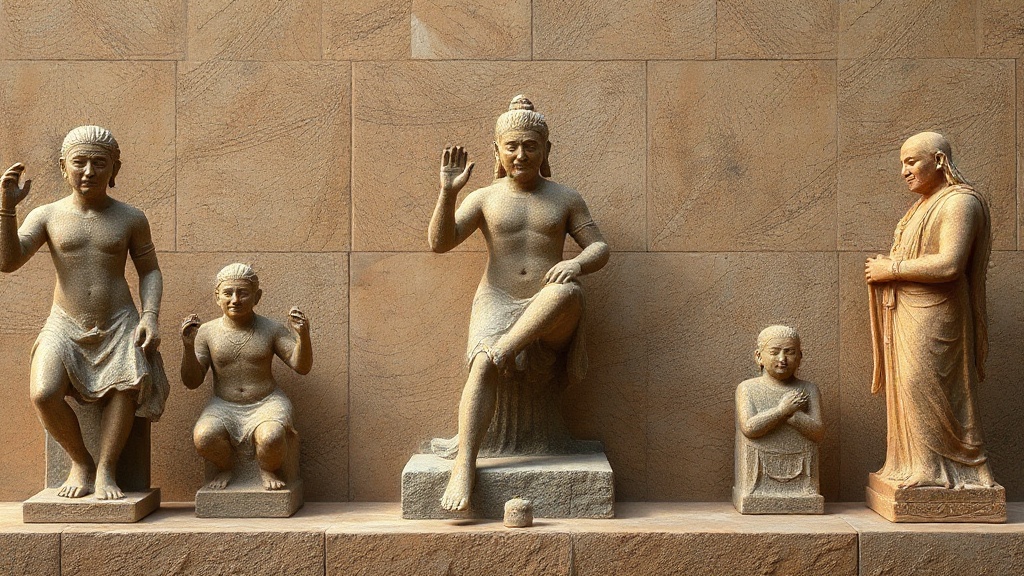
A browser game called Anthropeum asks players to look at a photograph of an ancient object and guess, among other things, what it is made of — stone, clay, metal, ivory, terracotta (r/IndianHistory). It sounds like trivia. It is actually a very old problem. Long before museum labels existed, the languages of ancient South Asia had to solve the same puzzle: how do you talk about an image without saying, up front, what it's made of and how it got that way?
Sanskrit and Old Tamil answered that question very differently, and the gap between them says something about how sculpture itself developed in the two traditions.
Sanskrit's Working Vocabulary
Classical Sanskrit did not have one word for "artist." It had a word for craft — śilpa (skill, artistic or manual work) — and a separate agent noun for the person who did it, śilpin (a craftsman or sculptor). The distinction mattered because śilpa covered carpentry, metalwork, painting, and architecture together, as a single professional category, rather than singling out "fine art" as something separate from a trade.
For the finished object, Sanskrit had at least two competing words with different implications. Mūrti (form, embodiment, or image) comes from a root, mūrch, meaning to congeal or take solid shape — the same idea used for milk curdling into curd. A mūrti is not a picture of a god; it is the god's form having solidified into matter. Pratimā (likeness, reflection, image) is more modest — it just means a copy or a resemblance, the word you'd use for a mirror image as much as for a statue.
Material terms were kept separate again. Śilā meant stone or rock, specifically a worked slab rather than a boulder. Loha meant metal, and in many contexts specifically the reddish metals — copper and its alloys — which is why a metalworker is a lohakāra. Bronze casting by the lost-wax method, used for the great Chola-era temple bronzes centuries later, required its own technical language for wax models, moulds, and pouring — vocabulary that belongs to a genre of Sanskrit technical literature called śilpa śāstra, treatises on craft that laid down proportion, posture, and material for temple images. That these treatises exist at all, as a distinct textual genre, tells you sculpture had become a codified discipline with rules to write down.
Old Tamil's Quieter Vocabulary
Old Tamil, the language of the Sangam corpus (the body of poetry compiled by convention between roughly 300 BCE and 300 CE), grew up in a different world. Sangam poetry is organized around two great categories: akam (interior life — love, longing, and domestic emotion) and puram (exterior life — war, kingship, and public heroism). Neither category was built to describe temple image-making, because the elaborate stone and bronze icon culture of South Indian temples — the world that produced the Chola bronzes and their Sanskrit śilpa śāstra rulebooks — mostly postdates the Sangam period itself.
What survives in Old Tamil, instead, is material vocabulary attached to ordinary and prestige objects rather than to a theorized craft of sculpture: words for stone (kal), for gold (pon), for copper and bronze objects used as weapons or ornaments. The poems describe what things are made of far more often than they describe the process of making them. Linguist and Tamil scholar Kamil Zvelebil, in his survey of the Sangam corpus, notes that its vocabulary is dense with concrete, sensory nouns for landscape, body, and object but comparatively thin on abstract craft or process terminology of the kind Sanskrit śilpa śāstra accumulated (Zvelebil, Tamil Literature, Brill). There is no Old Tamil equivalent, in what survives of that corpus, of the Sanskrit śilpin as a named professional category with its own technical manual. The Tamil grammatical tradition's foundational text, the Tolkappiyam (the oldest surviving Tamil grammar), is a grammar of poetic and social convention, not a manual of craft.
What the Gap Means
None of this means Old Tamil speakers lacked skilled metalworkers or masons — archaeology of the same period shows plenty of both. It means the literature that survives from that period wasn't organized to talk about the making of images the way Sanskrit śilpa śāstra texts were. Sculpture, as a codified subject with its own named vocabulary for medium and method, arrives later in the Tamil-speaking south, largely once temple culture and its associated Sanskrit-influenced textual traditions had taken root — a chronology scholars debate in detail regarding exact dating, but agree on in broad outline.
That timing gap is itself a kind of historical evidence. Vocabulary tends to get precise exactly where a society has built specialized institutions — guilds, temple workshops, courtly patronage — around a task. Sanskrit's fussy distinctions between śilā and loha, between mūrti and pratimā, mark a tradition where sculpture had already become a bureaucratized craft with rules. Old Tamil's comparative silence marks a tradition where that bureaucratization hadn't happened yet, at least not in the texts that survive.
Which brings the story back to a browser game asking players to guess "stone, clay, or metal" from a photograph. It's a modern shorthand for a distinction that ancient South Asian societies took centuries, and several different vocabularies, to work out for themselves — and that different regions worked out on very different schedules.