The Weaver’s Mark: Spindle Whorls and the Archaeology of Iron Age Textile Production at Kodumanal
Excavations at the Iron Age site of Kodumanal reveal physical evidence of early industrial weaving, bridging the gap between classical trade texts and Tamil-Brahmi inscriptions.

Rohan Bhattacharya for SwavedaAugust 29, 2026
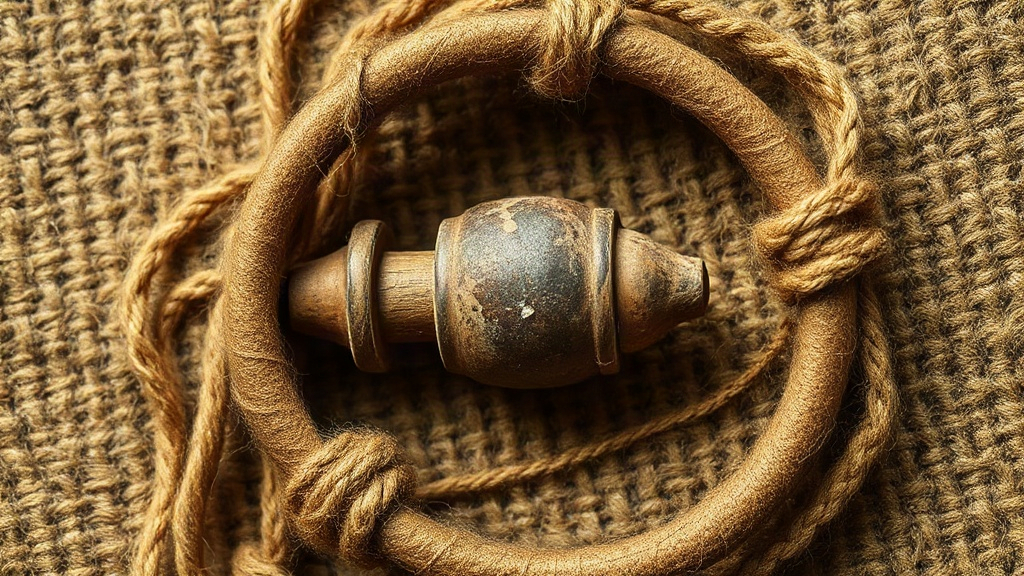
The dry, red earth of Kodumanal, situated on the northern bank of the Noyyal River in Tamil Nadu, has long served as a critical reference point for South Asian archaeologists. For decades, researchers associated the site primarily with its extensive semi-precious stone bead industry and its megalithic burials. Yet, beneath the spectacular bead-making workshops and the dramatic stone circles lies a more mundane class of artifact that is rewriting the economic history of the Indian Ocean: the spindle whorl (a small, weighted disc used to spin thread).
While classical Mediterranean texts—including the Periplus Maris Erythraei (The Voyage Around the Erythraean Sea)—frequently praise the fine quality of South Indian textiles, literary sources cannot establish the scale or organization of production. For the archaeologist, texts are secondary to stratigraphy. Recent systematically documented layers at Kodumanal, published in reports by the Archaeological Survey of India (ASI) and discussed in journals like Puratattva and Man and Environment, provide the physical evidence of early industrial weaving that bridges the gap between early Tamil-Brahmi inscriptions and Mediterranean trade routes.
The Stratigraphy of the Spin
During excavations conducted by the Tamil Nadu State Department of Archaeology and Punjabi University, researchers isolated distinct occupational phases dating from the 4th century BCE to the 3rd century CE. The recovery of hundreds of terracotta and stone spindle whorls from these domestic and industrial strata indicates that yarn production was not merely a household chore, but a highly organized, specialized craft.
In the study of ancient textile technology, the physical properties of a spindle whorl dictate the type of thread produced. Heavy, wide whorls are used to spin coarse fibers like wool or hemp. Light, narrow whorls, conversely, are required to spin short-staple cotton fibers into fine, high-count threads without snapping them.
The spindle whorls recovered from the primary occupational layers at Kodumanal are predominantly lightweight, low-fired terracotta discs. Many feature a central perforation showing uniform wear patterns from wooden spindles. Their low mass indicates that the weavers of Kodumanal were systematically spinning fine cotton yarn. This material correlates directly with the high-quality cotton fabrics (karuphasina) described by Greek and Roman merchants who traded along the Malabar and Coromandel coasts.
Dyed Yarn and the Chemistry of Indigo
Evidence shows that the weavers of the Noyyal River valley were not merely exporting raw yarn, but were master dyers. In several trenches at Kodumanal, archaeologists uncovered circular, brick-lined vats embedded in the natural soil, accompanied by drains and conduits.
Chemical analysis of the soil residues within these vats, detailed in excavation monographs, revealed trace elements of plant-based dyestuffs, including indigo (Indigofera tinctoria). The presence of these processing vats directly alongside clusters of spindle whorls and iron needles demonstrates a localized, vertically integrated textile infrastructure.
Furthermore, rare impressions of woven fabric have been recovered from the interior surfaces of local potsherds. These impressions reveal a tight, plain-weave structure with a high thread count. In some instances, the warp (the vertical threads held stationary on a loom) and weft (the horizontal threads woven through the warp) show variations in thickness, a characteristic feature of handloom production. This physical evidence proves that the region was exporting finished, dyed textiles rather than raw agricultural fiber.
Epigraphy on the Workshop Floor
The socio-economic organization of this textile industry is recorded on the very tools of production. Kodumanal has yielded one of the largest assemblages of inscribed potsherds and utility items in South India. Dozens of these potsherds, as well as several flat spindle whorls, bear graffiti marks and short Tamil-Brahmi inscriptions.
Scholars debating the social structure of Iron Age Tamilakam point to these inscriptions as evidence of literate, individual craftspeople. The names etched into the clay before firing—often simple personal names like Adan or Sattan—suggest that individual weavers marked their own equipment and vessels to establish ownership in shared workshop environments.
This contrasts with the centralized, state-run textile workshops described in Northern Indian treaties like the Arthashastra (Treatise on Statecraft). At Kodumanal, the evidence points to a decentralized but highly cooperative guild system. Individual artisans operated independent looms but shared communal resources, such as dyeing vats and finishing areas, to meet the massive export demands of the Roman trade network.
Bridging the Mediterranean Gap
For decades, historians relied on the silent testimony of Roman coin hoards found across the Coimbatore region to explain the economic pull of the interior Tamil lands. The presence of these hoards was often attributed solely to the trade of beryl and pepper. However, the sheer volume of textile-production artifacts at Kodumanal suggests that cloth was an equally powerful economic driver.
Unlike precious gemstones or metals, textiles are organic materials that rarely survive the acidic soils of South India. The acidic ground conditions destroy the organic fibers, leaving behind a "stratigraphy of silence" where the most valuable export commodity is invisible to the naked eye. It is here that the durable, non-biodegradable tools of the trade—the ceramic spindle whorls, the brick vats, and the iron needles—become critical proxy evidence.
By analyzing the distribution of these artifacts across different chronological layers, archaeologists can map the rise of Kodumanal from a localized settlement into a major industrial node. The peak density of spindle whorls matches the period of intensive trade with the West, proving that the demand of the Mediterranean market transformed the domestic looms of the Noyyal Valley into a highly coordinated export industry.