The Superintendent of Mining and Other Ghost Officials: What the Arthashastra's Bureaucracy Actually Tells Us
Kautilya's Arthashastra lists dozens of superintendents, from mining to weaving. Scholars still argue whether this was a real bureaucracy or an administrative wish-list.

Rohan Bhattacharya for SwavedaJuly 25, 2026
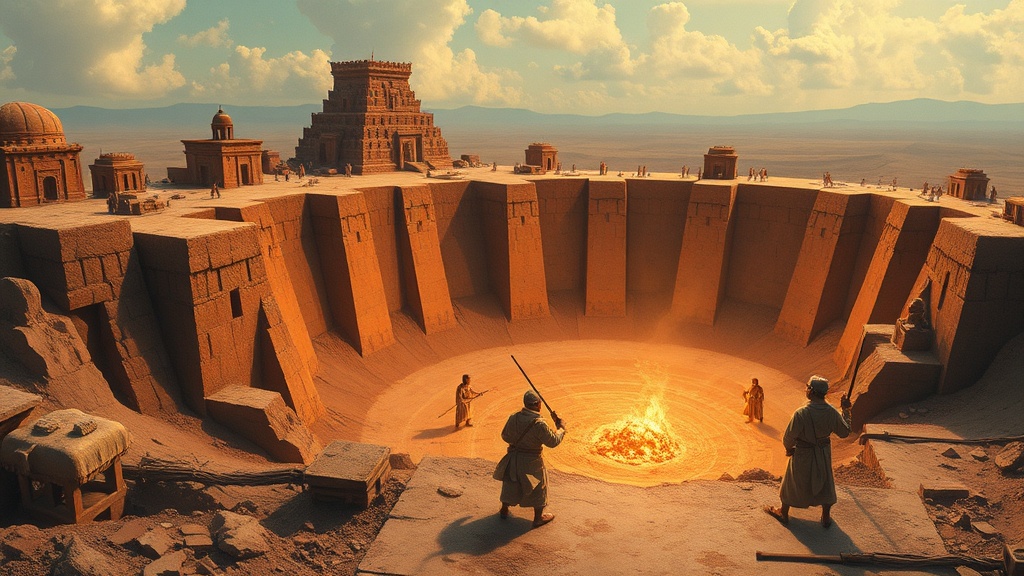
Open the Arthashastra to Book Two and you meet a government that seems to have an office for everything. There is an adhyaksha (superintendent) for mines, one for shipping, one for weaving, one for the treasury, one for slaughterhouses, one for gambling halls, and one for prostitutes. Read in one sitting, the list feels less like a statute book and more like a filing cabinet that swallowed an entire kingdom. The question that keeps archaeologists and Sanskritists arguing is simple to ask and hard to answer: did any of this exist on the ground, or is Book Two a bureaucratic fantasy — a manual for a state its author wished into being?
That question matters more than it sounds. The Arthashastra is the closest thing early India has to an administrative blueprint, and it is routinely cited as evidence for what Mauryan governance looked like under Chandragupta and Ashoka. But the text we read today is not a Mauryan-era document in any simple sense. Patrick Olivelle's critical edition and translation, published as King, Governance, and Law in Ancient India (Oxford University Press, 2013), argues on linguistic and structural grounds that the text as we have it was compiled and layered over centuries, with the bulk of its final redaction plausibly dating to around the 2nd or 3rd century CE — long after the Mauryan empire had collapsed. That timeline reframes everything. The superintendent of mines in Book Two may describe an idealized office rather than a position anyone actually held under Ashoka.
A Text Written in Titles
The Arthashastra's genius, and its trap for the unwary reader, is its sheer specificity. Kautilya (a name the text uses for its author, traditionally identified with a minister of Chandragupta Maurya, though the identification itself is a matter of tradition rather than settled fact) does not gesture vaguely at "officials." He names them, defines their jurisdiction, and sets their qualifications and pay. R.P. Kangle's three-volume critical edition and translation (University of Bombay, 1960–1965) remains the standard scholarly baseline for this material, and it shows just how granular the taxonomy gets: separate superintendents for gold, for the mint, for the storehouse, for tolls, for weights and measures, each with named duties and named punishments for named failures.
That granularity is what makes the text useful to historians even when its historicity is in doubt. A fictional or aspirational bureaucracy still tells you what a Sanskrit-literate administrative class in early India imagined good governance should look like — which taxes were worth collecting, which resources needed state monopoly, which crimes threatened revenue enough to warrant a dedicated office. The mining superintendent's chapter, for instance, spends more time on assaying ore and preventing theft by smelters than on anything resembling geological survey. That tells you the office existed to protect state revenue from metal, not to develop mining as a technical field.
The Mismatch With the Ground
Here is where the archaeologist in me gets uneasy. If Book Two describes an actual Mauryan civil service, we should expect some trace of it in the epigraphic record — seals, administrative titles, findspots that cluster the way a real ministry's paperwork would. Ashokan inscriptions do reference officials, including the mahamatta (roughly, high officer) and the rajuka (a district-level administrator mentioned in several edicts), and these terms overlap only loosely with the Arthashastra's adhyaksha vocabulary. The two bodies of evidence — inscriptional and textual — do not map onto each other cleanly. Thomas Trautmann's study Kautilya and the Arthasastra (Brill, 1971) was among the first to apply statistical and stylistic analysis to the text's composite authorship, and his conclusion — that the treatise is a stitched-together work rather than a single author's field manual — has held up well enough to be the near-consensus starting point for later scholars, including Olivelle.
This is not a reason to throw the text away as evidence. It is a reason to read it the way a stratigrapher reads a mixed-fill trench: layer by layer, asking what belongs to which period rather than assuming the whole deposit is contemporaneous. The superintendent of mining may be Mauryan in spirit, Shunga or Kushana in the detail of the chapter that survives, and later still in the redaction that fixed its final Sanskrit. Untangling which parts are older than which is a philological problem as much as a historical one, and it is nowhere near settled.
Reading It as a Mirror, Not a Photograph
The more productive way to use the administrative chapters, then, is as a mirror of bureaucratic anxiety rather than a photograph of bureaucratic fact. The text worries obsessively about embezzlement, about officials colluding with merchants, about revenue leaking out of state monopolies on salt, liquor, and metal. That worry is itself data — not about what the Mauryan state built, but about what a later administrative culture feared losing. Whether Chandragupta ever appointed a literal superintendent of mines is, on current evidence, unanswerable. That a text-producing elite thought such an office was worth inventing on paper is not in doubt at all.