The Silt of Rakhigarhi: Mud-Brick Stratigraphy and Soil Micromorphology at Mound 6
An analysis of mud-brick dimensions, hearth placements, and soil micromorphology at Rakhigarhi’s Mound 6 reveals how the transition to the Mature Harappan phase was a gradual, site-specific process.

Rohan Bhattacharya for SwavedaAugust 31, 2026
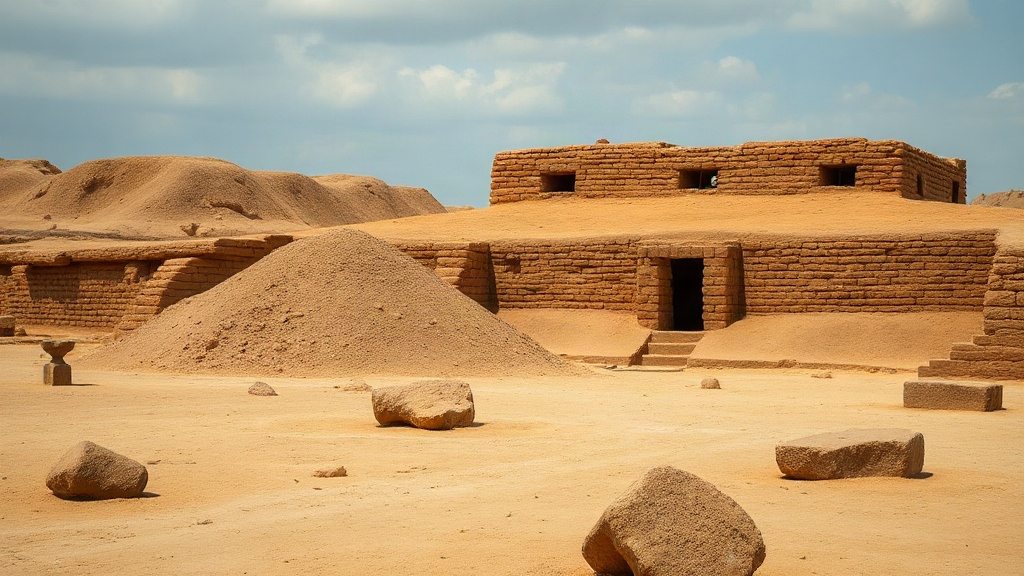
The transition from the Early Harappan to the Mature Harappan period is often portrayed in general histories as a sudden, uniform administrative shift. This narrative suggests that standardized weights, planned grid layouts, and uniform mud-brick ratios appeared almost overnight across the Indus Valley. However, close stratigraphic work at Rakhigarhi, located in the Ghaggar-Hakra basin in Haryana, offers a more complex, localized picture.
By examining the soil layers and building materials of Mound 6, archaeologists are tracing how local populations slowly adapted their architectural methods and pyrotechnic features. This physical evidence suggests a gradual, in-situ evolution rather than a rapid, externally imposed cultural transformation.
The Stratigraphy of Mound 6
In the terminology of the Archaeological Survey of India (ASI), Mound 6 at Rakhigarhi represents a residential area containing both Early Harappan (often termed Hakra Ware or Sothi-Siswal phases) and Mature Harappan deposits. Excavations directed by Amarendra Nath, published in the ASI excavation reports, outline a clear stratigraphic sequence that preserves the physical transition between these eras.
In the lower occupational levels, designated as Period I (Early Harappan), the architecture consists primarily of circular semi-subterranean pit dwellings and irregular mud-brick structures. As the stratigraphy rises into Period II (Mature Harappan), these early features are slowly replaced by multi-roomed rectangular houses built of molded mud bricks, accompanied by a shift in ceramic styles.
The transition is not marked by an ash layer or a structural break that would indicate a violent conquest or sudden abandonment. Instead, the layers show continuous occupation, with older debris leveled to form the foundations for newer, more structured walls.
Standardizing the Brick: From 1:2:3 to 1:2:4
Mud bricks are the literal building blocks of Harappan chronology. In his excavations and subsequent reports published in Puratattva, Amarendra Nath documented a shift in the metrology of these bricks at Mound 6.
During the Early Harappan phase, builders hand-molded mud bricks without a rigid regional standard. The dimensions varied, though they frequently adhered to a ratio of 1:2:3 (typically averaging around 10 centimeters in thickness, 20 centimeters in width, and 30 centimeters in length). These bricks were often tempered with coarse organic material, such as straw and animal dung, which left visible negative impressions in the fired or sun-dried clay matrix.
As the site transitioned into the Mature Harappan phase, a highly standardized brick ratio of 1:2:4 became dominant. In Mound 6, these bricks typically measure 7 by 14 by 28 centimeters for residential walls, and 10 by 20 by 40 centimeters for city walls and public platforms.
This change in ratio was not just a bureaucratic decision. The 1:2:4 ratio is mathematically optimal for header-and-stretcher bonding, which prevents vertical seams from aligning and makes walls structurally stronger. The transition at Mound 6 shows intermediate phases where both brick sizes were used in the same structures. This overlap indicates that local builders were gradually adopting new construction standards rather than discarding their existing inventories.
Soil Micromorphology and the Climate Record
To understand the environmental context of this architectural transition, researchers have utilized soil micromorphology—the microscopic study of undisturbed soil samples in thin sections under a polarizing microscope. This technique allows archaeologists to observe micro-stratigraphy, such as individual dust storms, seasonal floods, and human activity compacted into millimeters of earth.
Studies on Harappan soil micromorphology, discussed in journals like Antiquity and Man and Environment, reveal that the early layers of Mound 6 contain high amounts of fine alluvial silt mixed with organic debris. This composition indicates a relatively wet environment with active seasonal water channels nearby.
Over time, the micromorphological slides show a gradual increase in windblown (aeolian) sand grains and carbonate nodules known as kankar. This micro-stratigraphic change reflects a slow drying of the local environment.
Crucially, this environmental shift correlates directly with the changing architectural styles. As water became less reliable, the local population shifted from water-dependent agricultural practices to organized urban storage. The standardization of mud-brick walls and the construction of raised platforms were practical adaptations to seasonal unpredictability and dust storms, providing stable, elevated living surfaces.
Hearth Placements and Pyrotechnic Evolution
The evolution of domestic hearths (chulhas) at Mound 6 provides further evidence of a gradual, domestic transition. In the earliest levels, hearths are simple, shallow depressions dug directly into the soil, often unlined and showing irregular burning patterns on the surrounding clay.
As the stratigraphy progresses toward the Mature Harappan phase, these open fires are replaced by clay-plastered, underground pit-ovens and above-ground, keyhole-shaped hearths. These advanced hearths feature central pillars to support cooking vessels and draft holes to control airflow.
This development in pyrotechnical design allowed for higher, more controlled temperatures. The change closely mirrors the technological advances seen in the local pottery. Coarse, hand-formed Sothi-Siswal vessels gradually gave way to fine, wheel-made, sturdy red-slip pottery fired in specialized kilns. The domestic hearths demonstrate that technological knowledge was developing incrementally within the households of Rakhigarhi, alongside the public adoption of standardized brick ratios.
⚖ Scholarly Debate: Sudden Shift vs. Local Evolution
The speed and driver of the Mature Harappan transition remain central points of discussion in South Asian archaeology.
One perspective argues that the transition was rapid, likely driven by a centralized authority or an administrative class that quickly standardized municipal rules, writing systems, weights, and brick sizes across the region. Supporters of this view point to the relatively sudden appearance of planned streets and drainage networks in major urban centers.
The opposing view, supported by the stratigraphic evidence from Rakhigarhi's Mound 6, argues for a gradual, decentralized process. Proponents of this model suggest that the "Harappan style" emerged from centuries of trade, shared technology, and mutual adaptation among different regional groups.
The overlapping brick sizes, continuous developmental sequences in hearth technology, and gradual micromorphological changes observed at Rakhigarhi show that the local population did not overnight abandon their old ways of life. Instead, they adapted their existing traditions to meet the challenges of a changing climate and expanding trade networks.
Ultimately, the silt and clay of Mound 6 suggest that the rise of the Harappan civilization was not a sudden administrative event, but a slow, practical evolution grounded in the everyday mud-brick architecture of the Indus plains.