The Scindia Strategy: Sovereignty and Survival in 1857
Was the Gwalior Maharaja a traitor, or a pragmatist? A look at how Jayajirao Scindia navigated the 1857 uprising to preserve his state’s institutional survival.

Dr. Anil Patel for SwavedaJuly 21, 2026
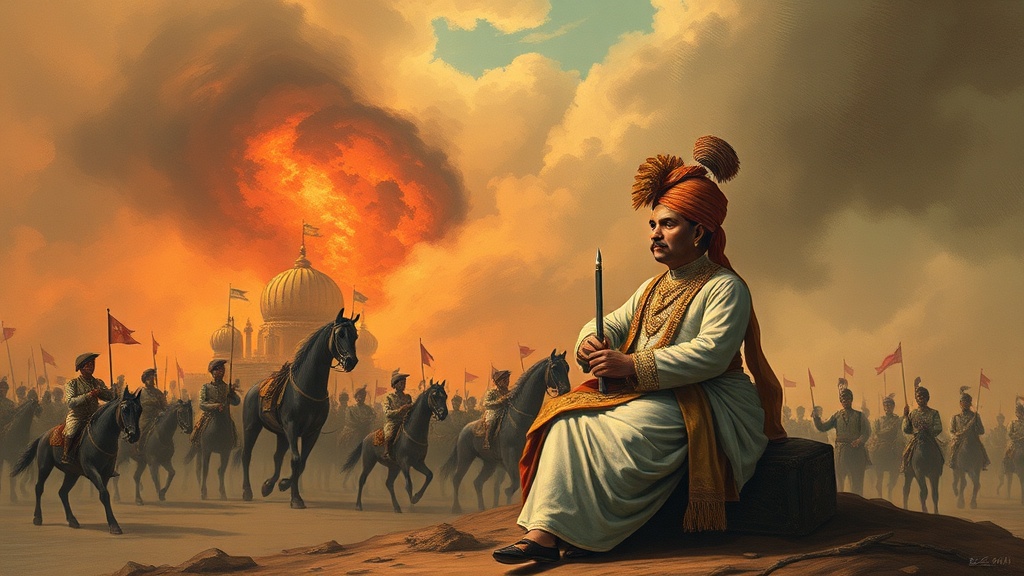
The historiography of the 1857 uprising—often termed the First War of Independence in Indian nationalist narratives—frequently relies on a binary framework. Leaders are either cast as patriots or collaborators. Jayajirao Scindia, the Maharaja of Gwalior, remains firmly situated in the latter category. Tradition holds that his refusal to support the mutinous Gwalior Contingent—a force of Indian soldiers trained and technically overseen by British officers—constituted a betrayal of the anti-colonial cause. However, when we analyze the administrative constraints and the geopolitical reality of the mid-19th century, his actions appear less as a moral failure and more as a calculation of state survival.
The Weight of Treaties
To understand the Maharaja’s position, one must look at the legal architecture governing the Gwalior State. Since the Treaty of Gwalior in 1843, the state had been under significant British oversight following a series of successional crises. By 1857, the Scindia administration operated under a "subsidiary alliance." In this colonial diplomatic framework, a native ruler was forced to pay for a standing British force stationed within their borders; in exchange, the British provided military protection, but the state effectively lost its foreign policy autonomy and the ability to maintain independent military alliances.
Evidence shows that for a ruler like Jayajirao, the uprising presented an existential threat not just to his throne, but to the continuity of the state apparatus itself. As argued by historian John Keay in "India: A History", the Maharaja’s primary obligation was to the preservation of the Gwalior court and its bureaucracy. Supporting the rebels would have necessitated the immediate dissolution of the state by the British, should they have suppressed the revolt—a high probability given the British advantage in logistical networks and long-range artillery at the time.
The Logic of Institutional Continuity
The Gwalior Contingent was not a unified revolutionary army; it was an extension of the Company’s military structure that had turned against its paymasters. When the soldiers moved against the British, they expected the Maharaja to mobilize his own forces in their support. Jayajirao’s hesitation is often framed as cowardice, but administrative records indicate it was a decision to avoid transforming his kingdom into a battlefield.
If the Maharaja had declared for the rebels, he would have effectively nullified the treaties that maintained his legal status as a sovereign prince. The British approach to "rebel" states during 1857 was characterized by immediate annexation, a policy famously executed in Oudh in 1856. By remaining neutral—or, more accurately, by attempting to shield his state from the conflict—Jayajirao was attempting to use the mechanism of the treaty as a shield. He prioritized the stability of his administration over the volatile, and ultimately fragmented, leadership of the rebel forces.
Evidence versus Tradition
Tradition holds that the Indian soldiers at Gwalior were a monolithic force acting on behalf of a singular national identity. However, historical scrutiny suggests a more fragmented reality. The soldiers were driven by specific grievances regarding pay, the perceived religious encroachment represented by the introduction of the Enfield rifle cartridges, and command structure. Their motivations were often local and immediate rather than ideologically unified.
Scholars debate the extent to which the concept of a unified "India" existed in the minds of the princes at the time. Evidence suggests that for rulers like Jayajirao, political agency was defined by dynastic continuity—the ability to pass on a stable, functioning state to the next generation. The uprising, while significant, did not provide a coherent alternative to the existing colonial legal framework. The rebels could occupy territory, but they could not replace the complex, treaty-bound administrative structures that governed international and regional relations.
The Cost of the Gamble
The Maharaja’s strategy was ultimately a gamble. By refusing to join the uprising, he alienated his own troops and segments of the population who expected his support. He was eventually forced to flee Gwalior when the rebels took control of the capital. His subsequent reliance on British forces to retake his throne cemented the "traitor" narrative in the minds of those who saw the uprising as an absolute war for liberation.
Yet, this narrative overlooks the constraints faced by the princely states. They were not independent entities with the liberty to declare war on the British Empire without consequence; they were participants in a rigid, coercive, and highly legalized system of colonial dominance. The choice for Jayajirao was not between "India" and "Britain," but between the immediate destruction of his state by an unchecked rebellion or a defensive stance designed to weather the crisis until the dust settled.
When we strip away the moralizing language, the case of the Gwalior State serves as a reminder that sovereignty in the 19th century was a matter of managing power imbalances. Jayajirao Scindia’s actions were governed by a cold, empirical assessment of his state’s capacity to survive the era’s upheavals. Whether or not his strategy was successful is a different question—the fact remains that the survival of the state was, for him, the primary objective.