The Pottery of Tepe Sadegh: What Bronze Age Ceramics Reveal About Helmand-Harappan Trade
New chemical and stylistic analysis of Bronze Age pottery from Tepe Sadegh in Iran maps the overland trade networks connecting the Helmand civilization with early Indus Valley settlements.

Vikram Joshi for SwavedaAugust 25, 2026
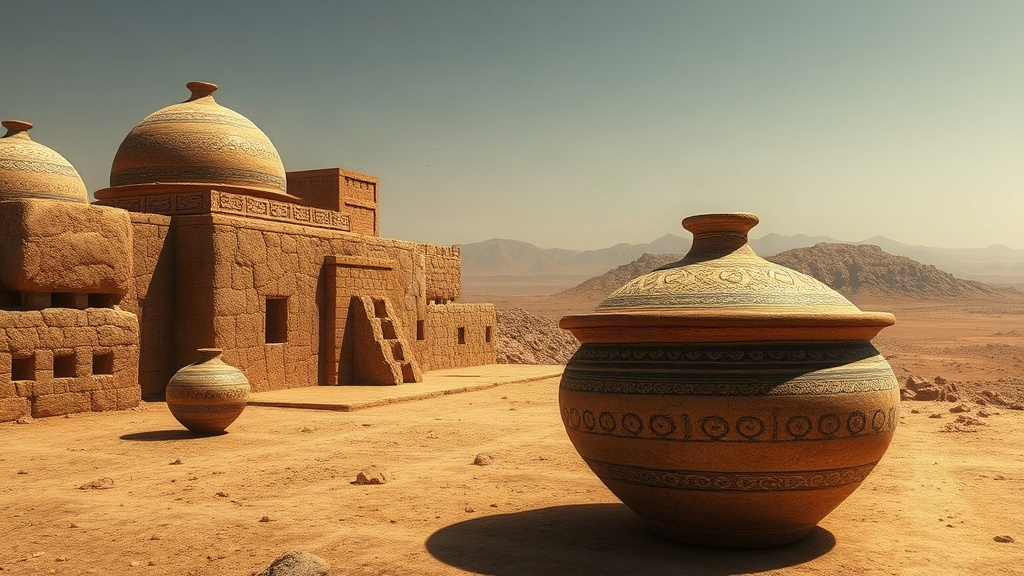
The Sistan Basin, a closed terminal lake basin straddling the modern border of Iran and Afghanistan, served as a crucial geographic corridor during the Bronze Age. Within this arid landscape lies Tepe Sadegh, a specialized settlement associated with Shahr-i Sokhta, the urban center of the Helmand civilization. New archaeological research published in the journal Archaeological Research in Asia provides fresh clarity on how these eastern Iranian plateau communities interacted with the Indus Valley Civilization, also known as the Harappan civilization.
By analyzing the chemical compositions and stylistic designs of ceramic vessels excavated from Tepe Sadegh, researchers have mapped the specific overland trade routes and cultural exchanges that linked the Helmand valley to early Harappan settlements. The findings offer physical evidence of how prehistoric communities maintained long-distance economic relationships without centralized empire structures.
The Sistan Junction and the Helmand Culture
During the third millennium BCE, the Helmand civilization flourished in the fertile helmand river delta. Shahr-i Sokhta functioned as the primary urban hub, supported by smaller satellite sites like Tepe Sadegh. These settlements did not exist in isolation. They operated at a geographic crossroads connecting Mesopotamia and the Iranian plateau to the west with the Indus Valley to the east.
Tradition holds that ancient trade routes were vast, free-flowing highways of cultural exchange. However, archaeology shows that prehistoric trade was highly structured, relying on specific localized networks. The pottery recovered from Tepe Sadegh represents a tangible record of these exchanges.
To determine whether these ceramic vessels were local imitations or genuine imports, researchers subjected the pottery to petrographic analysis (the microscopic study of minerals in ceramic paste) and chemical characterization. This scientific approach allows archaeologists to distinguish between the clay profiles of the Sistan Basin and those of the Indus River valley.
Chemical Signatures and Stylistic Merging
The scientific analysis of the Tepe Sadegh ceramics reveals two distinct patterns of interaction.
First, a significant portion of the pottery displaying Indus-style designs was manufactured using local Sistan clay. These vessels feature classic Harappan motifs, including geometric patterns and specific stylized flora. The physical presence of locally made vessels with foreign designs suggests that Harappan artisans may have been residing in the Sistan settlements, or that local potters were trained in Indus techniques. Scholars debate whether this represents a diasporic community of Indus merchants living abroad or a deep-seated cultural preference among the local elite for foreign aesthetic styles.
Second, the study identified genuine imported vessels. These pots were made from non-local clay, with mineral compositions pointing directly to the Indus Valley region. The imported vessels are predominantly restricted to specialized wares, such as storage jars and fine-painted serving vessels. The transport of heavy ceramic vessels over hundreds of miles of rugged terrain indicates that the overland trade routes were stable, highly organized, and economically viable.
The exchange was not one-sided. The presence of Helmand-style pottery, particularly buff ware with distinctive zoomorphic (animal-shaped) paintings, has been documented at western Harappan border sites. This reciprocal flow of material culture demonstrates that the Helmand and Indus civilizations maintained a peer-to-peer relationship rather than one of colonial dominance.
Mapping the Overland Routes
The trade network connecting Tepe Sadegh to the Indus Valley relied on distinct geographic pathways. Rather than traversing the harsh deserts of central Baluchistan directly, traders utilized river valleys and mountain passes.
The northern route likely followed the Argandab River valley, leading toward the Gomal Pass, which provided entry into the northern Indus plains. This route connected Sistan with early Harappan sites in modern-day Khyber Pakhtunkhwa and Punjab. The southern route ran through the Kech-Makran valley, linking southeastern Iran to the coastal and inland sites of Sindh and Gujarat.
The chemical data from Tepe Sadegh suggests that the northern mountain passes were the primary corridors for ceramic trade during the early and mature Harappan phases. The heavy mineral temper found in the imported Tepe Sadegh pottery matches the geological formations of the northern Indus region, rather than the alluvial plains of the south.
Rethinking Bronze Age Interaction
Historically, the study of Bronze Age trade has focused heavily on maritime routes. Scholars have extensively documented the sea-based trade between the Indus Valley and Mesopotamia through the Persian Gulf. However, the evidence from Tepe Sadegh emphasizes the equal importance of overland networks.
These land routes did not just move pottery. The trade in ceramics was accompanied by the movement of raw materials, including lapis lazuli from Badakhshan, turquoise from Central Asia, and copper from the Iranian plateau. The pottery acted as the packaging for these valuable commodities, or as prestigious household items used to establish social status among regional elites.
By verifying the dual presence of genuine Indus imports and locally produced hybrid wares, the research at Tepe Sadegh illustrates that the borders between these ancient cultural zones were highly permeable. The Helmand and Harappan civilizations were linked by a shared economic reality that transformed regional styles and left a permanent chemical trace in the soil of the Sistan Basin.