The Ports of Rajendra: How the Sabhas of the Kaveri Delta Funded Chola Maritime Mobilization
While Chola naval expeditions are often cast as grand imperial adventures, local temple inscriptions show how village assemblies managed the hyper-local tax structures that built and provisioned the fleet.

Rohan Bhattacharya for SwavedaAugust 6, 2026
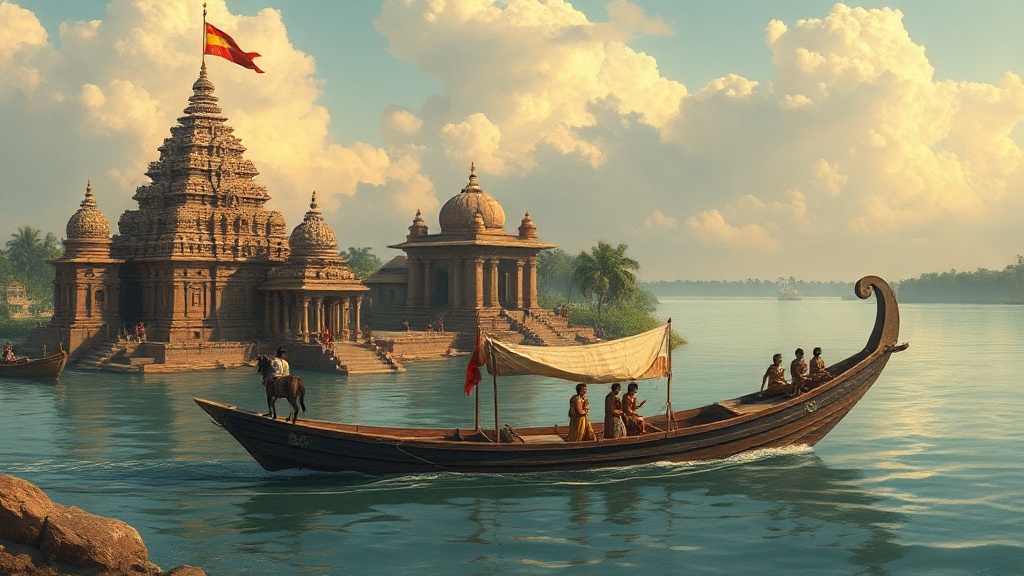
The grand naval campaigns of Rajendra Chola I, which extended across the Bay of Bengal to the ports of Srivijaya in the eleventh century, are frequently represented in popular histories as centralized imperial conquests. This perspective, while dramatic, overlooks the complex administrative reality preserved on the stone walls of Kaveri Delta temples. A close reading of these local records reveals that the Chola naval apparatus was not sustained by a modern, state-run military-industrial complex. Instead, evidence shows it relied on a highly decentralized system of village assemblies called sabhas (Brahmin landowning assemblies) and urs (non-Brahmin village assemblies, with ur meaning "village" or "settlement") to organize the primary resources, labor, and local taxation required for maritime mobilization.
The stratigraphy of Chola administrative history is clearest in the epigraphical records of Tanjavur, Tiruchirappalli, and the surrounding delta. Rather than showing a uniform flow of wealth from the periphery to the center, these inscriptions document a reciprocal, highly transactional relationship between the imperial court and local corporate bodies. In the Kaveri Delta, where seasonal flooding created a highly productive agricultural landscape, the sabhas functioned as the primary fiscal intermediaries. They converted agricultural surplus into the specific material requirements of a state preparing for long-distance naval warfare.
The Fiscal Stratigraphy of the Sabhas
Inscriptions published in the multi-volume South Indian Inscriptions series by the Archaeological Survey of India (ASI) demonstrate how sabhas managed hyper-local tax structures. These assemblies held the authority to levy local taxes, known as kadamai (land tax) and kudimai (tenancy dues), and to remit them in times of state need or temple endowment. To support the state's military and naval apparatus, the imperial center often requisitioned specific levies, but it was the sabha that determined how these burdens were distributed among the landholdings.
For example, inscriptions from the reign of Rajaraja I and Rajendra I show that the sabha of Uttiramerur, though north of the Kaveri proper, operated under a highly structured committee system known as variyams (specialized village committees). The eri-variyam (tank committee) managed water resources, while the pon-variyam (gold committee) supervised the quality and weight of currency used in trade and tax collection. When the imperial state required funds for military expeditions, it did not send royal tax collectors to individual households. Instead, the royal court issued orders to the sabhas, which then allocated the tax burden, managed the collection of paddy (unhusked rice), and commuted agricultural goods into gold or silver to pay soldiers and sailors.
This localized tax collection was critical for provisioning the merchant-navy fleets. Ships departing from port towns like Kaveripattinam—the ancient port city at the mouth of the Kaveri—required massive quantities of dried rations, fresh water, and ironware. The sabhas of the immediate hinterland managed the agricultural estates that produced these provisions, ensuring a steady supply chain from the interior fields to the coast.
Iron, Timber, and Local Metallurgy
A naval fleet is built of timber and held together by iron. In the dry, upland zones bordering the Kaveri Delta, iron-smelting workshops operated under the oversight of local assemblies and merchant guilds like the Anjuvannam (an association of foreign merchants) and Manigramam (a guild of local traders). Archaeological surveys published in the journal Man and Environment highlight numerous iron-slag heaps and ruined furnaces across the Tiruchirappalli and Pudukkottai districts, dating to the Chola period.
The sabhas regulated the woodcutters and charcoal burners who supplied the fuel for these smelting operations. The procurement of timber for ship construction—specifically hard woods like teak and poon, which were resistant to marine borers—required careful environmental management. Inscriptions record the existence of communal forests (kadu [forest or wild tract]) and village-regulated groves where cutting was strictly monitored by the sabha's forest committee (totta-variyam [garden committee]). By controlling access to these natural resources, the village assemblies directly managed the raw materials that supplied the shipyards of the Coromandel Coast.
Furthermore, the labor required to transport these heavy raw materials from the interior to the coastal ports was organized through the system of vetti (free or forced communal labor). The sabhas held the register of households obligated to perform vetti. Under the direction of the assembly, these laborers cleared roads, maintained canals for transport boats, and physically hauled timber and iron ore to the assembly points.
The Role of Temple Treasury and Guilds
In Chola society, the temple was not merely a spiritual center but the primary civic and financial institution of the village. The sabha worked in tandem with the temple authorities, often storing the village's communal treasury within the secure stone vaults of the temple. Royal donations of gold, won during military campaigns, were frequently deposited with local temple treasuries.
Rather than letting this capital sit idle, the sabha loaned the gold to local merchant associations and farming cooperatives at fixed interest rates, paid in paddy or coconut oil. This system of agricultural credit, documented extensively in reports by the Epigraphy Branch of the ASI, stimulated the local economy, creating the liquidity necessary to fund artisans, weavers, and metalworkers. When the state needed to mobilize its fleet, the sabha could call in these loans or utilize the accumulated interest to procure specialized goods, such as sails and weaponry, from professional craft guilds.
By analyzing these mundane transactions—loans of a few dozen kazanju (a unit of gold weight), disputes over canal clearing, and exemptions from local tolls—archaeologists and historians reconstruct a picture of Chola maritime power that is deeply rooted in the soil of the Kaveri Delta. The grand vessels that sailed across the Bay of Bengal were built, provisioned, and manned because hundreds of local assemblies successfully managed the boring, daily details of village administration.
Sources and Further Reading
- Archaeological Survey of India (ASI): Epigraphical records and historical excavations published in South Indian Inscriptions.
- The Journal of the Indian Society for Prehistoric and Quaternary Studies: Research on medieval metallurgy and land-use patterns published in Man and Environment.
- The Indian Economic & Social History Review: Studies on the role of merchant guilds and agrarian organization under the Cholas, particularly the dynamics of the Anjuvannam and Manigramam guilds.
- The Journal of the Society for Clay Archaeology: Stratigraphical and ceramic analyses of early coastal ports published in Antiquity.
- The Indian Archaeological Society: Discourse on local assemblies, temple treasuries, and administrative structures of the Kaveri Delta in Puratattva.