The People of Mohenjo-daro Didn't Vanish — Their DNA Is Still Here
A new documentary calls Mohenjo-daro's people "lost." Genomic research says their ancestry never left — it's folded into South Asians alive today.

Dr. Anil Patel for SwavedaJuly 27, 2026
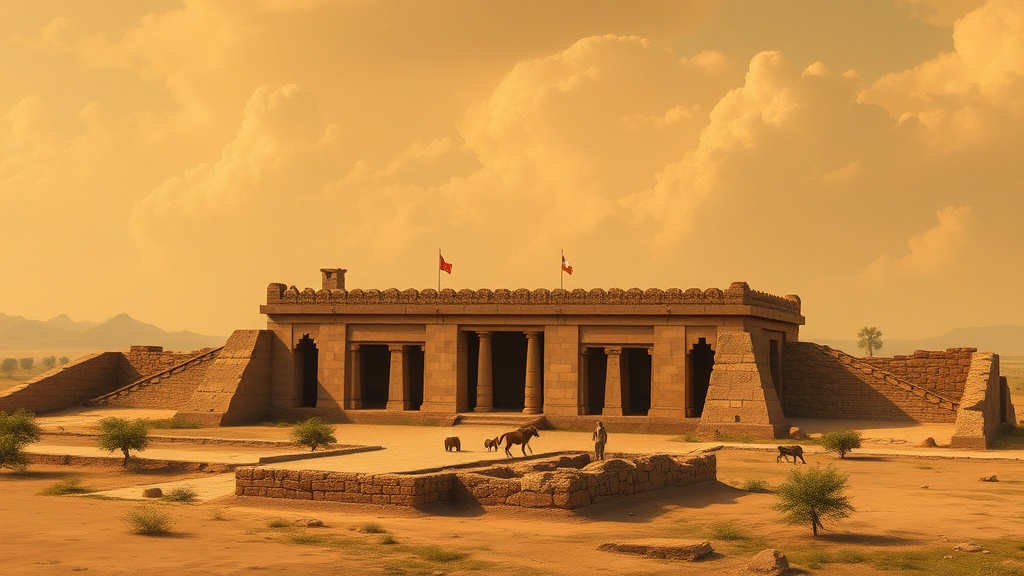
The trailer language is seductive: a civilization vanishes, its cities swallowed by silt, its people erased from history. It's the kind of framing documentaries reach for because "lost" sells better than "reorganized." Harappa.com's post introducing its Mohenjo-daro film leans into that mystery — the sealed city, the unread script, the people who seem to disappear from the record after roughly 1900 BCE. As a hook, it works. As a description of what happened to the people themselves, the genetics don't cooperate.
What "lost" usually means
When popular treatments call the Indus Valley Civilization "lost," they usually mean one of two things: the script hasn't been deciphered, or the great cities were abandoned. Both are true, in the narrow sense. Mohenjo-daro and Harappa did empty out. Urban administration, standardized weights, the seals — all of that faded from the archaeological record after the civilization's mature phase. What doesn't fade is the population itself. People don't need cities to keep existing, and they don't need a deciphered script to leave descendants.
This is where a 2019 genomic study becomes relevant. Vagheesh Narasimhan and a large team working with the Reich lab at Harvard published "The Formation of Human Populations in South and Central Asia" in Science. The paper analyzed ancient DNA from dozens of individuals across South and Central Asia, including skeletons associated with the Indus Valley Civilization's cultural sphere, alongside genome-wide data from present-day South Asian populations.
The ancestry that didn't disappear
The study's central finding, for our purposes, is about continuity rather than replacement. Narasimhan and colleagues identified what they call "Indus Periphery" individuals — people genetically linked to the Indus Valley cultural zone, found buried outside its core cities, in places like the Bactria-Margiana Archaeological Complex in Central Asia. These individuals carry a mixture of ancestry that the paper connects to two older source populations: one related to Iranian farmers, and one related to South Asian hunter-gatherers.
That mixture matters because it's the same genetic backbone that shows up, in different proportions, in the ancestry components long labeled "Ancestral South Indian" (ASI) and "Ancestral North Indian" (ANI) — the two-way mixture that geneticists have used for over a decade to model South Asian population history. The Narasimhan paper argues the Indus Periphery ancestry is a major contributor to both of those components. In practice, that means the genetic signature associated with Indus Valley-era populations didn't stop at 1900 BCE. It became part of the ancestry of South Asians living today, across a wide range of modern populations included in the study's dataset.
None of this is the same as saying the Indus Valley Civilization's culture, language, or institutions survived intact. Evidence shows genetic continuity. Tradition and popular narrative hold that Mohenjo-daro's people vanished. Scholars still debate what happened to the specific languages, religious practices, and political structures of the mature Harappan phase — that's a separate question from population continuity, and the aDNA (ancient DNA) data doesn't resolve it.
Why the distinction matters
The slippage between "the cities were abandoned" and "the people disappeared" isn't just pedantic. It shapes how audiences think about Indian prehistory. If a documentary implies an entire people vanished, it invites speculation about migration, invasion, or catastrophe as tidy explanations for a phenomenon that the archaeological and genetic record treats as more gradual and more mundane — climate shifts affecting river systems, changing trade networks, and a slow deurbanization that unfolded over generations, not a single vanishing act.
The Narasimhan paper doesn't claim to explain why Mohenjo-daro's urban phase ended. What it does is track where the people went, genetically speaking, after the cities stopped being cities. And the answer is: nowhere dramatic. They stayed in South Asia, had children, and their DNA diffused into the ancestry pool that every population geneticist working on the subcontinent now has to account for.
A better word than "lost"
"Lost" implies absence. What the genomic evidence actually supports is transformation — a population whose urban civilization ended but whose genetic contribution to the subcontinent didn't. Harappa.com's film may still be worth watching for its treatment of the archaeology and the unresolved script. But the framing of a vanished people deserves the same scrutiny historians already give to Indus seals: interesting, evocative, and not yet fully readable — but not proof of disappearance either.
The next time a documentary reaches for "lost civilization," the honest correction isn't that the claim is wrong everywhere. It's that it conflates two different kinds of ending — a city's, and a people's — and only one of those endings actually happened.