The Mudwalls of Hastinapura: Why Painted Grey Ware Settlements Left No Monuments
Excations at Hastinapura show how the Painted Grey Ware culture relied on perishable mud and wattle-and-daub, explaining why this early iron-using era left no monumental stone ruins.

Rohan Bhattacharya for SwavedaAugust 9, 2026
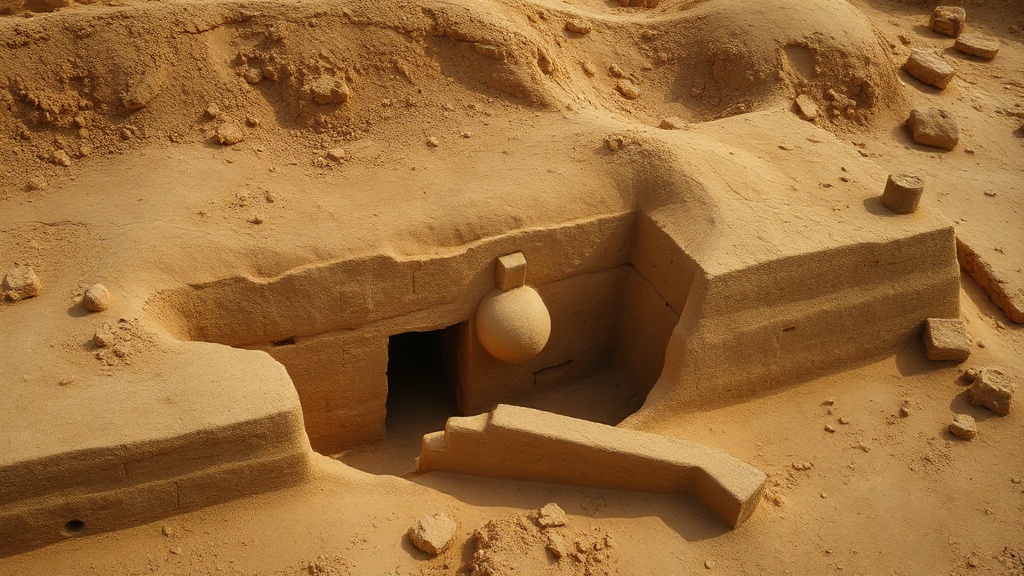
For field archaeologists accustomed to the grand stone architecture of the Mediterranean or the neatly aligned baked-brick streets of Harappa, the stratigraphy of the Ganga-Yamuna Doab (the fertile land between the two rivers) presents a frustrating puzzle. The Painted Grey Ware (PGW) culture, which flourished in northern India during the iron-using era of the first millennium BCE, has long been at the center of chronological and cultural arguments. Yet, visitors to sites like Hastinapura or Ahichchhatra will find no soaring stone pillars, no monumental palaces, and no defensive brick fortresses from this era.
The absence of monumental stone ruins has occasionally led to skepticism about the scale of these settlements. However, a closer look at the physical evidence reveals that this lack of preservation is a predictable consequence of the building materials and environmental conditions of the ancient Doab.
The Ephemeral Materials of the Doab
During his landmark excavations at Hastinapura in the early 1950s, B.B. Lal, writing in the Excavations at Hastinapura and other Explorations in the Upper Ganga and Sutlej Basins 1950-52, documented the structural layers of Period II, the PGW phase. What he uncovered were not stone foundations, but the ghosts of perishable dwellings.
The primary building technique of the PGW culture was wattle-and-daub, a method where a woven lattice of wooden strips (wattle) is plastered with wet earth, clay, or mud (daub). Excavators at Hastinapura and other PGW sites regularly find fragments of baked clay bearing the distinct impressions of reeds and bamboo poles. These fragments are the accidental survivors of ancient fires; when a wattle-and-daub house burned down, the clay plaster baked into hard terracotta, preserving the texture of the organic supports that have long since rotted away.
In addition to wattle-and-daub, PGW builders relied on rammed earth and mud bricks. Unlike the kiln-burnt bricks of the Indus Valley Civilization, which could withstand centuries of waterlogging, sun-dried mud bricks dissolve back into the surrounding soil when exposed to heavy monsoon rains and seasonal flooding.
The Chemistry of Decay
The preservation of ancient structures is highly dependent on local geology and soil chemistry. In the semi-arid regions of Gujarat or Sindh, unbaked mud structures can sometimes survive for millennia. In contrast, the alluvial plains of the Ganga-Yamuna river system experience intense annual monsoons and high humidity.
According to geological and chemical studies published in Man and Environment, the acidic nature of the local soil, combined with a high water table, accelerates the decay of organic materials like wood, thatch, and bamboo. Over centuries, repeated cycles of wetting and drying compress these mud-walled settlements into homogenous clay layers. To an untrained eye, an excavated PGW trench looks like simple sterile soil, but careful stratigraphic analysis reveals thin, compacted bands of clay that represent the collapsed roofs and floors of ancient homes.
Furthermore, the PGW culture was fundamentally pastoral-agrarian. While they possessed iron technology—primarily used for weapons and clearing agricultural land—their social organization did not require the massive, centralized labor forces needed to quarry, transport, and carve stone. Stone was also a scarce commodity in the deep alluvial plains of the Doab; bringing sandstone or granite from the nearest hills of central India or the Himalayas would have required a highly organized trade network that had not yet developed during the early PGW period.
The Debate Over Identity
The cultural identity of the PGW makers remains a subject of intense discussion in South Asian archaeology.
⚖ Scholarly debate: Evidence shows that B.B. Lal and several subsequent researchers associated the PGW culture directly with the late Vedic period and the events of the Mahabharata. This school of thought points to the geographic overlap between PGW sites—such as Hastinapura, Kurukshetra, and Indraprastha—and the locations mentioned in Vedic and Epic literature.
Conversely, other scholars argue against equating material culture assemblages directly with linguistic or literary groups. Writing in journals like Antiquity and Puratattva, skeptics point out that a ceramic tradition like PGW does not inherently carry a language or ethnic identity. They argue that tying a specific pottery style to the Sanskrit-speaking authors of the Vedic texts is a speculative leap that cannot be proven by stratigraphy alone. This camp views the PGW culture as a regional, early iron-using technological phase rather than the material footprint of a specific literary epic.
The Transition to Stone
The reliance on mud and wood persisted long after the PGW period. Even during the rise of the first cities in the Mahajanapada (great kingdoms) period, wood remained the dominant building material. Early historic accounts, including descriptions of the Mauryan capital of Pataliputra, note that the city’s massive defensive walls were constructed of timber palisades rather than stone.
It was only during the Mauryan Empire, under the reign of Ashoka in the third century BCE, that stone architecture became a prominent feature of the Indian landscape. This shift was not merely a technological upgrade, but a political and ideological statement. Stone was imported, carved, and erected to display royal decrees and project imperial permanence across the subcontinent.
For the field archaeologist, the lack of monumental ruins in the PGW layers is not a sign of cultural stagnation. Instead, as recorded in the pages of Puratattva, these humble mud ruins demonstrate a highly successful adaptation to a fertile, forested river valley where wood and clay were abundant, and stone was far over the horizon.