The Mortar of Rakhigarhi: What Gypsum Plaster in Trench RGR-7 Reveals About Early Harappan Structural Transitions
A close reading of Mound 7's micro-stratigraphy reveals how a sudden shift to gypsum-based plaster marks the transition from regional Siswal occupations to the inter-regional networks of the Mature Harappan period.

Rohan Bhattacharya for SwavedaAugust 8, 2026
The transition from localized agrarian communities to the integrated urban network of the Indus Civilization is often represented in textbooks by sudden, monumental shifts. Standard narratives emphasize the rapid appearance of planned streets, standardized weights, and baked-brick platforms. Yet, the mechanics of this transition are frequently preserved in less glamorous, microscopic details.
At the site of Rakhigarhi in Haryana, India, one of these details lies in the changing composition of structural plaster. A careful reading of the micro-stratigraphy (the study of archaeological soil layers) and soil chemistry within Trench RGR-7 on Mound 7 shows that the adoption of gypsum-based plaster, replacing simpler mud plaster, occurred precisely during the transition from the regional Early Harappan Siswal phase to the Mature Harappan period. This material shift offers physical evidence of inter-regional mineral procurement and technological standardization long before the construction of the site's most celebrated monumental platforms.
The Stratigraphy of Mound 7
Mound 7 at Rakhigarhi, which serves as both a residential area and a burial site, provides an ideal sequence for observing the step-by-step evolution of Harappan material culture. Excavations conducted by the Archaeological Survey of India (ASI) and academic partners have documented a clear stratigraphic sequence here, moving from the Early Harappan Siswal culture up to the Mature Harappan urban phase. Reports in journals like Puratattva and Man and Environment highlight how these trenches yield deep columns of uninterrupted human occupation.
In the lower levels of Trench RGR-7, the earliest structural remains consist of semi-subterranean circular pits and mud-brick structures. The mortar and plaster used in these early Siswal-phase structures are straightforward. Micromorphological analysis (the microscopic study of undisturbed soils and sediments) of these early layers shows that builders relied entirely on locally sourced alluvial clay (soil deposited by running water), mixed with organic temper (strengthening additives) such as husk, straw, and animal dung to prevent shrinking and cracking as the mud dried.
This plaster was functional but highly susceptible to water damage and weathering, requiring frequent reapplication. The stratigraphic layers in these early levels are often separated by thin laminations of washed-out mud plaster, indicating a constant cycle of erosion and repair during seasonal rains.
The Gypsum Shift in Trench RGR-7
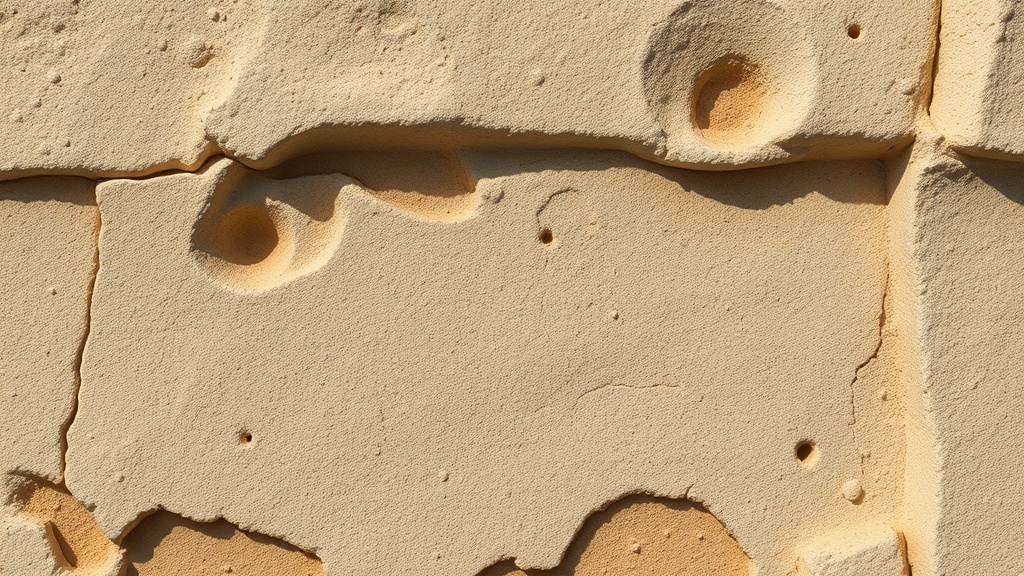
As the stratigraphy progresses upward into the transitional phase, a distinct change occurs. The mud-brick walls of the emerging Mature Harappan style are no longer coated solely with plain alluvial clay. Instead, a white-to-light-grey plaster layer appears, varying in thickness from a few millimeters to over a centimeter.
Chemical and mineralogical analyses of this plaster reveal a high concentration of calcium sulfate dihydrate, commonly known as gypsum. To create this plaster, the builders had to collect gypsum crystals, heat them to dehydrate the mineral into plaster of Paris, grind it into a fine powder, and mix it with water to apply to the brickwork.
This was not a gradual, experimental transition. The micro-stratigraphic record in Trench RGR-7 indicates that once the technique was adopted, gypsum plaster was used systematically across both domestic interiors and public drainage installations. The gypsum plaster provided a far more durable, water-resistant surface than mud plaster, which was particularly crucial for the brick drains and water-handling structures that defined Mature Harappan sanitation.
Mineral Sourcing and Early Trade Networks
The appearance of gypsum plaster at Rakhigarhi is not merely an achievement of ancient chemistry; it is a marker of changing geographic horizons. The alluvial plains of the Ghaggar-Hakra basin, where Rakhigarhi is situated, do not contain natural, easily accessible deposits of high-quality plaster-grade gypsum.
Geological surveys indicate that the nearest significant deposits of gypsum are located in the arid regions of the Thar Desert in Rajasthan, particularly around Bikaner and Jodhpur, as well as in parts of Haryana's western fringes. For the builders in Trench RGR-7 to use gypsum systematically, a reliable supply chain had to exist.
The sudden presence of this material in the transitional stratigraphy indicates that the community at Rakhigarhi was actively importing raw minerals over substantial distances before their architectural footprint expanded into monumental proportions. Rather than being a byproduct of urbanization, this long-distance resource acquisition was an active driver of the transition itself. The procurement of Rajasthan gypsum laid the logistical groundwork for the procurement of other materials, such as lapis lazuli (a deep-blue metamorphic rock), carnelian (a brownish-red mineral), and copper, which would soon flood the Mature Harappan city.
Debating the Chronology of Material Shifts
In Indian archaeology, dating these material transitions has often been a point of contention. Scholars debate the precise timeline and nature of this transition.
On one side, some scholars argue for a rapid, almost revolutionary transition to the Mature Harappan phase, driven by external trade contacts or sudden internal administrative consolidation. On the other side, an opposing group of scholars views it as a slow, local evolution with regional variations, where elements of the older Siswal culture persisted alongside newer urban technologies.
The evidence from the soil chemistry of Trench RGR-7 supports a model of deliberate, phased technological adoption. The shift in plaster composition occurs alongside changes in ceramic styles, where the bi-chrome (two-colored) pottery of the Siswal tradition gradually yields to the classic black-on-red sturdy ware of the Mature Harappan period.
By analyzing the interfaces between these layers, we see no evidence of a sudden destruction or abandonment. Instead, the sequence shows continuous occupation, where old mud-walled structures were systematically leveled, capped with clean clay, and rebuilt using standardized bricks and imported plaster.
This stratigraphy cautions against relying solely on spectacular finds to define historical horizons. While a decorated seal or a bronze figurine captures public attention, it is the dull, greyish plaster adhering to a broken brick in Trench RGR-7 that reveals the day-to-day reality of Harappan integration—a process built on reliable mortar, regional trade, and practical chemistry.
Sources and Archaeological Reports for Further Reading:
- For details on Rakhigarhi's excavation history and stratigraphic sequences, see the excavation reports published by the Archaeological Survey of India (ASI).
- Studies on Harappan plaster composition, mineral sourcing, and technological transitions can be found in the archives of Antiquity, Man and Environment, and Puratattva (the journal of the Indian Archaeological Society).
- For geological distributions of gypsum deposits in the Thar Desert and Rajasthan, refer to the Geological Survey of India (GSI).