The Micro-Stratigraphy of Rakhigarhi Trench RGR-7: Recalibrating Early-to-Mature Harappan Transition Charcoal and Phytolith Dates
Micro-stratigraphic analysis and plant microfossil dating at Rakhigarhi Trench RGR-7 reveal agricultural continuity during the Early to Mature Harappan transition.

Rohan Bhattacharya for SwavedaNovember 25, 2026
Listen to this article · 7 min · Read by an AI voice
By Rohan Bhattacharya
Archaeological stratigraphy is rarely as clean as a textbook diagram. Standard excavations frequently treat archaeological layers as discrete, monolithic blocks of time, assuming that a change in ceramic styles or mud-brick dimensions corresponds to a sudden, clean break in human occupation.
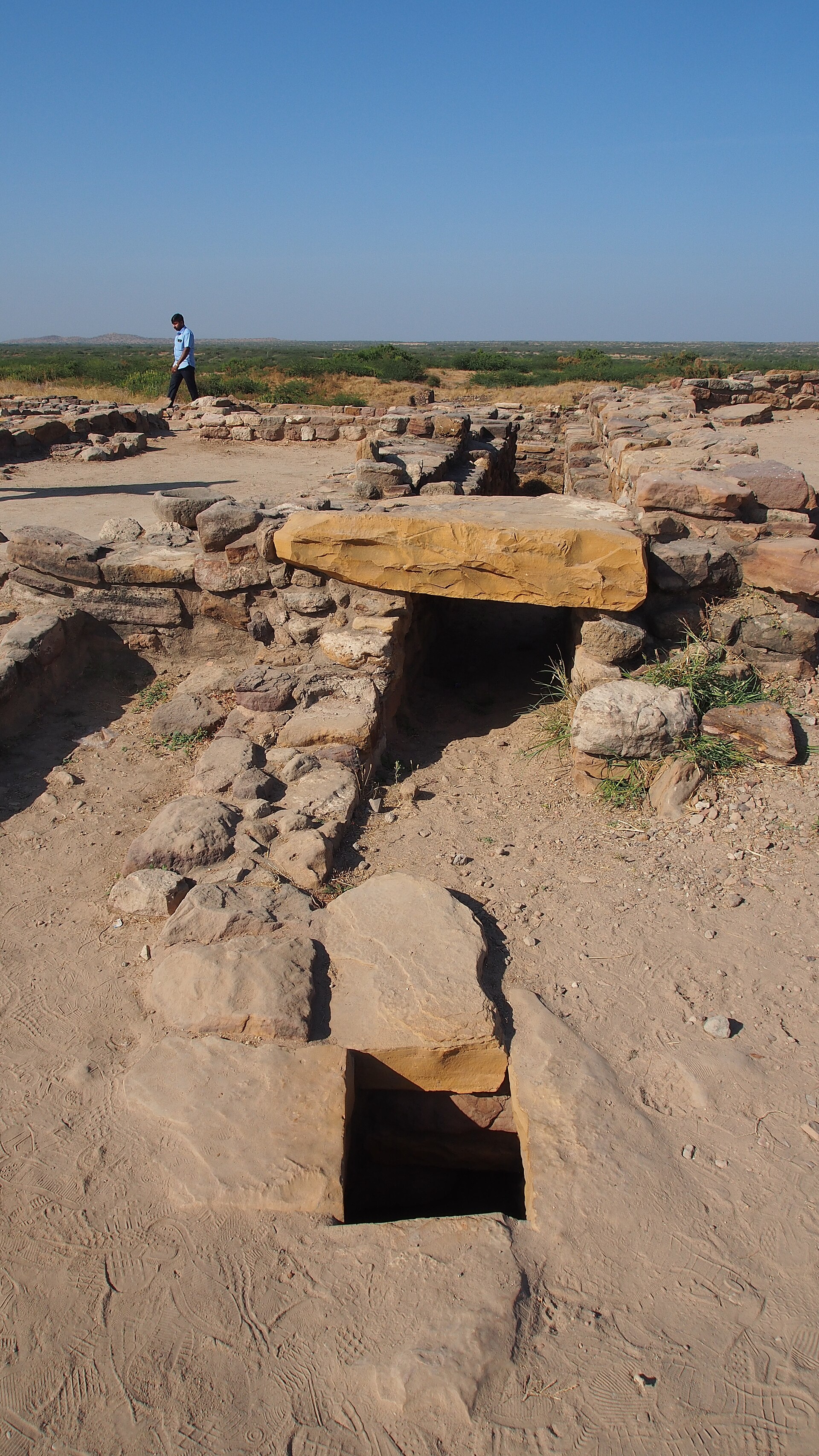
At Rakhigarhi, located in the Hisar district of Haryana, recent work has exposed the flaws in those broad assumptions. Mound RGR-7 has long been recognized as a primary necropolis of the Mature Harappan phase. However, targeted trenching at RGR-7 revealed underlying occupation deposits directly below the mature burial horizons. By combining sediment micromorphology—the microscopic study of undisturbed soil samples in thin sections under a polarizing microscope—with high-precision radiocarbon dating of charred macro-botanical seeds and phytoliths (microscopic silica structures formed within plant tissues), researchers are re-evaluating the absolute dates and environmental dynamics of the Early-to-Mature Harappan transition.
Stratigraphic Discontinuities and Micromorphology
In standard excavation practice, a field crew digs down to a visible color change or ash lens, assigns it a context number, and collects bulk charcoal samples for radiocarbon analysis. The problem with bulk charcoal dating lies in bioturbation (the churning of soil by earthworms, roots, or burrowing rodents) and pedoturbation (shrink-swell cycles in clay-rich soils). A piece of charcoal from an older layer can easily migrate upwards into a younger layer, or a rootlet can push modern carbon downwards, skewing the laboratory results.
Micromorphological analysis mitigates this issue by cutting undisturbed block samples out of the trench face, impregnating them with synthetic resin, and grinding them into razor-thin slides. Under microscopic examination, sedimentologists can observe the exact physical relationship between a charred seed and the surrounding soil matrix.
At Trench RGR-7, thin-section analysis demonstrates that the boundary between the Early Harappan (Sothi-Siswal horizon) and the Mature Harappan phase is not marked by a sudden destruction layer or a prolonged abandonment. Instead, micro-debris distributions show micro-laminations of hearth ash, trampled mud floors, and structural debitage that interdigitate—interlock like fingers—across the transition horizon. Soil micro-structures reveal continuous human treading and organic deposition, demonstrating that the site remained continuously occupied as local architectural and ceramic traditions evolved.
Phytoliths, Charred Seeds, and Radiocarbon Triangulation
To date these continuous micro-layers precisely, archaeobotanists focus on microfossils and charred macro-botanical remains. Phytoliths—inorganic silica particles that absorb into plant structures during their life cycle and survive indefinitely in soil after the plant decays—provide direct evidence of plant processing on specific living floors.
Because phytoliths consist of biogenic silica rather than organic carbon, they cannot be radiocarbon-dated directly. However, when phytolith clusters are trapped within sealed, un-bioturbated micro-hearths alongside charred agricultural seeds, accelerator mass spectrometry (AMS) radiocarbon dating of the charred seeds anchors the plant remains to precise calendar dates.
The botanical assemblage isolated from the RGR-7 lower horizons points to a resilient agricultural strategy. The macro-botanical record preserves a dual-cropping regime. Winter (rabi) crops such as wheat (Triticum) and barley (Hordeum vulgare) dominate the lower Early Harappan levels, alongside summer (kharif) crops such as indigenous millets and pulse varieties.
AMS dating of isolated, short-lived botanical samples—specifically charred cereal grains rather than long-lived wood charcoal—places the local Early Harappan occupation in the late fourth millennium BCE, transitioning steadily into the Mature Harappan urban phase around 2600 BCE. Because short-lived seeds do not suffer from the "old wood" effect (where heartwood from a centuries-old tree yields an artificially ancient date), these determinations provide a far sharper temporal boundary for the emergence of mature civic features in the Ghaggar-Hakra basin.
Re-evaluating the Early-to-Mature Transition Timeline
The evidence shows that agricultural practices at Rakhigarhi did not undergo a violent collapse or a sudden external revolution when the settlement expanded into a major urban center. Micro-stratigraphic sampling reveals that crop choice, field management, and processing techniques remained stable across the layer boundary.
Scholars debate whether the transition to urban planning in the regional Harappan context was driven by external trade network expansion or by internal demographic growth supported by localized agricultural surplus. The micro-stratigraphic record at RGR-7 supports the latter view: urban forms evolved directly atop localized, continuous agricultural habitations.
By isolating botanical microfossils from intact soil matrices, field archaeologists are moving away from broad, rigid chronological blocks. The fine-grained layers of Trench RGR-7 demonstrate that urbanism at Rakhigarhi was built incrementally, floor layer by floor layer, on a foundation of unbroken agricultural continuity.
Note: Archaeobotanical and radiocarbon methodologies vary by laboratory; exact calibrated date ranges depend on the specific atmospheric calibration curve applied.