The Mahabharata's Authorship: Tracing the Bhargava Connection Through Tradition and Evidence
An exploration into the traditional claims of Bhargava Brahmin authorship of the Mahabharata, examining textual clues and scholarly perspectives.

Vikram Joshi for SwavedaJune 11, 2026
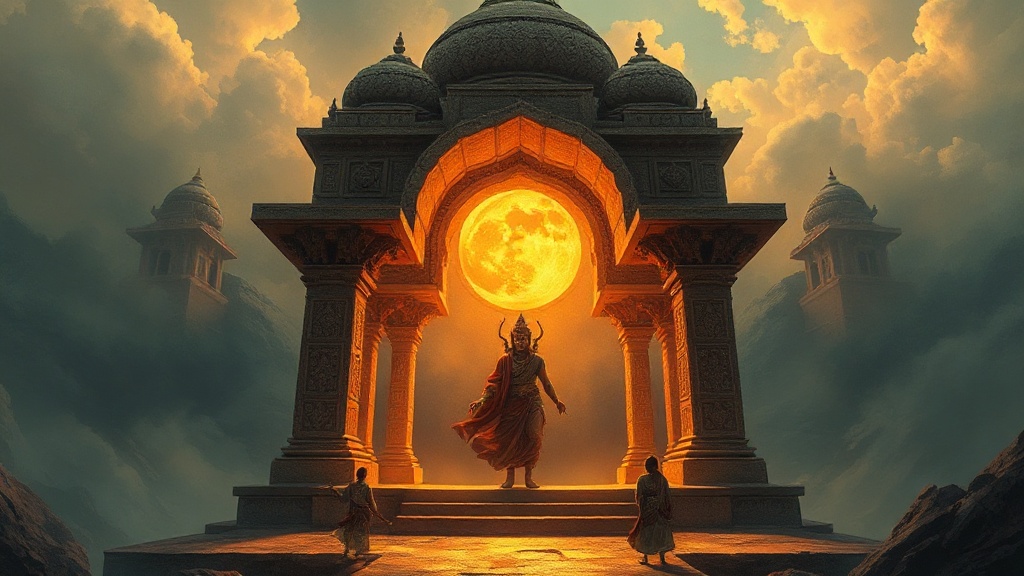
Tradition associates the epic Mahabharata with the Bhargava Brahmin lineage, specifically attributing its composition to Vyasa. This narrative, deeply embedded in Indian cultural memory, presents a singular author. However, a closer examination of the text itself, alongside scholarly analysis of its development, reveals a more complex picture. The question of authorship is not a simple matter of historical fact but a confluence of tradition, textual evolution, and scholarly interpretation.
The Puranic tradition frequently identifies Vyasa, son of Parashara, as the compiler and narrator of the Mahabharata. Vyasa himself is presented within the epic as a central figure, a sage, and the father of Dhritarashtra and Pandu. Many hymns and narratives within the Mahabharata explicitly credit him with its composition. This self-referential attribution forms the bedrock of the traditional view. The Bhargava connection arises from the broader genealogical and thematic links within the epic and related texts. The lineage of the Bhrigus, to which the Bhargavas belong, features prominently in the Mahabharata, often appearing as sages, advisors, and figures of authority. Some scholarly interpretations suggest that the pervasive presence and influence of the Bhrigu family in the epic's narratives, coupled with the identification of Vyasa as a Bhargava (though some traditions place him in a different lineage), may have led to the attribution of authorship to this Brahminical tradition.
However, the Mahabharata, as it exists today, is widely understood by scholars not as a single, monolithic work dictated by one author at a specific point in time. Instead, it is viewed as a layered text that evolved over centuries. This understanding stems from linguistic analysis, examination of evolving narrative strands, and the presence of diverse philosophical and ritualistic content. The epic likely began as a core narrative of the Bharata war, gradually accumulating additional stories, genealogies, philosophical discourse, and legalistic sections. This process of accretion and expansion suggests that "authorship" in the traditional sense may not fully capture the epic's formation.
The linguistic dating of different strata within the Mahabharata indicates its composition and redaction occurred over a prolonged period, potentially spanning from the mid-first millennium BCE to the early centuries CE. This timeframe challenges the notion of a single author like Vyasa composing the entire work in a definitive act. Instead, it points to a collaborative, evolving tradition of storytelling and compilation. Scholars note that the language and style of the earliest sections differ from those added later, reflecting shifts in Sanskrit usage and literary conventions.
Moreover, the theological and philosophical content within the Mahabharata exhibits a range of perspectives. While certain sections clearly reflect the influence of Brahminical thought and ritual, others engage with ascetic traditions, heterodox ideas, and philosophical debates that emerged over time. This diversity suggests a process of integration rather than a singular, unified authorial voice dictating a fixed text.
The association of the Bhargavas with the Mahabharata's authorship can also be seen as reflecting the broader cultural and intellectual milieu in which the epic was shaped. Brahmins, particularly those from prominent families like the Bhrigus, were custodians of Vedic knowledge, lore, and storytelling traditions. Their involvement in compiling, preserving, and transmitting such vast narratives would have been crucial. The attribution of authorship to a specific Brahminical lineage could signify their role as the intellectual architects and guardians of the epic's content and transmission.
Scholarly debate continues regarding the precise nature of Vyasa's role. Was he a historical figure who originated a significant part of the narrative, or is he a literary construct representing the accumulated wisdom and storytelling tradition? Evidence suggests that Vyasa is more accurately understood as the principal compiler and editor of the epic rather than its sole author in the modern sense. His role, as depicted in the text, is that of an intermediary who received the story and then transmitted it, adding his own insights and elaborations.
When considering the claim that Bhargava Brahmins composed the Mahabharata, it is essential to distinguish between tradition and verifiable historical evidence. Tradition, as found in Puranic literature and oral accounts, strongly points to Vyasa, who is linked to the Bhargava lineage. This tradition reflects the societal importance of Brahmins in preserving and shaping cultural narratives. However, textual analysis and the study of the epic's layers indicate a much longer and more complex process of formation, involving multiple contributions and revisions over centuries.
The evidence does not point to a single, identifiable group of Bhargava Brahmins definitively writing the entire Mahabharata at a specific time. Instead, the epic's vast scope and layered content suggest a collaborative effort within the broader Brahminical tradition, with the Bhargavas playing a significant role in its lineage, content, and transmission. The figure of Vyasa, traditionally seen as the author, is better understood as the central compiler and editor, embodying the culmination of this evolving tradition. Therefore, while tradition links the epic to the Bhargava lineage, scholarly inquiry highlights a more extended and multifaceted genesis, shaped by centuries of oral transmission, oral composition, and textual interpolation within the ancient Indian intellectual landscape. The Mahabharata stands as a testament to this evolving tradition, a compendium of wisdom, mythology, and philosophy that grew organically rather than being authored by a single hand.