The Lexicon of Clandestine Airwaves: Translating the Register of Congress Radio
A philological examination of the 1942 Congress Radio transcripts shows how Usha Mehta translated high Gandhian philosophy into urgent, vernacular political prose to evade British colonial censorship.

Meera Iyer for SwavedaOctober 24, 2026
On August 27, 1942, a shortwave signal cut through the crackle of the shortwave band across Bombay: "This is the Congress Radio calling on 42.34 metres from somewhere in India" (The India Forum). The speaker was 22-year-old law student Usha Mehta (Wikipedia). Operating out of clandestine hideouts alongside associates including Vithalbhai Jhaveri, Babubhai Khakar, and Ram Manohar Lohia, Mehta ran an underground broadcast network (Drishti IAS) to bypass the colonial censorship imposed after the arrest of top Indian National Congress leadership during the Quit India Movement (The India Forum).
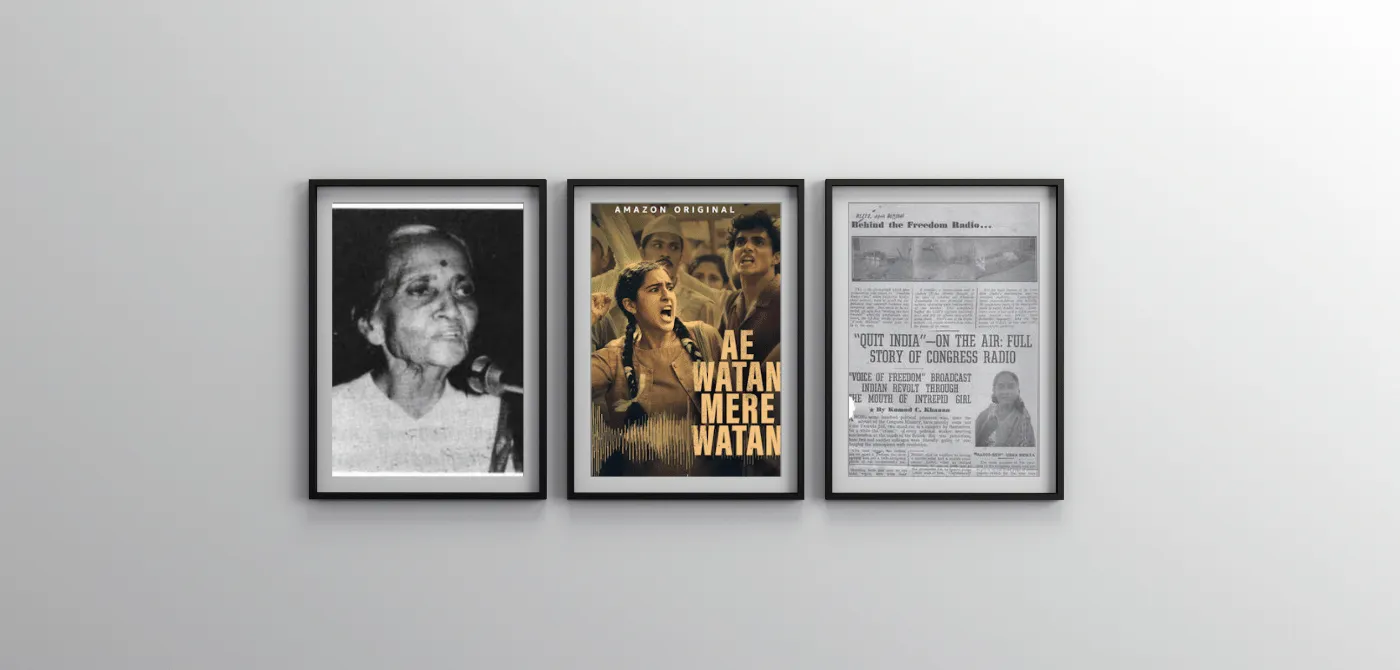
While history remembers Congress Radio as a daring technological feat, a philological examination of the surviving broadcast transcripts reveals a parallel linguistic strategy. Mehta and her cohort were forced to translate abstract Sanskritized political philosophy into direct, vernacular Hindi and Gujarati political code that could mobilize an underground public without triggering immediate colonial jamming or legal suppression.
From Philosophical Sanskrit to Vernacular Code
The core tension in the broadcasts lay in translating classical Gandhian concepts into urgent radio copy. Mahatma Gandhi's philosophy leaned heavily on high-register Sanskrit terms. Foremost among these was Ahiṃsā (अहिंसा, "non-violence"), a classical Sanskrit compound constructed from the negative prefix a- ("non") and the noun hiṃsā ("injury" or "harm"). In canonical philosophical texts, Ahiṃsā denotes a passive ascetic vow or an internal moral imperative.
In the radio transcripts, however, Mehta and Lohia altered the functional grammar of Ahiṃsā. The broadcasts shifted the register from passive moral philosophy to active political duty. The transcripts frequently pair Ahiṃsā with the Sanskrit term Satyāgraha (सत्याग्रह, "insistence on truth," derived from satya, meaning "truth," and āgraha, meaning "polite insistence" or "firm grasp"). In the mouth of the clandestine broadcaster, Satyāgraha ceased to mean individual soul-force and became a collective strategy of non-violent resistance against state coercion.
To make these Sanskritized concepts accessible to listeners across the regional dialect continuum, the broadcasters deployed tadbhava words (तद्भव, "descended from Sanskrit"—vernacular words derived from Sanskrit roots through centuries of phonetic evolution) alongside tatsama words (तत्सम, "same as Sanskrit"—direct, unevolved Sanskrit borrowings). Rather than relying solely on the high tatsama register favored by scholarly essays, the scripts embedded classical terms within everyday Gujarati and Hindi speech patterns.
Decoding the Vernacular Vocabulary
A close analysis of specific compound terms used in the surviving Gujarati and Hindi transcriptions highlights this translation process:
- Inqilāb (इन्क़िलाब, "revolution"): Borrowed into Hindi-Urdu from Arabic, this term was paired alongside Sanskrit-derived terms like Swarāj (स्वराज्य, "self-rule," from swa meaning "self" and rājya meaning "rule"). The pairing merged classical anti-colonial self-determination with modern revolutionary urgency.
- Jana-jāgṛti (जन-जागृति, "public awakening"): A tatsama compound formed from jana ("people") and jāgṛti ("awareness" or "wakefulness"). The transcript uses this word to frame civil disobedience not as chaotic unrest, but as a deliberate awakening of civic consciousness.
- Satyāgrahī (सत्याग्रही, "one who practices truth-resistance"): By adding the possessive suffix -ī to Satyāgraha, the broadcasters transformed an abstract doctrine into a personal identity for the listener on the street.
The English broadcasts, often delivered by Ram Manohar Lohia (Live History India), translated these same concepts using the direct political vocabulary of Western anti-fascist resistance (Modern Asian Studies). Evidence shows that this multi-lingual register allowed the station to reach diverse social classes, ranging from Gujarati traders in Bombay to Hindi-speaking factory workers (The Paperclip).
Bypassing Imperial Censorship
Colonial authorities operated under the Defence of India Rules, which heavily regulated both print media and public speech (The India Forum). Direct calls to armed rebellion were treasonous and easily targeted. By grounding their broadcast rhetoric in the moral authority of Sanskrit terminology while delivering the news of strikes and police action in crisp vernacular sentences, Congress Radio achieved a specific rhetorical balance.
Tradition holds that Usha Mehta composed many of her daily broadcast notes in invisible ink (The Paperclip) to evade physical seizure before reaching the microphone. But the true linguistic camouflage lay in the transcripts themselves: a text that sounded like a moral lecture on Ahiṃsā to colonial censors acted as an explicit call to mass civil disobedience for the listening public.
The station was silenced on November 12, 1942, when imperial police raided its secret transmission room in Bombay, arresting Mehta and her associates (The Tribune India). Yet the 88-day run of Congress Radio established a linguistic template for resistance, demonstrating how classical philosophical registers could be translated into the immediate, living prose of political action.