The Horse in the Dust: What Rigveda 1.162 Says the Ribs Should Look Like
A philological reading of the Rigveda's horse-sacrifice hymn, checked line by line against the horse bones actually dug up at Sintashta and Pirak.

Meera Iyer for SwavedaJuly 31, 2026
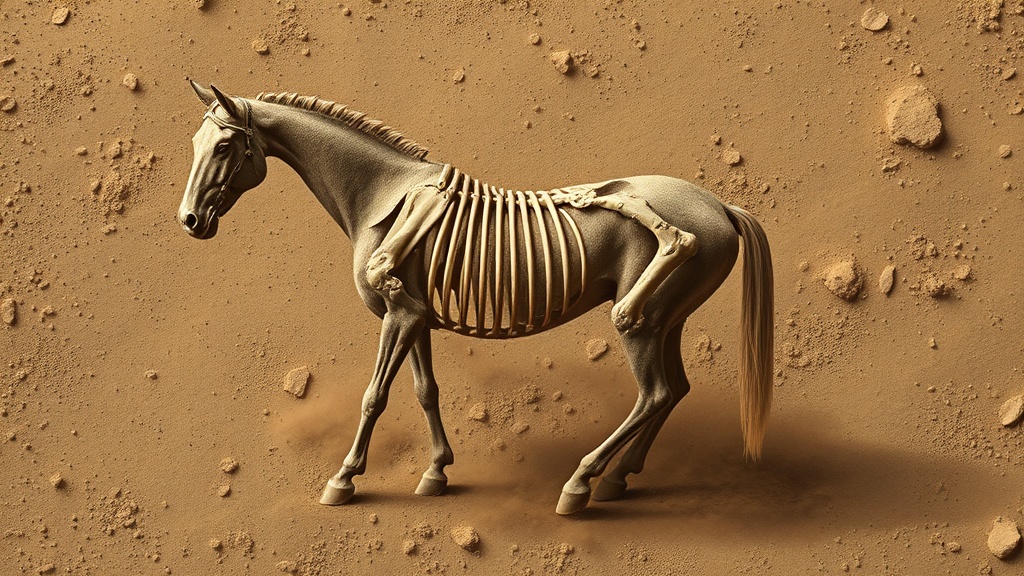
The horse is asked, politely, not to mind being cut apart. That is the strangest thing about Rigveda (a collection of Sanskrit hymns composed roughly between 1500 and 1200 BCE) Mandala (book) 1, Hymn 162. The poet addresses the sacrificial horse directly, apologizes in advance for the knife, and then walks through its body part by part as the priests carve it — a level of anatomical narration you don't get in most sacrificial poetry anywhere in the ancient world. That specificity is what makes the hymn testable. You can hold its vocabulary up against actual horse bones from the Bronze Age steppe and the edge of the Indus world, and see where the ritual described on the page matches what people actually buried.
The Rib Count Problem
The Sanskrit word for horse in the hymn is asva (horse), and the ritual itself is later known as asvamedha (horse sacrifice, literally "horse offering"), though that formal, kingship-linked version is described in more detail in later texts like the Shatapatha Brahmana, not in RV 1.162 itself — a distinction scholars are careful about, since "asvamedha" as a state ritual and the horse hymns of the Rigveda are not automatically the same ceremony separated by time.
One line of the hymn, in Ralph T.H. Griffith's translation, tells the officiants not to hack carelessly, and specifies the horse's vankri (ribs) — thirty-four of them — as something to be counted and handled correctly, kin as the horse is treated to be to the gods. A real horse has eighteen pairs of ribs, thirty-six total. The hymn's number is off by two. This isn't a gotcha; it's the kind of detail a philologist has to sit with rather than smooth over. It could reflect a different way of counting (excluding the floating ribs, for instance), a scribal or oral-transmission slip carried across centuries of memorized recitation, or a number chosen for its ritual resonance rather than veterinary accuracy. What it tells us clearly is that the poet, or the tradition behind the poet, cared enough about the horse's actual skeleton to specify a number at all. That's a text written by people who had looked closely at a butchered horse, whatever the arithmetic error.
What Sintashta Actually Buried
The archaeological record most often put in conversation with Indo-Iranian horse ritual is the Sintashta culture, a Bronze Age society of the southern Ural steppe (roughly 2100–1800 BCE), documented in detail in the Wikipedia entry on the Sintashta culture and in the broader synthesis by archaeologist David W. Anthony. Sintashta burials are famous for spoke-wheeled chariots and horse remains placed with the dead — but the remains are frequently partial: skulls and lower leg bones, sometimes paired, laid in graves rather than whole animals interred intact. That's a different gesture than the Rigvedic hymn describes. RV 1.162 narrates a single horse dismembered whole, part by part, with priests reciting over the process and the animal's spirit sent off intact to the gods. Sintashta graves, where partial horse deposits appear, suggest a token or representative offering — a economy of animal parts standing in for the whole animal — rather than a full-body ritual carving matching the hymn's sequence of thigh, shoulder, ribs, hoof.
The chronology also doesn't line up neatly. Sintashta predates the most plausible composition window for Rigveda Mandala 1 by centuries, and it sits far to the north and west of where the Rigvedic hymns were composed, in the Punjab and its borderlands. Any connection is about shared Indo-Iranian ritual ancestry, not a direct archaeological illustration of the hymn.
Pirak and the Missing Altar
Closer to the Rigveda's own geography is Pirak, a site in Balochistan excavated by French archaeologist Jean-François Jarrige, occupied from roughly the late second millennium BCE into the early first, as summarized on Wikipedia's Pirak entry. Pirak is known chiefly for terracotta horse figurines — small clay models, some with saddle-like details — rather than a comparable horse-sacrifice deposit. Scholars have debated what the figurines tell us about the arrival of the domesticated horse (Equus caballus) in the region, since actual skeletal evidence of horses at South Asian sites of this period is thin and easily confused with remains of onagers or other equids. Pirak gives evidence of horses as objects of representation and probably status, but not evidence of ritual dismemberment matching RV 1.162's careful, part-by-part vocabulary. There is no altar at Pirak that looks like the hymn.
Text and Trench, Not the Same Animal
Put the three side by side and the honest conclusion is modest. The Rigvedic hymn is precise about anatomy in a way that shows real familiarity with horse butchery, down to a rib count that is wrong but specific. Sintashta shows steppe societies burying horse parts with chariots in patterns that gesture toward similar Indo-Iranian ideas about horses, death, and status, without matching the hymn's full-body ritual sequence. Pirak shows horses present and valued on the edge of the Indus world, mostly in clay rather than bone, with no comparable sacrificial deposit at all. Tradition holds that these three things belong to one continuous story of the horse in early Indo-Iranian religion. The evidence shows three separate, partial pictures that don't quite fit together into that story yet — and the gap between the ribs on the page and the bones in the ground is exactly where the real work still is.