The Grammar of the Girdle: How the Mekhala of Sangam Poetry Maps onto Iron Age Adichanallur
An investigation into how early Tamil grammatical texts describing the mekhala (waist-girdle) align with physical bronze artifacts excavated at the Iron Age site of Adichanallur.

Asha Naidu for SwavedaAugust 8, 2026
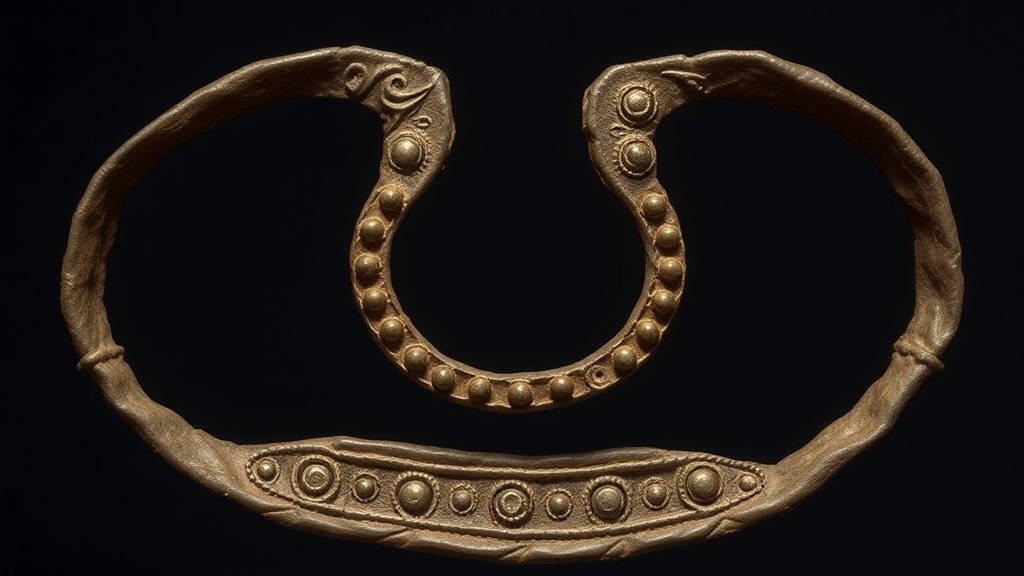
The search for the material realities behind the earliest layers of Tamil literature often leads to the dry, red-soil urn burial site of Adichanallur, located in the Thoothukudi district of Tamil Nadu. Excavated intermittently since the late nineteenth century, this extensive Iron Age cemetery has yielded thousands of bronze, iron, and gold artifacts. Among the most intriguing finds are fragments of bronze utility belts and ornamental bands designed to be worn around the hips.
These physical objects offer a material counterpart to the elite vocabulary found in the Tolkaappiyam (the "Ancient Book" or "Old Composition"), which stands as the earliest surviving Tamil grammatical treatise. By tracing the linguistic history of the mekhala (a girdle or hip-belt) and comparing its literary descriptions with the bronze hardware recovered from Adichanallur, we can observe how early Dravidian prestige vocabulary aligns with tangible Iron Age archaeological evidence.
The Etymology of the Waist-Girdle
In classical Indian literature, the waist-girdle is known by several names, but mekhala is among the most persistent. The word mekhala itself is of Indo-Aryan origin. It appears in Vedic texts to denote the sacred cord worn by a student during Upanayana (an initiation ceremony). Its adoption and adaptation in the southern Dravidian context reveals a complex process of cultural synthesis.
The word "etymology" refers to the origin and historical development of words. In the early Tamil grammatical tradition, particularly within the Tolkaappiyam, the focus of vocabulary is highly systematized. The text categorizes the human experience into akam (interior or romantic love poetry) and puram (exterior or heroic war poetry). Within these thematic spheres, personal ornaments are not mere decorations. They serve as social markers of status, gender, and stage of life.
Evidence shows that early Tamil speakers adopted the prestige term mekhala alongside indigenous Dravidian terms like alkul (the pelvic region or loins) and kovan (a loincloth or waist-string) to describe the adornment of the midsection. In later Sangam poems—the classical Tamil anthologies—the girdle becomes a central literary motif. The sliding down of a woman's hip-belt is a conventional poetic device used to signal pining, weight loss, or emotional distress in the akam (interior or romantic love poetry) genre.
The Material Evidence of Adichanallur
While the poetry presents a stylized, highly romanticized view of personal adornment, the graves of Adichanallur provide the physical reality of the southern Iron Age. Scholars debate the precise chronology of this era. Some specialists propose that the Southern Iron Age began as early as 1000 BCE, citing early radiocarbon dates from various peninsular sites. However, other researchers argue for a more conservative timeline, placing the robust development of this metallurgical phase closer to 500 BCE.
Archaeological excavations at Adichanallur, particularly those documented by the French consul Louis Lapicque in the early twentieth century and subsequent investigations by the Archaeological Survey of India, have unearthed numerous bronze items. Among these are heavy bronze rings, linked chains, and curved metallic bands. Conservation analysis of these artifacts indicates they were designed to be worn around the waist.
Unlike the delicate, jewel-encrusted gold girdles described in medieval literature, the Adichanallur waist-bands are substantial, functional, and cast from high-tin bronze. High-tin bronze is a copper alloy containing more than 15 percent tin, prized for its strength and golden luster. Some of these bands feature incised geometric patterns, while others consist of interlocking bronze rings that would have jingled during movement. This physical characteristic matches the auditory imagery in early Tamil poetry, which frequently describes the soft, rhythmic sound made by a woman's girdle as she walks.
Aligning Text and Artifact
Scholars debate the exact chronological relationship between the earliest strata of the Tolkaappiyam and the burials at Adichanallur. However, the linguistic and material records converge on the social function of these items.
In the puram (exterior or heroic war poetry) poems, chieftains and warriors are described as wearing sturdy belts of leather and metal to hold their weapons. Meanwhile, women in the akam (interior or romantic love poetry) poems wear ornamental bands. The Adichanallur graves contain both types of material. Some urn burials contain robust iron swords and knives alongside heavy bronze belt-loops, suggesting utilitarian military gear. Other burials contain delicate bronze figurines and fine chains, pointing to ornamental use.
Furthermore, the presence of these complex bronze ornaments in elite burials suggests that the waist-girdle was a highly valued possession. In the ancient Tamil landscape, metalworking was a specialized, prestigious craft. The production of a jointed bronze waist-band required precise metallurgical knowledge, including the sourcing of copper and tin, alloy formulation, and lost-wax casting. Lost-wax casting is a metalworking technique where molten metal is poured into a mold made from a wax model.
The linguistic elevation of the mekhala in early Tamil grammar reflects this high material value. By naming and classifying these ornaments, the authors of the Tolkaappiyam were codifying the material culture of an emerging elite class. This is the very class buried with high-tin bronze ornaments in the urns of Adichanallur.
Precision in the Archaeological Record
To avoid over-interpretation, modern archaeologists emphasize that we cannot definitively link specific poetic lines to individual skeletons. Tradition holds that the Sangam literature describes a pristine, heroic age of Tamil kingship. However, the sober archaeological record from Adichanallur shows a society that was highly stratified, with significant wealth disparities indicated by the varying complexity of grave goods.
The bronze girdles of Adichanallur demonstrate that the elaborate descriptions of personal adornment in early Tamil literature were not entirely products of poetic imagination. They were grounded in a real, sophisticated tradition of metallurgy and personal display that defined the South Indian Iron Age.