The Geography of Drama: What the Sanskrit Plays of Bhasa and Kalidasa Reveal About Ancient Trade Routes
An analysis of classical Sanskrit dramas by Kalidasa and Bhasa reveals that their literary itineraries closely mirror the actual archaeological trade routes of Gupta-era India.

Dr. Anil Patel for SwavedaAugust 28, 2026
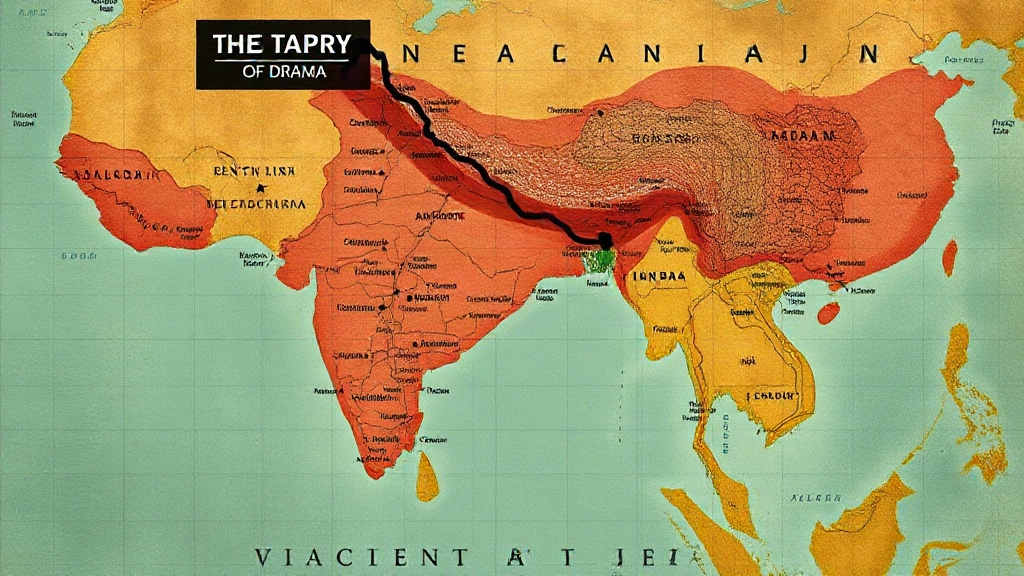
The classical Sanskrit dramas of the first millennium are frequently analyzed for their complex aesthetics, their courtly politics, and their contribution to the theory of rasa (aesthetic flavor). However, these texts also function as highly structured geographic records. When playwrights such as Bhasa and Kalidasa mapped the journeys of their characters, they did not rely purely on mythical geography. Instead, they traced routes that aligned with the physical road networks, riverine corridors, and trade hubs of early historic India.
By comparing the literary itineraries of these plays with archaeological site reports from the Archaeological Survey of India (ASI), researchers can observe a precise overlay. The movements of messengers, merchants, and exiled kings in classical literature reflect the practical realities of travel and trade during the Maurya, Kushan, and Gupta eras.
The Cloud Messenger's Path: Kalidasa’s Meghaduta
In the Meghaduta (The Cloud Messenger), a lyric poem composed by Kalidasa around the fifth century CE, an exiled yaksha (nature spirit) asks a passing cloud to carry a message north to his wife in the Himalayan city of Alaka. The route Kalidasa prescribes for the cloud is remarkably specific. Rather than directing the cloud in a straight northern line from Central India, the poet instructs it to take a deliberate western detour.
The cloud begins its journey from Ramagiri (often identified by historians as Ramtek near Nagpur) and travels north-west toward Vidisha and Ujjayini (modern Ujjain). This detour matches the established trade routes of the period. Vidisha was a major metropolitan center located at the junction of the north-south trade route, the Dakshinapatha (southern highway), and the east-west route connecting the Gangetic plain to the ports of Gujarat.
Kalidasa’s insistence that the cloud visit Ujjayini—even though it adds length to the journey—reflects the economic preeminence of the city during the Gupta period. Archaeological excavations at Ujjain have revealed extensive defensive walls, rich deposits of Northern Black Polished Ware, and punch-marked coins, confirming its status as a premier trade emporium. The literary detour of the cloud mirrors the physical detour that merchants took to trade precious stones, spices, and textiles in the markets of Avanti (the ancient region of western Malwa).
Bhasa’s Urban Centers and the Uttarapatha
Writing several centuries earlier, the playwright Bhasa, whose works include Charudatta (The Story of Charudatta) and Pratijnayaugandharayana (The Vows of Yaugandharayana), set his dramas within bustling urban landscapes. These plays are populated by merchants, courtesans, cart-drivers, and night watchmen, offering a view of city life that is deeply grounded in the geography of northern India.
In Bhasa’s plays, the city of Ujjayini again serves as a central hub. The characters frequently reference travels along the Uttarapatha (northern highway), the major transcontinental trade route that stretched from Taxila in the far northwest, through the Gangetic plains, down to the port of Tamralipti in Bengal.
The description of urban infrastructure in Bhasa’s plays—including the layout of market streets, the design of multi-story brick houses, and the presence of city walls—closely matches the archaeological records of cities along this highway. Excavations at sites like Bhita, Kaushambi, and Ahichchhatra show a transition from mud-brick to kiln-burnt brick architecture during the Kushan and Gupta periods, mirroring the prosperous domestic settings described in Bhasa's domestic comedies.
⚖ Scholarly Debate: Literary Imagination vs. Historical Accuracy
There is an ongoing scholarly debate regarding how literally we should interpret these literary itineraries.
On one side, philologists and historians argue that the geographical descriptions in classical Sanskrit drama are highly accurate representations of the contemporary landscape. They point out that playwrights wrote for highly educated, cosmopolitan audiences (nagaraka) who were familiar with travel and trade. Inaccurate geography would have broken the audience's sense of immersion. Therefore, the routes described must have been based on actual itineraries traveled by merchants and pilgrims.
On the other side, some scholars suggest that these texts present an idealized, traditional geography. They argue that certain places are included not because they were active trade centers during the playwright's lifetime, but because they held deep mythological and historical prestige. In this view, the routes are literary constructs that merge contemporary knowledge with inherited poetic conventions, rather than precise travel guides.
Mapping the Tangible Past
Despite these debates, the physical evidence uncovered by archaeologists continues to support the basic layout of the literary routes. The distribution of Roman pottery, clay sealings, and coin hoards across Central India confirms that the towns mentioned by Kalidasa and Bhasa were indeed bustling nodes in a global network connecting the Mediterranean world with East Asia.
By reading classical dramas alongside archaeological excavation reports, we gain a more grounded understanding of both the literature and the land. The routes of the Meghaduta and the cities of Bhasa show that the ancient Indian literary imagination was deeply anchored in the dust, brick, and commerce of the physical world.
Sources and Further Reading
For those interested in exploring classical Sanskrit drama and its historical context, scholars and readers often discuss these plays and their geographic settings in educational forums: