The Etymology of Empire: Linguistic Shifts in 16th-Century Deccan Statecraft
After the 1565 Battle of Talikota, Deccan inscriptions reveal a shift from traditional Vijayanagara terminology to Persianized administrative titles, marking a new era of hybrid statecraft.

Asha Naidu for SwavedaJuly 23, 2026
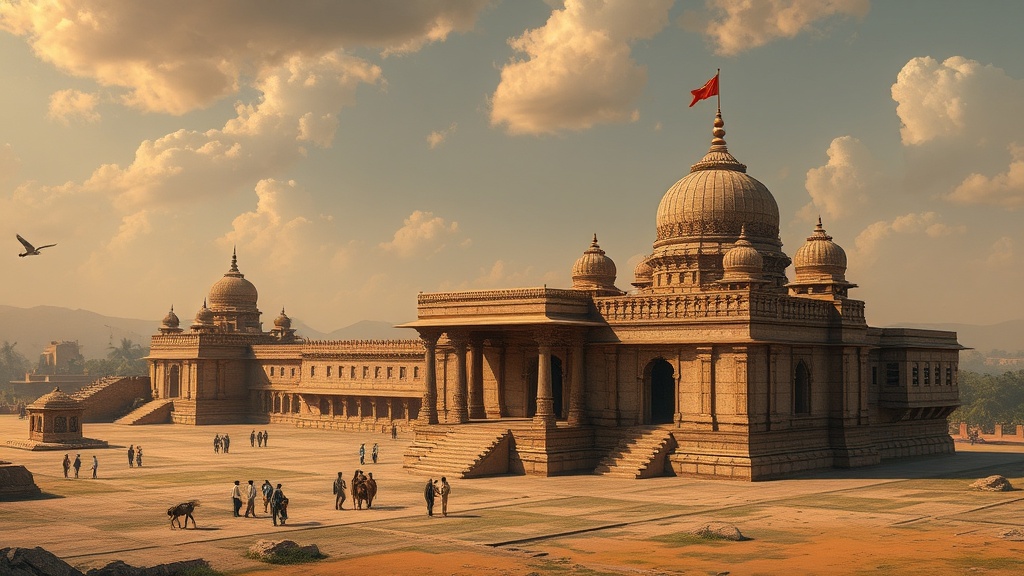
Language is a fossil record of power. When a political structure collapses, the vocabulary of governance rarely survives the transition intact. In the Deccan, the cataclysmic Battle of Talikota in 1565 serves as a sharp linguistic fault line. Before this engagement, inscriptions across the Vijayanagara Empire utilized a distinct vocabulary to describe local authority; after the decline of the central Hampi state, epigraphy begins to show an integration of Sultanate-influenced administrative terminology.
The term Nayaka (military governor) serves as a primary case study in this evolution. In the Vijayanagara system, a Nayaka was a high-ranking official granted land, known as nayankara (a land-assignment system for military support), in exchange for military service and tribute. The word itself is rooted in the Sanskrit nāya, meaning a leader or guide. Epigraphic records from the peak of Vijayanagara power consistently position the Nayaka as a subordinate yet essential node in a hierarchical network that derived its legitimacy from the Raya (emperor) at Hampi.
As the authority of the Aravidu dynasty fractured following the defeat at Talikota, the administrative landscape of the peninsula decentralized. Scholars debate the extent to which this shift represents a direct rupture in statecraft, but the epigraphic evidence points to a gradual adoption of hybrid terminologies. As localized powers emerged, they often sought to bolster their regional authority by adopting titles that resonated with the prestige of the surrounding Deccan Sultanates.
The Linguistic Pivot
Inscriptions from the late 16th and early 17th centuries show a distinct shift. Where earlier grants relied on the Nayaka framework, later records begin to intersperse these terms with Persian-derived administrative language. This was not a sudden replacement of vocabulary, but a pragmatic absorption. The administrative needs of the post-Talikota era required a way to communicate authority to a populace now navigating a fragmented political geography.
The shift is evident in the transition of land-tenure terminology. While the nayankara system remained a persistent model for land management, documents began to reflect the influence of Sultanate revenue systems. The use of terms like faujdari (a jurisdiction headed by a faujdar, or military/police officer) or diwani (relating to the office of the diwan, or finance minister) appears with greater frequency in the transition zones between the remnants of the empire and the encroaching Sultanate bureaucracies.
Interpreting the Epigraphic Record
Historians distinguish between the formal Sanskritized court language of the earlier Vijayanagara period and the more functional, multilingual epigraphy of the successor states. Tradition holds that the Vijayanagara state remained a bastion of classical tradition, yet the linguistic evidence shows a more adaptive reality.
The Battle of Talikota accelerated these trends, forcing regional governors to pivot toward the political reality of the Deccan Sultanates. As noted by historian Richard Eaton, the period was characterized by a "social synthesis" where the military and administrative technologies of the Persianate world were seamlessly integrated into the existing local structures. Because the centralizing force of the Vijayanagara throne was diminished, local Nayakas became autonomous power brokers. Their need to manage revenue and local administration meant incorporating the standardized Persian administrative registers that were becoming the lingua franca (a common language used for trade or communication between groups) of regional governance across the Deccan plateau.
Understanding the Vocabulary of Rule
To grasp this shift, one must look at how titles changed function. A title was never just a label; it was a compact between the ruler and the ruled. In the pre-1565 period, the title of Nayaka defined a relationship based on the amaram (a specific land grant provided for the maintenance of troops). Evidence shows that even as the political entity of Vijayanagara faded, the structure of the Nayaka land grant persisted for generations.
However, the labels used to describe the officials managing these grants began to mirror the administrative language of their neighbors. As Sanjay Subrahmanyam suggests in his analysis of political culture, these linguistic borrowings were a strategic choice, reflecting the fluidity of boundaries in the pre-modern Deccan. This is a classic example of linguistic convergence—where different languages and political cultures share administrative tools despite being in competition.
While scholars debate the specific nature of this transition—whether it was an act of survival or a genuine transformation of state identity—the inscriptions themselves are unambiguous. The late 16th century saw the erosion of a monolithic linguistic state. In its place emerged a vernacular administration that drew from two distinct, yet increasingly overlapping, traditions. By tracing the decline of purely Sanskrit-derived titles and the rise of Persian-influenced bureaucracy, we see how the map of the Deccan was rewritten not just by the sword, but by the pen. The terminology of the Nayaka did not die; it simply learned to speak a new language of authority.