The Etymology of Cotton: What Sanskrit 'Karpāsa' and Hebrew 'Karpas' Reveal About Early Indian Ocean Trade
How a word for cotton traveled from ancient Austroasiatic speakers to Sanskrit and the Hebrew Bible, mapping the oldest maritime trade routes of the Indian Ocean.

Asha Naidu for SwavedaAugust 29, 2026
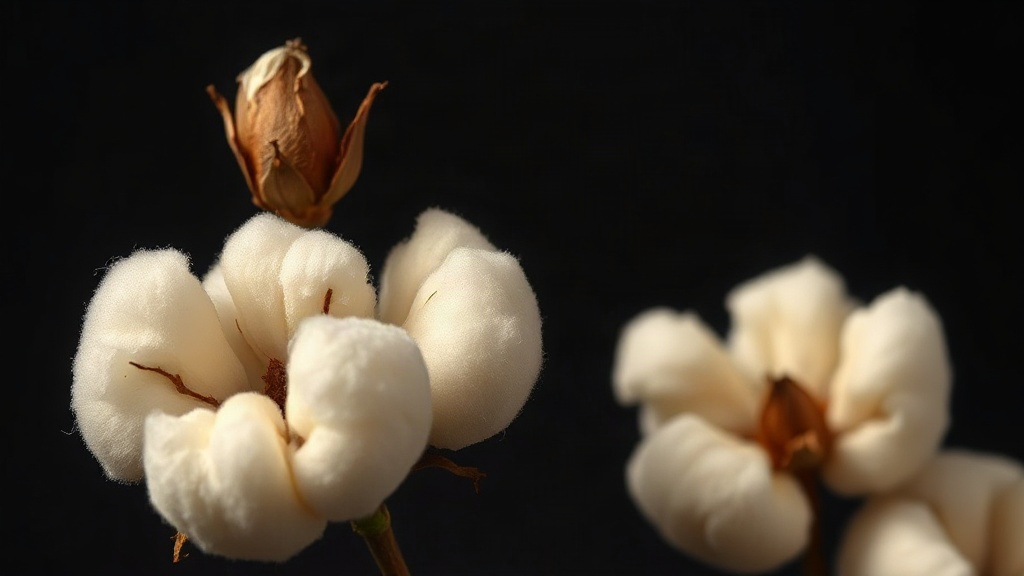
The global trade of Indian textiles is often treated as a story of the modern era, dominated by the East India Companies of Europe. Yet the earliest chapter of this trade is preserved in the very words we use to describe cotton. By tracking how a single botanical term traveled across language families, historical linguists and archaeologists have mapped an ancient, highly active maritime trade network that linked the fields of India to the palaces of the ancient Near East.
At the center of this linguistic journey is the Sanskrit word karpāsa (cotton) and its Hebrew equivalent, karpas (fine linen or cotton). The path these words traveled reveals a deep history of prehistoric technology transfer, regional tribal exchanges, and long-distance sea trade.
The Austroasiatic Roots of Indian Cotton
Before cotton became an item of international commerce, it had to be domesticated and named. Archaeological evidence shows that cotton (Gossypium) was cultivated very early in the Indian subcontinent. Cotton thread residues discovered at Mehrgarh in modern Pakistan date back to the sixth millennium BCE, preserved inside copper beads.
However, the names used for cotton in historical Indian languages do not originate from Indo-European roots. Instead, historical linguists trace the Sanskrit word karpāsa to Austroasiatic languages, a family spoken by indigenous groups in South and Southeast Asia, including the Munda peoples of central and eastern India.
In Austroasiatic tongues, words for cotton are often built around the root kapas. For instance, in Austroasiatic languages like Sakai, the word is gapas, and in Semang, it is kāpas. Linguists believe that early Indo-Aryan speakers, migrating into the subcontinent, borrowed this word from local Austroasiatic-speaking cultivators. The borrowing process added a Sanskrit suffix and phonetic styling, turning the regional Austroasiatic kapas into the formal Sanskrit karpāsa. This linguistic adoption indicates that the incoming Indo-Aryan groups learned cotton cultivation directly from the established agrarian populations of the subcontinent.
⚖ Scholarly Debate: Indo-Aryan Origins and Regional Contact
The nature of the contact between Indo-Aryan speakers and indigenous populations remains a subject of intense academic investigation.
Evidence shows that the Rigveda, the oldest Indo-Aryan text, does not contain the word karpāsa. Instead, the word first appears in later Vedic literature, specifically the Sutras, such as the Gautama Dharmasutra. This delayed appearance suggests to many linguists that Indo-Aryan speakers did not bring cotton technology with them.
Under the widely discussed Indo-Aryan Migration theory, pastoralist groups from the Central Asian steppes entered the subcontinent in the second millennium BCE, gradually absorbing local technological vocabularies, including agricultural terms for indigenous crops like cotton.
Conversely, proponents of indigenous Aryan models, or the Out-of-India hypothesis, suggest that Indo-Aryan languages are native to the subcontinent. Scholars supporting this view argue that the absence of cotton vocabulary in early texts is a matter of literary genre rather than historical absence. They argue that early texts focused on pastoral rituals, while agricultural technologies like cotton weaving were localized industries that only gained literary representation as administrative and legal texts developed later.
Regardless of the migration models, linguists generally agree that karpāsa represents an early borrowing from non-Indo-Aryan sources, reflecting a multi-ethnic, multilingual network of trade and technology sharing within ancient India.
The Journey Westward: From Sanskrit to Hebrew
As Indian merchants began exporting textiles westward across the Arabian Sea, the name of the fiber traveled with the goods.
Through maritime trade routes managed by Phoenician, South Arabian, and Babylonian merchants, Indian cotton textiles reached the Persian Gulf and the Levant. Along this route, the Sanskrit karpāsa entered the Semitic languages.
The most famous evidence of this linguistic export appears in the Hebrew Bible. In the Book of Esther (1:6), which describes the opulence of the palace of the Persian king Ahasuerus in Susa, the text details hangings of white cotton and blue material. The Hebrew word used for this luxurious fabric is karpas (כַּרְפַּס), translated in various contexts as green hangings, fine linen, or cotton.
Linguists have confirmed that karpas is not a native Semitic word. It is a direct loanword from the Sanskrit karpāsa. Its presence in a Persian court setting described in the Hebrew Bible highlights that Indian cotton was prized as an exotic, high-status luxury item in the imperial centers of the Near East during the mid-to-first millennium BCE.
Archaeological Corroboration of the Maritime Route
This linguistic trail is supported by physical discoveries along the Indian Ocean trade rim. Archaeological excavations have uncovered Indian cotton textiles at several ancient Near Eastern and Egyptian sites.
At the site of Al-Ghurayfah in Saudi Arabia, archaeologists identified cotton fibers dating to the late first millennium BCE. Similarly, excavations at the Red Sea port of Berenike have yielded massive quantities of Indian-made sailcloth and textiles, confirming that Indian cotton was systematically shipped across the ocean.
By tracing the word karpāsa from the tribal forests of central India, through the refinement of Sanskrit literature, and finally onto the luxury inventory lists of Persian kings in Susa, we see a clear picture of India's early global integration. Long before modern shipping lanes were mapped, a humble Austroasiatic word for a seed fiber had already traveled thousands of miles, leaving its permanent mark on the languages of the ancient world.