The Dwaraka Excavations: What Marine Archaeology Shows About the Submerged City of the Mahabharata
A comparison of the textual description of Dwaraka's submergence in the Mahabharata with the archaeological findings of stone anchors and structures off the coast of Gujarat.

Vikram Joshi for SwavedaSeptember 1, 2026
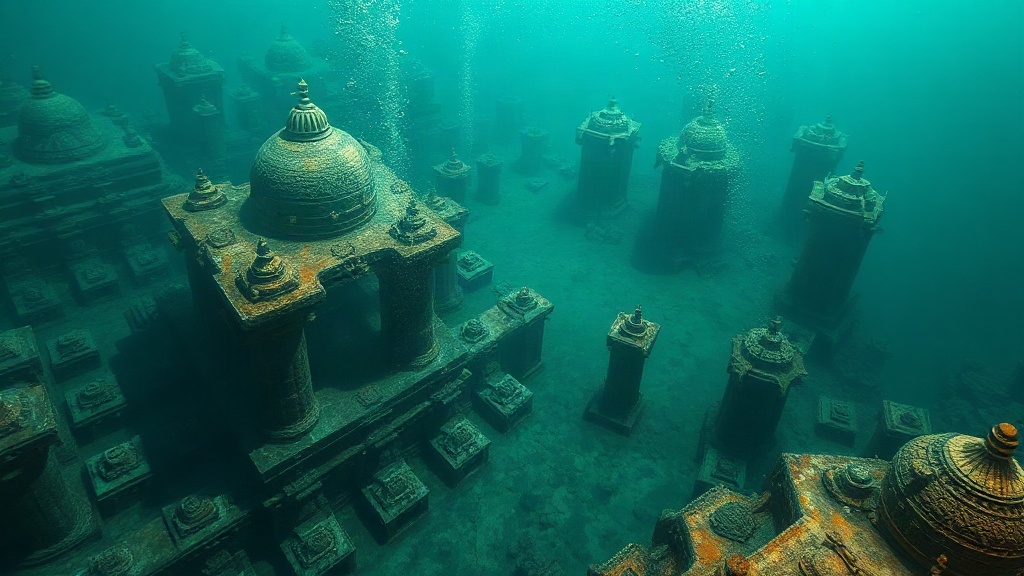
The coast of Dwarka in Gujarat represents a unique intersection of Indian literary tradition and marine archaeology. In the Mausala Parva ("Book of the Clubs"), the sixteenth book of the Mahabharata (a major ancient Sanskrit epic), the text describes the sudden engulfment of the sacred city of Dwaraka by the rising sea. According to the translation by K.M. Ganguli, the ocean rose to swallow the city, covering its mansions and streets as Arjuna and the surviving citizens watched.
For decades, underwater archaeologists have sought to investigate whether this literary event corresponds to physical ruins on the seabed of the Arabian Sea. Investigations led by the Archaeological Survey of India (ASI) and the National Institute of Oceanography (NIO) have recovered tangible material culture from the waters off modern Dwarka and nearby Bet Dwarka. However, a significant chronological gap remains between the traditional dates assigned to the epic and the actual antiquity of the recovered artifacts.
The Textual Tradition of Submergence
In the Mausala Parva ("Book of the Clubs"), the submergence is depicted as an inevitable natural event following the departure of Krishna. The text states that the sea, which had been beating against the shores, suddenly rushed into the city, submerging everything but the temple of the deity.
To evaluate this account, marine archaeologists have focused on two primary locations: the waters directly off the temple town of Dwarka, near the mouth of the Gomti River, and the island of Bet Dwarka, located about 30 kilometers to the north. These locations are central to the geography of the Krishna legend.
Archaeological Findings and Material Culture
Systematic underwater explorations began in the 1980s under the leadership of archaeologist S.R. Rao of the NIO. The investigations revealed a range of submerged structures, including dressed stone blocks, circular bastions, and a large collection of stone anchors.
According to research published by the National Institute of Oceanography, the most common artifacts found in the Dwarka waters are triangular and three-holed trapezoidal stone anchors. These anchors were fashioned from sandstone and limestone. Similar anchors have been documented across the western Indian Ocean, particularly in the Mediterranean and the Red Sea. Marine archaeologists from the NIO, writing in the Current Science journal, note that these stone anchors served as heavy mooring devices for ancient and medieval merchant vessels navigating the busy trade routes of the Arabian Sea.
On the island of Bet Dwarka, onshore and intertidal excavations yielded different categories of material culture. Archaeologists recovered protohistoric pottery, including Lustrous Red Ware, along with copper objects and a small seal made of conch shell. These discoveries indicate that Bet Dwarka was an active port and trading post.
The Chronological Divergence
While the physical existence of submerged structures and maritime artifacts is verified, dating these objects presents a challenge to traditional historical frameworks. Many traditional accounts and astronomical calculations place the events of the Mahabharata and the submergence of Dwaraka in the late fourth millennium BCE, specifically around 3102 BCE.
The archaeological data, however, indicates a much later timeline. The stone anchors recovered from the Dwarka seabed are typologically similar to those used in the late Bronze Age and early historical periods. Scholars publishing in Current Science suggest that the marine installations and anchors off Dwarka date between the 15th century BCE and the historical period, extending up to the medieval era.
The pottery and shell artifacts from Bet Dwarka are dated to the late Harappan or post-Harappan transition, roughly corresponding to 1500–1200 BCE. No archaeological evidence recovered from the seabed or the intertidal zones points to a major urban center dating to 3100 BCE.
Interpreting the Submerged Ruins
The presence of submerged structures off the Gujarat coast is often explained by natural sea-level fluctuations and coastal erosion. Marine geologists and archaeologists have documented that the shoreline of western India has shifted significantly over the millennia.
Evidence shows that several structures near the modern shoreline, including ancient temples and ghats (steps leading to a river or body of water), were gradually reclaimed by the sea due to coastal storms, tectonic activity, or rising sea levels. The submerged blocks found off Dwarka are interpreted by many contemporary archaeologists as the remains of ancient harbor installations, jetty walls, or temples damaged by coastal encroachment rather than a massive, single cataclysmic event that destroyed an entire metropolis in the fourth millennium BCE.
The archaeological record demonstrates that Dwarka was a thriving center of maritime trade, interacting with regions across the Arabian Sea for over two thousand years. The poetic description in the Mausala Parva ("Book of the Clubs") may well preserve the memory of a real coastal encroachment or tsunami that impacted these ancient ports, which was later integrated into the narrative of the epic.
By distinguishing the recited epic tradition from the physical artifacts recovered from the seafloor, researchers continue to reconstruct a highly detailed picture of early Indian seafaring, port construction, and maritime trade along the western coast.