The Digital Concordance: How Mahadevan’s 1977 Grid is Reorganizing Tamil Nadu’s Iron Age Potsherd Debate
The digitization of Iravatham Mahadevan’s landmark 1977 concordance provides archaeologists with a standardized tool to evaluate disputed graffiti marks on Iron Age black-and-red ware.

Rohan Bhattacharya for SwavedaAugust 14, 2026
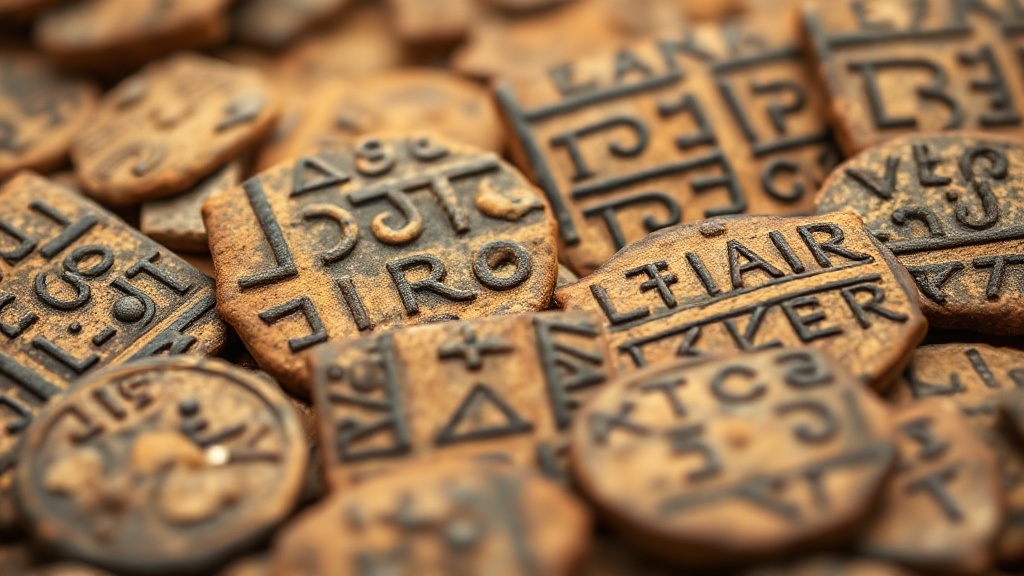
In the excavation of Iron Age cemetery sites across Tamil Nadu, from the sandy urn fields of Adichanallur to the industrial workshops of Kodumanal, the most common finds are often the most frustrating. Among the assemblages of black-and-red ware—a type of pottery fired in a dual-atmosphere kiln to produce a dark interior and a reddish exterior—archaeologists routinely find post-firing scratches known as graffiti marks.
For over a century, these marks have occupied a disputed territory in Indian archaeology. Some scholars view them as a precursor to the Tamil-Brahmi script (the earliest regional alphabet), others see them as degenerate Indus Valley signs, and a conservative school views them as simple owner marks or clan symbols. The debate has long suffered from a lack of comparative systematics. Without a standardized, universally accepted corpus, one researcher's "fish sign" is another's accidental cross-hatching.
The challenge of organizing these fragmented scratchings has received a new tool. The digitization of Iravatham Mahadevan’s landmark 1977 work, The Indus Script: Texts, Concordance and Tables, has been completed and made available online through Harappa.com. This digital resource provides epigraphists and archaeologists with the standardized sign-list and grid system needed to rigorously analyze and compare the graffiti of the southern Iron Age with northern proto-historic scripts.
The Problem of the Potsherd
In publications like Antiquity, Puratattva, and the memoirs of the Archaeological Survey of India (ASI), the reporting of graffiti marks has historically been highly subjective. Excavators draw the marks by hand, publish them as line art in site reports, and offer localized interpretations.
The primary difficulty lies in distinguishing between an intentional, linguistic sign and a casual doodle. In stratigraphy, a secure context is everything. When a potsherd is recovered from a sealed trench, its depth and association with organic material can establish its age through radiocarbon dating. However, the meaning of a mark scratched onto that potsherd after it was fired remains unreadable without a comparative index.
Mahadevan, a civil servant turned epigraphist, published his concordance in 1977 to resolve a similar structural problem for the Indus script. He organized thousands of inscribed objects into a systematic grid of 417 distinct signs. By assigning a stable numerical code to each sign, Mahadevan allowed researchers to discuss the same symbol using the same identifier, regardless of regional variations in execution.
The new digital version of this concordance, developed by Rajesh Rao of the University of Washington in collaboration with Harappa.com, translates Mahadevan's paper-bound grid into an interactive database. For researchers working on the southern Iron Age, this digital tool offers a method to test old theories with statistical precision.
The Indus Connection and Southern Stratigraphy
The debate over whether southern graffiti marks are related to the Indus script is old and deeply polarized. In the early-to-mid 20th century, archaeologists like G.R. Hunter and B.B. Lal argued that a significant percentage of the symbols found on megalithic—meaning large-stone monument—pottery in South India shared a common morphology with Indus signs.
Tradition holds among some regional historians that these marks represent a direct migration of literate communities from the collapsing Harappan urban centers to the southern peninsula. However, evidence shows that a large chronological gap exists between the decline of the Indus cities and the flowering of the South Indian Iron Age.
By using the digitized Mahadevan concordance, researchers can now bypass subjective visual matching. Instead of claiming a mark "looks like" a specific Indus sign, scholars can map the precise stroke order, positional frequency, and pairing patterns of southern graffiti against the computerized Indus database.
For instance, the "jar" sign (Sign 311 in Mahadevan's list) is the most common character in the Indus script. If southern graffiti marks were truly a continuation of the Indus writing system, one would expect to see Sign 311 appearing in similar structural positions—such as terminating sequences—on the black-and-red ware of Tamil Nadu. Preliminary quantitative comparisons, however, suggest that the southern marks behave differently, occurring mostly as single signs rather than in the complex, multi-sign sequences characteristic of the Indus seals.
Standardizing the Finds at Kodumanal and Adichanallur
The need for a rigid digital index is particularly acute when analyzing sites like Kodumanal in the Erode district. Excavations directed by K. Rajan and reported in journals like Man and Environment revealed a major industrial center specializing in gemstone bead-making and iron smelting. The site yielded hundreds of potsherds inscribed with both Tamil-Brahmi letters and non-alphabetic graffiti.
At Kodumanal, graffiti marks and Tamil-Brahmi script sometimes appear on the same vessel. This co-occurrence raises critical questions: Were the graffiti marks a parallel system of communication used by illiterate potters, or did they serve a separate functional purpose, such as indicating capacity or kiln batches?
By applying the digital concordance grid to the Kodumanal corpus, researchers can systematically document which signs are restricted to graffiti and which ones transition into formal Tamil-Brahmi letters. The digital format allows for rapid cross-referencing with other major southern sites, such as the coastal port of Arikamedu and the inland burial sites of Adichanallur.
Rather than relying on isolated site reports, epigraphists can now run queries to determine if a specific three-stroke mark from an urn burial at Adichanallur matches the exact structural grid of a mark found on a domestic hearth vessel at Kodumanal.
A Skeptical View of the Signs
Despite the utility of the digital concordance, many archaeologists remain skeptical of any attempts to read linguistic meaning into these simple geometric marks. In the pages of Puratattva, the consensus has leaned toward viewing most graffiti as non-linguistic. A simple trident, a star, or a pair of intersecting lines can easily be invented independently by different cultures separated by thousands of kilometers and centuries of time.
The digitization of Mahadevan's 1977 work does not solve the question of what these marks mean. What it does, however, is remove the logistical barrier to systematic study. By organizing the scattered fragments of Tamil Nadu's Iron Age pottery under a single, searchable taxonomy, the digital concordance allows researchers to treat these scratched lines not as isolated mysteries, but as data points in a broader, structured landscape.