The Brahmi Keyboard: Reconnecting with Ancient India's Written Past
An Android keyboard for the Brahmi script, ancestor to many South Asian writing systems, aims to bridge ancient history and modern technology, making India's linguistic heritage more accessible.
Asha Naidu for SwavedaJuly 13, 2026
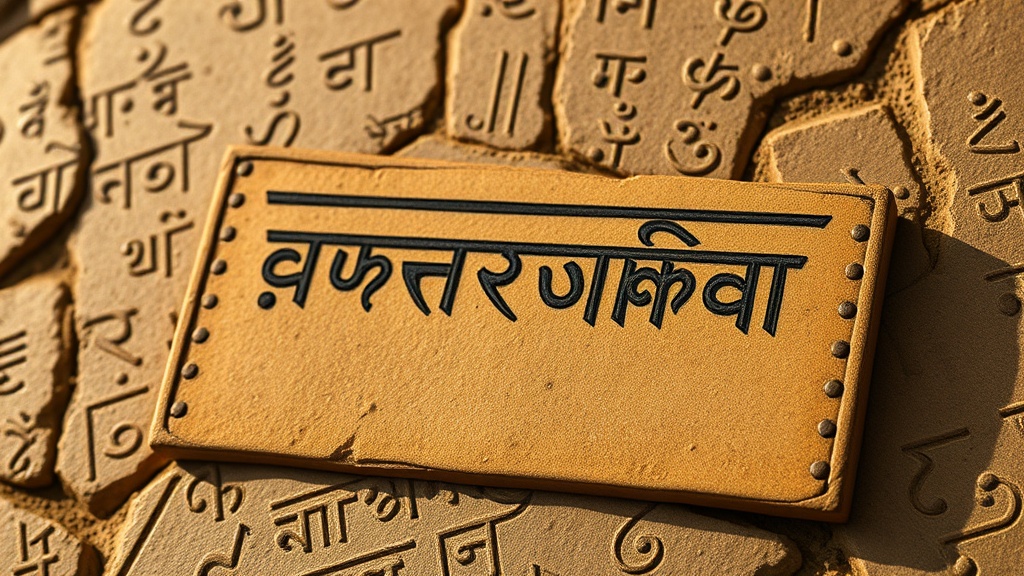
The whisper of history often arrives in unexpected forms. For many, it is the rustle of ancient manuscripts or the hushed reverence of archaeological sites. For others, it might be the tap-tap-tap of fingers on a smartphone screen. The development of an Android keyboard for the Brahmi script seeks to unite these seemingly disparate worlds, offering a tangible connection to India's deep linguistic past through contemporary technology.
Brahmi is not merely an ancient script; it is the progenitor of a vast family of writing systems that continue to flourish across South Asia today. From the Devanagari used for Hindi and Sanskrit to the Bengali, Gurmukhi, Gujarati, Odia, Telugu, Kannada, Tamil, and Sinhala scripts, their roots intertwine with Brahmi. This ancient script, dating back to at least the 3rd century BCE, was instrumental in the dissemination of early Buddhist and Jain texts, as well as royal edicts inscribed on pillars and rocks by emperors like Ashoka. To engage with Brahmi is to engage with the foundational layers of India's written heritage.
The challenge in creating a Brahmi keyboard for modern devices lies in translating a script designed for carving on stone or inscribing on palm leaves to a digital interface optimized for touchscreens and limited display real estate. Unlike the flowing, cursive nature of many modern South Asian scripts, Brahmi characters can be angular and sometimes require precise placement of diacritics (vowel signs and other modifiers).
A key consideration for any script's digital representation is its encoding. For Brahmi, this means aligning with the Unicode standard, a universal system for representing text on computers. The Unicode Consortium has assigned specific code points to Brahmi characters, allowing them to be recognized and displayed across different devices and software. Without this standardization, a Brahmi character typed on one phone might appear as a jumble of symbols on another.
The technical hurdles extend to the user experience. Designing a keyboard layout requires balancing ease of input with completeness of character representation. Early attempts or informal digital renditions of Brahmi often suffered from incomplete character sets or awkward input methods, making them impractical for widespread use. A well-designed keyboard must offer intuitive access to the full range of Brahmi letters and their common modifiers.
For instance, the primary consonants in Brahmi, such as ‘k’ (ka), ‘t’ (ta), and ‘p’ (pa), form the basis of the script. However, the vast majority of written words utilize conjunct consonants, where two or more consonants are combined to form a single unit, or vowels that are not at the beginning of a word. Rendering these correctly on a digital screen is complex. A keyboard application must intelligently predict and insert these conjuncts or medial vowels based on user input, a process that draws parallels with the auto-correction and predictive text features familiar to smartphone users today.
The act of typing in Brahmi on a smartphone is more than just an exercise in digital input. It is an act of historical reclamation and cultural affirmation. For scholars, researchers, and students of ancient Indian history and linguistics, such a tool provides unprecedented access to primary source materials. Epigraphic inscriptions, early manuscripts, and scholarly texts that were once accessible only to those with specialized knowledge and the ability to read them in their original script can now be more readily explored and analyzed.
Consider the Ashoka pillars, bearing edicts in various Prakrit languages written in Brahmi script. While translations exist, direct engagement with the original script offers a deeper understanding of the nuances of language and historical context. A Brahmi keyboard allows individuals to type out these inscriptions, compare them with transliterations, and perhaps even contribute to ongoing decipherment efforts or the creation of new digital archives.
Beyond academic pursuits, the Brahmi keyboard has the potential to foster a broader public connection with India's ancient past. It democratizes access to a fundamental element of cultural heritage. Imagine individuals tracing their lineage through historical documents, or engaging with ancient literature in its original written form. This technology can make abstract historical concepts feel more immediate and personal.
The origin of the word "keyboard" itself hints at its function: a board of keys. In the context of Brahmi, these keys unlock not just letters, but pathways to millennia of thought, governance, and culture. The Brahmi script emerged during a period of significant intellectual and social change in ancient India, serving as a vital medium for the spread of new ideas and religious traditions. Its digital revival on a device held in the palm of one's hand represents a remarkable arc of history.
The development of such applications is often a collaborative effort. Linguists, epigraphers, software developers, and user interface designers must work in concert. Early versions might focus on a core set of characters and common conjuncts, with later iterations expanding functionality based on user feedback and linguistic scholarship. The goal is not merely to replicate the script but to create a usable, efficient, and historically informed digital tool.
As technology continues to evolve, so too will the possibilities for engaging with ancient scripts. Projects that bring Brahmi, or indeed any script of historical significance, to modern digital platforms are invaluable. They serve as a reminder that history is not a static entity confined to museums and textbooks, but a living, evolving legacy that can be reanimated through innovation and accessibility. The Brahmi keyboard, in its quiet digital way, is a significant step in that ongoing process, connecting the whispers of the past with the hum of the present.