The Black-and-Red Ware of Adichanallur: What the Iron Age Kiln Stratigraphy at Mound B Reveals About Southern Pyrotechnology
Excavations by the Archaeological Survey of India at Adichanallur's Mound B reveal well-preserved Iron Age kilns, shedding light on the complex firing techniques behind black-and-red ware.

Rohan Bhattacharya for SwavedaSeptember 2, 2026
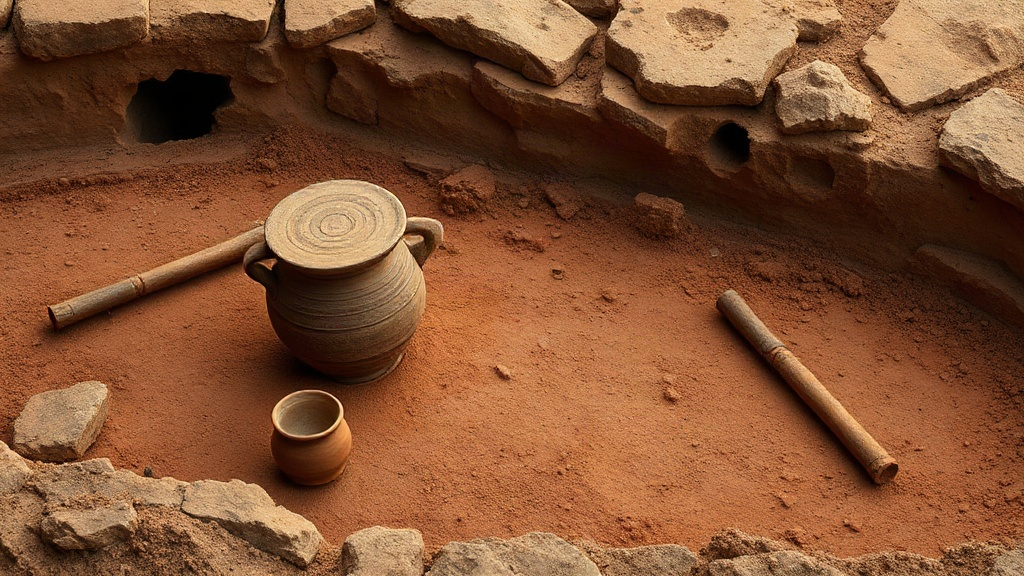
The dry, wind-swept urn burial site of Adichanallur in the Thamirabarani valley of Tamil Nadu has long been central to debates surrounding the antiquity of the South Indian Iron Age. While early twentieth-century excavations focused heavily on retrieving spectacular grave goods—such as gold diadems, bronze figurines, and iron weapons—modern stratigraphic analysis offers a far more grounded understanding of the communities that occupied this landscape. Recent excavations conducted by the Archaeological Survey of India (ASI) at Mound B have shifted attention from the burials themselves to the domestic and industrial areas of the site, exposing a series of well-preserved potters' kilns. These structural remains provide direct physical evidence of the pyrotechnology behind black-and-red ware, a highly distinctive ceramic type of protohistoric South India.
The Stratigraphy of Mound B
In the discipline of archaeology, the systematic study of soil layers, known as stratigraphy, is crucial for establishing relative chronology. At Adichanallur's Mound B, ASI archaeologists uncovered a clear sequence of occupational deposits that run adjacent to the extensive urn burial fields. The excavations revealed that the site was not merely a cemetery, but a multi-functional settlement with active workshop zones.
Within the lower occupational levels, researchers identified circular clay structures lined with burnt earth, vitrified potsherds, and thick layers of ash and charcoal. These features have been identified as updraft kilns used for firing local earthenware. The stratigraphic relationship between these kilns and the surrounding burial urns suggests that pottery production was conducted concurrently with the mortuary practices at the site. Rather than importing vessels from distant manufacturing centers, local artisans produced the large, coarse red-ware burial urns and the fine black-and-red ware vessels on-site.
Firing the Black-and-Red Ware
The most technically demanding product of these kilns was black-and-red ware. This pottery is characterized by a lustrous black surface on the interior and the upper rim, while the exterior body of the vessel is a bright red. This dual coloration is not the result of using two different slips (liquid clay mixtures used to coat pottery). Instead, it is the product of a sophisticated firing technique known as inverted firing.
During this process, potters placed the vessels upside down in the kiln. The interior of the pots, along with the rims, was packed with organic matter such as husks, dung, or leaves, which excluded oxygen during firing. As the temperature rose, this organic material charred, creating a localized reducing atmosphere (an oxygen-poor environment) inside the vessel. This reduction converted the iron oxides in the clay slip to black magnetite, turning the interior black. Meanwhile, the exterior of the vessel remained exposed to the circulating air within the kiln. This oxidizing atmosphere (an oxygen-rich environment) allowed the iron in the clay to oxidize fully, resulting in a vibrant red color.
The kilns excavated at Mound B demonstrate how ancient potters managed these draft conditions. The presence of slag, vitrified clay linings, and ash lenses indicates that the kilns were designed to reach and maintain the high temperatures necessary to fuse the slips and achieve the characteristic metallic ring of high-quality black-and-red ware.
⚖ Scholarly debate: The Chronological Puzzle
While the technological aspects of the Adichanallur pottery are well-documented, the absolute dating of the site remains a subject of intense scholarly debate. Establishing a precise timeline for the transition from the Megalithic (large stone monument) phase to the early historic period in Tamil Nadu relies heavily on radiocarbon dating of organic material associated with these layers.
In reports published in journals such as Puratattva and the bulletin of the ASI, researchers have presented conflicting chronologies for Adichanallur. Early estimates, based primarily on typological comparisons of iron implements and pottery shapes with other sites in the Deccan, placed the site between 1000 BCE and 300 BCE.
However, carbon-14 dating of husks and organic remains retrieved from inside the burial urns has produced a wider range of dates. Some accelerator mass spectrometry (AMS) dates suggest that the earliest burials at Adichanallur could date back to the late second millennium BCE, potentially pushing the local beginning of the Iron Age as far back as 1500 BCE. Conversely, skeptical voices within the Archaeological Survey of India and independent academic circles urge caution. They note that carbon samples retrieved from disturbed burial contexts or shallow stratigraphy can easily be contaminated by younger organic carbon, leading to anomalous dates.
Furthermore, critics point out that many of the published dates lack the clear stratigraphic context required to tie them securely to specific technological phases, such as the introduction of the kilns at Mound B. Until a comprehensive, peer-reviewed series of stratigraphically secured AMS dates is published for all occupational layers of Mound B, the absolute timeline for Adichanallur's pyrotechnological development remains open to interpretation.
A Landscape of Production
The discovery of the Mound B kilns reframes our understanding of Adichanallur. Rather than viewing the site solely through the lens of ancestor worship and elaborate burial rites, the stratigraphic evidence forces us to consider the daily, messy realities of an industrial workspace. The potters of Adichanallur were master pyrotechnicians, managing complex kiln atmospheres to produce vessels that served both the living and the dead. The red and black vessels found inside the deep burial pits were not rare import goods; they were the direct products of the very soils and kilns now being mapped layer by layer.