The Barley of Burzahom: What New Paleobotanical Analyses Reveal About Neolithic Kashmir
A re-examination of soil flotation samples from the Kashmir Valley's earliest Neolithic levels challenges long-held assumptions about early crop choices, pointing to a localized preference for hardy barley.

Rohan Bhattacharya for SwavedaAugust 25, 2026
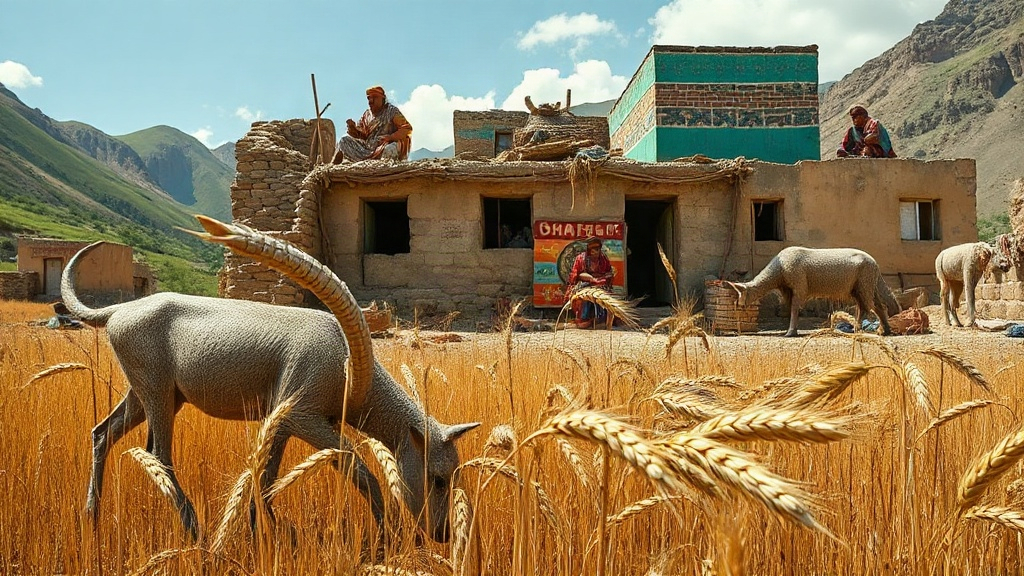
The archaeological site of Burzahom, situated on a Pleistocene terrace overlooking the Dal Lake in Kashmir, has long occupied a unique position in South Asian archaeology. Excavated systematically by the Archaeological Survey of India (ASI) under T.N. Khazanchi between 1960 and 1971, the site is famous for its subterranean pit-dwellings, polished stone axes, and bone tools. However, for decades, the precise agricultural choices of these early northern neolithic settlers remained poorly understood.
Traditional assumptions in South Asian prehistory often projected a reliance on wheat as the primary staple of early northern agriculture. Yet, recent paleobotanical reanalyses of soil flotation samples—the process of using water to separate charred organic remains from archaeological soil—are shifting this narrative. The earliest occupational deposits at Burzahom, dating to the aceramic (pottery-free) Neolithic period, show a clear, localized preference for barley (Hordeum vulgare) over wheat (Triticum). This preference points to a deliberate adaptation to the high-altitude, moisture-heavy lacustrine (lake-derived) clay soils of the Kashmir Valley.
The Stratigraphy of the Pit-Dwellers
In the reports of the Archaeological Survey of India, Burzahom is divided into four distinct occupational phases. Period I, the aceramic Neolithic, is defined by dwelling pits dug directly into the natural loessic silt—fine, wind-blown deposit. These subterranean structures, some circular and others rectangular, featured timber posts that supported thatched roofs.
Historically, dating disputes have surrounded the transition from these semi-subterranean pits to the mud-brick and stone architecture of Period II. Early radiocarbon dating in the mid-20th century suffered from broad margins of error. According to chronological assessments published in journals like Antiquity and Puratattva, the earliest occupation of Burzahom is now understood to settle firmly within the third millennium BCE, around 2900–2600 BCE.
For field archaeologists, the key to understanding how these pit-dwellers lived lies in the micro-stratigraphy of the pit fills. While early excavators focused on recovery of bone harpoons and polished celts (stone axes), the unspectacular layers of grey ash and charred organic matter at the bottom of these pits contain the real evidence of daily survival. It is within these deep, undisturbed hearth deposits that archaeobotanists have isolated the carbonized seeds of the valley's earliest crops.
Flotation Samples and the Barley Shift
In the early decades of Indian archaeology, paleobotanical recovery was rudimentary. Grains were mostly recovered when visible to the naked eye, a bias that favored larger seeds or dense concentrations. The introduction of systematic flotation techniques changed this landscape. By mixing soil samples from secure stratigraphic layers with water, lighter carbonized seeds float to the surface, allowing researchers to capture tiny weed seeds, chaff, and cereal grains.
When researchers re-examined flotation residues from the early levels of Burzahom, they discovered that the agricultural package was far from uniform. While wheat (Triticum aestivum and Triticum turgidum) was present in small quantities, the dominant cereal throughout the aceramic and early ceramic Neolithic levels was six-row hulled barley (Hordeum vulgare).
This finding challenges the older diffusionist models which assumed that the entire northern Neolithic complex was merely an eastern extension of the Near Eastern wheat-based agricultural package. Instead, the evidence shows a highly selective adoption of crops. The high ratio of barley to wheat grains indicates that the early inhabitants of Burzahom were making specific choices based on their immediate environment.
Adapting to the Lacustrine Clay
The preference for barley over wheat in the Kashmir Valley is deeply tied to the regional geology. The valley is filled with Karewa deposits—thick, lacustrine clay terraces formed by ancient lakes. These soils are heavy, retain high levels of moisture, and can easily become waterlogged during the spring snowmelt.
Physiologically, barley is a highly resilient crop. While wheat is sensitive to waterlogging and requires well-drained soils, certain varieties of barley tolerate damp, heavy soils and cold climates much more effectively. In the high-altitude microclimates of the Kashmir Valley, where frost can linger late into the spring, barley provided a more reliable yield.
Furthermore, the paleobotanical record from Burzahom, as discussed in publications like Man and Environment, reveals that the barley found in the earliest levels was fully domesticated, showing uniform grain size and non-brittle rachis—the stem that holds the grain, which in wild varieties shatters easily to disperse seeds. This suggests that the pit-dwellers were not experimenting with wild grasses but had arrived in the valley with an already domesticated agricultural toolkit, which they then tailored to the specific demands of the wetland margins.
The Broader Himalayan Network
The agricultural strategy of Burzahom was not isolated. Comparable Neolithic sites in the region, such as Gufkral, located southeast of Srinagar, show a matching stratigraphic and botanical sequence. In Gufkral’s Period IA (ceramic-free Neolithic), flotation samples similarly yielded high concentrations of barley alongside wild lentils and sheep-goat domesticates.
Scholars debate whether this barley-reliant economy was connected to trans-Himalayan trade routes. The presence of jadeite beads and harvest tools made of curved stone knives at Burzahom has led some researchers to suggest early contact with the Neolithic cultures of East Asia, such as those in the Sichuan and Gansu provinces, where cold-tolerant crops were also staple foods. However, the botanical evidence at Burzahom remains distinctly South Asian and West Asian in its genetic lineage, indicating that while cultural objects may have traveled across the mountain passes, the agricultural core of the valley was adapted from local and western domesticates.
Ultimately, the barley of Burzahom reminds us that the transition to farming was not a single, unstoppable wave of progress. It was a slow, sometimes clumsy process of trial and error, recorded not in spectacular golden treasures, but in the charred, microscopic remains of ancient dinners preserved in the damp clay of Kashmir.