Samarkand's Outskirts: What Ordinary People Ate and Wore (13th-15th Centuries)
Archaeological finds reveal the daily lives of common people on Samarkand's outskirts between the 13th and 15th centuries, focusing on their material culture.

Kavya Sharma for SwavedaJuly 13, 2026
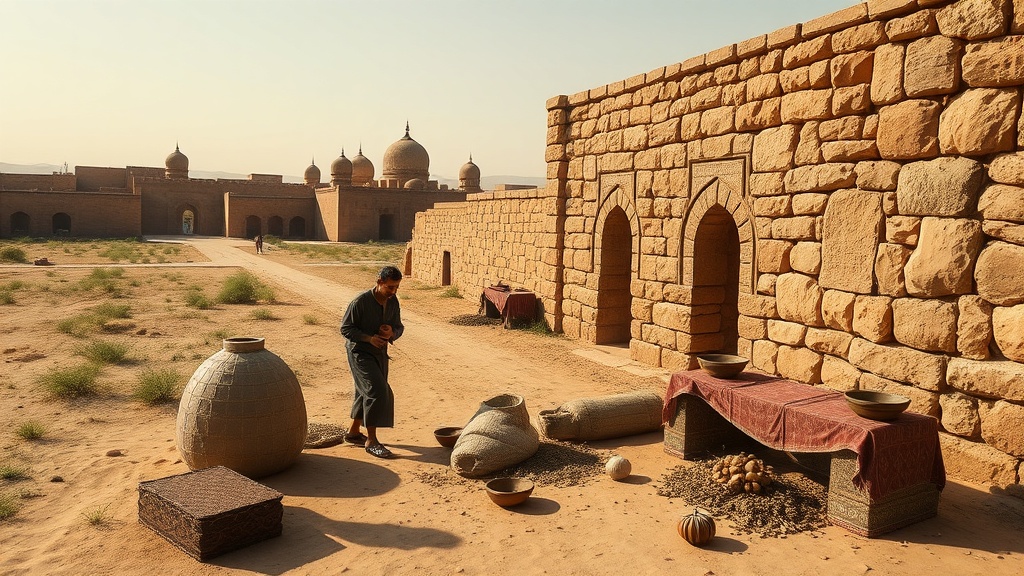
The name Samarkand conjures images of Tamerlane's grandeur, of turquoise domes and bustling Silk Road markets. Yet, beneath this imperial veneer lies the story of everyday people, whose lives played out not in palaces, but on the dusty outskirts of this famed Central Asian city. Between the 13th and 15th centuries, a period marked by Mongol invasions and the rise of Timurid power, ordinary men and women in Samarkand's environs subsisted on a diet and used objects far removed from royal luxury. Archaeological excavations, particularly of sites like Ablak-Tash, offer a tangible connection to their material world, revealing what they ate, how they cooked, and what they wore.
Life on the city's fringe meant a close connection to the land. Excavations have unearthed evidence of agricultural practices and the foodstuffs that sustained these communities. Among the most common finds are fragments of pottery, which serve as direct windows into daily routines. These weren't the finely painted ceramics of the elite, but robust, utilitarian wares used for cooking and storage. Analysis of residues found in these pots has provided clues about their diet.
Wheat and barley were staple grains, the foundation of most meals. These would have been ground into flour using saddle querns, simple but effective milling tools found at many sites. Bread, baked in communal or household ovens, was likely a daily staple. Evidence also points to the consumption of legumes, such as peas and beans, which provided essential protein. These would have been boiled or stewed, often with other ingredients to create hearty meals.
Meat was likely consumed, though perhaps not daily for everyone. Animal bones unearthed at habitation sites indicate the presence of sheep and goats, common livestock in the region. Their meat would have been roasted or stewed. While no written menus survive from these common households, the combination of grains, legumes, and available animal proteins paints a picture of a diet that was, by necessity, resourceful and based on local availability.
The cooking vessels themselves tell a story. Large ceramic pots, often with rounded bases designed to sit directly on embers or a hearth, were used for boiling and stewing. Smaller bowls and plates, though often undecorated, served for eating. The sheer quantity of pottery shards found at sites like Ablak-Tash suggests that ceramic ware was both widely used and, due to its fragility, frequently broken and replaced. This points to a consistent, perhaps even daily, use of these items in food preparation and consumption.
Beyond the kitchen, the material culture of Samarkand's outskirts offers glimpses into personal adornment and the textiles that clothed its people. While organic materials like cloth and leather rarely survive the centuries, archaeological finds sometimes include tools related to textile production. Spindles, made of clay or stone, were used to twist fibers into thread. Fragments of loom weights, used to tension warp threads on a loom, also indicate that weaving was a common household activity.
The source of these fibers is likely to have been local. Cotton cultivation was present in the region, and sheep provided wool. The quality and fineness of the textiles would have varied greatly. While the wealthy might have afforded imported silks or finely woven cottons, ordinary people would have worn coarser fabrics made from locally produced wool or cotton. The colors of their clothing would have been derived from natural dyes, likely muted earth tones or brighter hues achieved through plants available in the region.
Evidence of metal objects, such as iron nails, tools, and sometimes simple jewelry or buckles, also emerges from excavations. These objects speak to the practical needs of daily life – repairs, farming implements, and functional fastenings for clothing. Even a simple copper coin found at a habitation site, like those depicting rulers or religious inscriptions, offers a tangible link to the broader economic and political landscape, though its primary function for an individual was likely trade or personal adornment.
The period from the 13th to the 15th centuries in Samarkand was a time of immense change. Empires rose and fell, and the city itself was a nexus of trade and culture. Yet, for the majority of people living in its outskirts, life was shaped by the rhythms of agriculture, the practicalities of domestic production, and the use of common, durable materials. The humble pottery shard, the fragments of a stone spindle, the worn metal buckle – these are the artifacts that allow us to reconstruct not just the history of rulers and conquerors, but the shape of ordinary lives in a pivotal time and place. They remind us that history is not only made in grand courts but is also woven into the fabric of everyday existence, in the food people ate and the simple objects they used.