Refining the Timeline: Radiocarbon Precision at the Rakhigarhi Cemetery
Recent AMS dating of the Rakhigarhi cemetery challenges previous chronologies. We examine the stratigraphic evidence and the necessity of independent verification in Harappan research.

Rohan Bhattacharya for SwavedaJuly 19, 2026
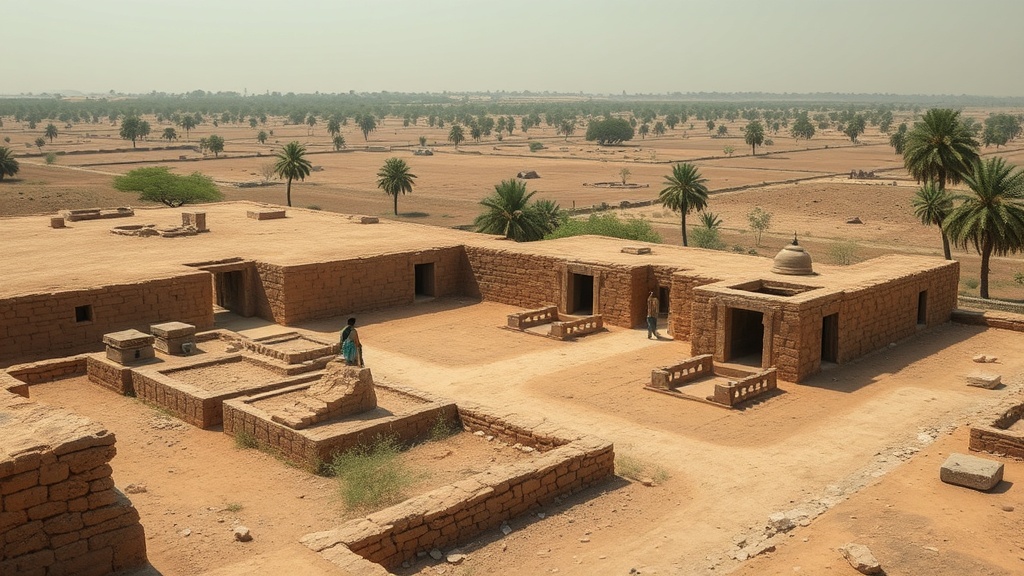
The site of Rakhigarhi, located in the Hisar district of Haryana, functions as a persistent variable in the study of the Mature Harappan phase (c. 2600–1900 BCE). For decades, the Harappan chronology relied on relative dating—comparisons of ceramic styles, seal motifs, and bead typologies. However, these methods often leave gaps in the resolution of site occupation. In 2019, a research team led by Vasant Shinde published a series of Accelerator Mass Spectrometry (AMS) dates obtained from human skeletal remains found in the cemetery at Rakhigarhi, offering a more precise temporal anchor for the settlement’s later stages.
The Problem of Stratigraphic Context
In archaeology, a date is only as reliable as the layer from which it is extracted. Stratigraphy—the study of rock or soil layers and their formation—serves as the primary tool for establishing the sequence of events. When we excavate a burial, we are dealing with a "cut," or a pit dug into an earlier, pre-existing layer. If the site formation processes are not meticulously recorded, samples can be contaminated by intrusive material from younger levels or mixed with older sediments.
The 2019 Nature report utilized AMS dating to determine the age of individuals buried in the Rakhigarhi cemetery. AMS dating is a method that counts individual atoms in a sample, allowing for much smaller amounts of organic material to be dated compared to traditional radiocarbon methods. Shinde’s team processed these samples to refine the timeline of the Mature Harappan occupation, which has historically been assigned to a range of 2600 to 1900 BCE based on broader regional ceramic sequences. The goal of such work is to transition from broad cultural phases to specific, datable human activity.
Dissecting the Data
Shinde et al. (2019) provided calibrated radiocarbon dates for several burials. These dates suggest that the cemetery remained in use during the later portions of the Mature Harappan phase. This is significant because it provides a check against older, speculative chronologies that often relied on the stylistic evolution of pottery without direct, high-precision temporal validation.
Scholars have long used the journal Puratattva and the Indian Archaeology: A Review (the annual bulletin published by the Archaeological Survey of India) to debate these nuances. A recurring issue in these debates is the lack of "closed finds"—artifacts or remains found in a sealed, undisturbed stratigraphic context. Without clear, undisturbed layers, chronological arguments become circular: the pottery dates the layer, and the layer dates the pottery. AMS dating breaks this cycle by providing an independent measurement of organic remains found within the grave.
The Limits of Calibration
Radiocarbon dating is not a simple clock; it requires calibration against tree-ring data and other independent terrestrial markers to correct for fluctuations in atmospheric carbon over millennia. This process often yields a probability range rather than a single calendar year.
In the 2019 study, the researchers presented their findings within these calibrated ranges. For the archaeological community, this shift toward direct dating is necessary to address the "missing layers" in our understanding of site abandonment. When a settlement like Rakhigarhi began to transition from its peak to its eventual post-urban state, the soil evidence is often messy. Distinguishing between the end of the Mature Harappan phase and the beginning of the Late Harappan is notoriously difficult without absolute dates derived from bones or charcoal within a clear stratigraphic cut.
Moving Beyond Tradition
Evidence shows that the cemetery at Rakhigarhi is not a monolith of a single event, but a landscape that changed over generations. While tradition holds that site chronologies are fixed by the presence of specific diagnostic artifacts—like perforated jars or certain types of terracotta bangles—scholars debate the actual lifespan of these objects.
The reliance on AMS dating represents a shift in methodology, moving away from subjective typological dating toward material-based evidence. As field archaeologists, we look for the "boring" details: the precise depth of a burial pit, the presence of specific soil inclusions, and the association of skeletal remains with buried hearths or floor levels. These details are the true indicators of a site's chronology.
As we continue to reconcile the genomic and archaeological datasets coming out of sites like Rakhigarhi, the emphasis must remain on the integrity of the stratigraphic record. Direct dating of remains, when coupled with a rigorous description of the site’s depositional history, offers the best path forward for establishing a timeline that withstands academic scrutiny. The ongoing work by researchers, as cataloged in databases such as the Archaeological Survey of India archives, confirms that the Harappan chronology is not a closed book, but a work of constant revision.
Note: Information regarding the specific burial sequences and calibrated date ranges is based on the 2019 analysis and remains subject to re-evaluation as further comparative data from neighboring Harappan sites becomes available.