Reading a Satavahana Coin's Ship: What a Punch-Marked Vessel Tells Us About Andhra's Indian Ocean Trade
A lead coin from the Satavahana dynasty shows a two-masted ship. Read alongside the Periplus and the Arikamedu excavations, it maps how Andhra's coast plugged into Indian Ocean trade.

Kavya Sharma for SwavedaJuly 30, 2026
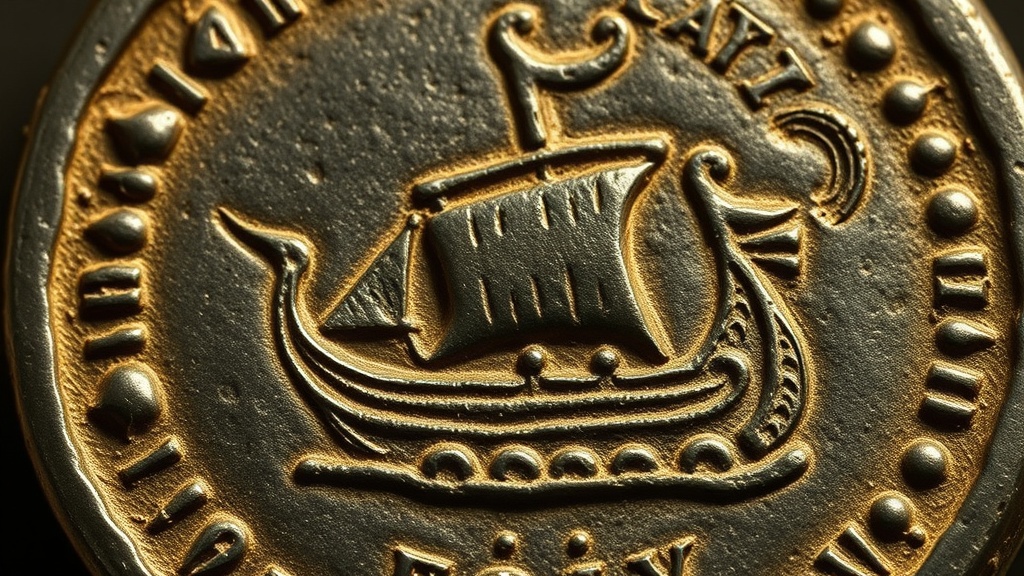
Turn the coin over and there it is: two masts, a hull, rigging picked out in crude strokes by someone working lead with a hand-cut die two thousand years ago. It is not a beautiful object. The metal is dull, the strike is often off-center, and the ship looks more like a child's drawing than a portrait. But it is one of the very few images from ancient India of a vessel that actually sailed — and it survives in enough numbers, from enough sites on the Andhra coast, that numismatists have leaned on it for decades to argue something specific: that the Satavahana dynasty, which controlled the Deccan and the Andhra coastline roughly from the 2nd century BCE to the 3rd century CE, ran a maritime economy, not just a land-based one.
The coin type is usually described in catalogues as a lead or potin issue bearing a two-masted ship on the obverse, attributed most often to the Satavahana ruler Yajna Sri Satakarni, known from find-spots along the eastern Deccan coast. The British Museum's collection database and older catalogue work by Robert Sewell on Andhra coins have long treated the ship motif as a Satavahana coastal issue rather than a purely inland type — the argument being that a ruler does not put a ship on money unless ships matter to the economy that money serves.
What "the ship coin" actually shows
Numismatic descriptions of the type consistently note a double-masted vessel, sometimes with what look like oars or steering gear at the stern, struck on small lead or potin (a copper-lead-tin alloy) flans. Lead was cheap and locally available in the Deccan, which is part of why so many Satavahana issues, including this one, survive in bulk rather than as rare museum showpieces — they were low-value coin struck for everyday, not ceremonial, use. That matters for the argument being made here: this was not a commemorative medal for a single voyage. It was working currency circulating in a region that was, apparently, thinking about ships often enough to put one on its coinage.
The Periplus, read alongside the coin
The other leg of this argument is textual. The Periplus of the Erythraean Sea, an anonymous Greek merchant's sailing manual usually dated to the 1st century CE, describes ports on India's eastern and western coasts, the goods moving through them, and the sailing seasons governed by the monsoon. Scholars reading the Periplus alongside Satavahana coin finds have long treated the two as complementary: the text names ports and cargoes from an outsider's practical, commercial point of view, while the coins are the material trace left by the economy the Periplus describes from the inside. Neither source alone proves an integrated trade system; together, historians argue, they make a stronger case than either would on its own.
Arikamedu: the site that anchors the argument
The third leg is archaeological. Excavations at Arikamedu, a port site near modern Puducherry first dug by Mortimer Wheeler in the 1940s and studied further by Vimala Begley in later decades, produced Roman amphora sherds, Arretine ware (a fine Italian tableware), and evidence of local bead and textile workshops. Begley's re-excavations, published through the University of Pennsylvania's ongoing Arikamedu research, pushed back against Wheeler's original framing of the site as a short-lived "Roman trading station," arguing instead for a longer, locally-driven history of exchange in which Roman goods were one strand among several. That revision matters for how the coin evidence gets read too: it discourages treating Andhra's Indian Ocean trade as something that happened only because Rome wanted pepper, and instead frames it as a regional maritime economy that predates and outlasts direct Roman contact.
What the coin can and can't tell you
Here the registers have to be kept separate. Evidence shows lead and potin coins bearing a two-masted ship were struck under Satavahana authority and circulate on the Andhra coast. Evidence shows Roman-linked material culture at Arikamedu and a Greek merchant's account describing Indian ports in commercial terms. What scholars debate is the tighter causal chain — whether this specific coin type funded specific voyages, whether it was struck at a port town for maritime traders as a class, or whether its ship image is closer to state symbolism than to a literal shipping receipt. Numismatic attribution for Satavahana lead issues is itself an ongoing, sometimes contested field, given how few securely stratified hoards exist compared to the volume of coins in private and museum hands.
What the ship coin offers, more modestly, is corroboration. It does not prove Andhra's Indian Ocean trade on its own. But held next to a Greek merchant's sailing directions and next to broken amphorae dug out of the ground near Puducherry, a crude lead ship stops looking like decoration and starts looking like an economy's fingerprint — small, low-value, and everywhere, which is exactly what real trade currency tends to look like.