Re-examining Vedic Synthesis: Beyond the 'Grand Reunion' Narrative
This article critically examines the 'Grand Reunion' hypothesis, which links Indus Valley and Southern Indian cultures to Vedic synthesis. It explores evidence and scholarly debate, questioning narratives of simple merger and displacement.

Vikram Joshi for SwavedaJune 21, 2026
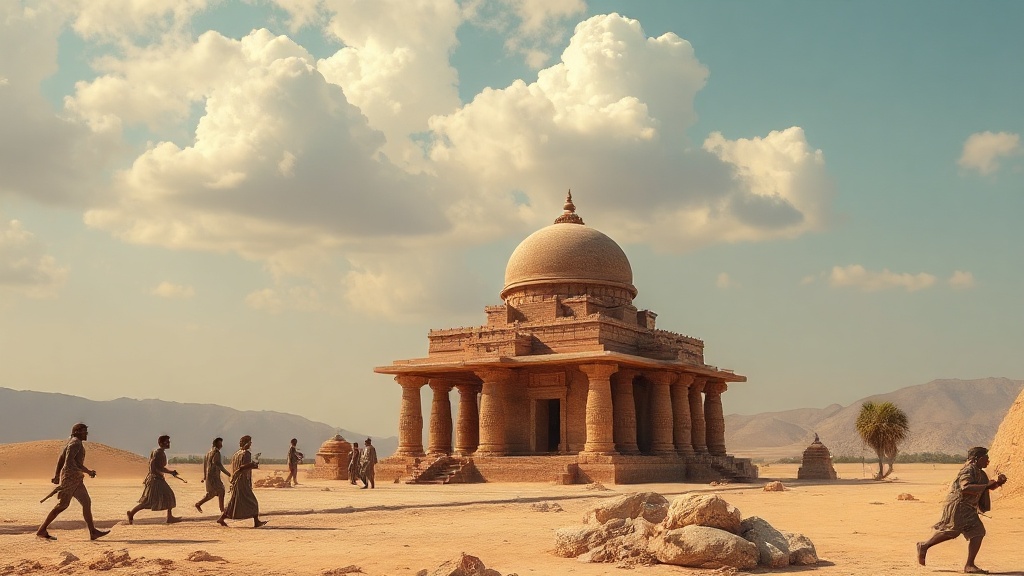
The idea of a singular, foundational event for India's diverse cultural and religious landscape is compelling. One recent hypothesis, termed the 'Grand Reunion,' suggests that the development of Vedic synthesis was built upon a merger between the urban civilization of the Indus Valley and the ancient cultures of Southern India, specifically sites like Keezhadi and Adichanallur. This perspective actively pushes back against older models that posited a displacement of indigenous populations by incoming Indo-Aryan speakers. However, a closer examination of the available archaeological, linguistic, and textual evidence reveals a more complex, nuanced picture than a simple 'reunion' might imply.
The 'Grand Reunion' hypothesis draws strength from apparent continuities and overlaps between different phases of Indian history. Proponents point to the long timeline of human settlement in South India, with archaeological evidence suggesting sophisticated Iron Age cultures predating or contemporary with certain Vedic periods. Sites like Adichanallur in Tamil Nadu have yielded rich finds, including elaborate burials and metalwork, while Keezhadi has revealed evidence of a large, organized urban settlement with a distinct script and trade networks, pushing back its timeline significantly. The argument is that these established southern traditions did not simply disappear but contributed to, or were integrated into, the emerging Vedic traditions of the North, creating a synthesis.
This view offers an alternative to the long-standing, and increasingly challenged, model of Indo-Aryan migration and cultural imposition. For decades, mainstream scholarship suggested that the Vedic corpus, particularly the Rigveda, was brought to the Indian subcontinent by Indo-Aryan speaking peoples migrating from Central Asia. This migration, it was argued, led to the displacement and subjugation of the existing Indus Valley Civilization inhabitants and the indigenous populations of the subcontinent. The 'Grand Reunion' hypothesis seeks to dismantle this unidirectional narrative, proposing a more equitable exchange and integration.
However, the concept of a 'Grand Reunion' as a primary driver for Vedic synthesis warrants careful scrutiny. While acknowledging the deep antiquity and sophistication of South Indian cultures, the direct causal link to the formative stages of Vedic thought requires more robust evidence. The Vedic corpus itself, primarily written in Sanskrit, exhibits linguistic and thematic elements that scholars generally trace to Indo-Iranian roots, distinct from the Dravidian linguistic family dominant in South India. While the presence of Dravidian loanwords in Vedic Sanskrit and vice versa indicates long-term interaction and cultural exchange, this is different from suggesting a foundational 'merger' of distinct cultural systems led directly to Vedic synthesis.
Archaeological evidence also presents a complex picture. The Indus Valley Civilization, with its advanced urban planning, standardized weights and measures, and unique script (as yet undeciphered), represents a distinct cultural and technological phase. While connections between the Indus Valley and later South Indian cultures are being explored, particularly through trade and potential population movements, the direct, cohesive integration of a fully formed Indus urban system with burgeoning Southern Iron Age societies to create Vedic synthesis is not a widely accepted scholarly consensus. The timeline of these developments, and the nature of their interaction, are subjects of ongoing research and debate.
Scholarly debate also focuses on the interpretation of material culture. While both Indus Valley sites and Southern Iron Age sites demonstrate advanced craftsmanship, the specific forms, styles, and symbolic representations often differ. The interpretation of funerary practices, religious iconography, and settlement patterns requires careful comparative analysis, distinguishing between shared cultural substrata, parallel developments, and direct influence. Simply finding shared elements does not automatically equate to a 'Grand Reunion' that fundamentally birthed Vedic traditions.
The timeline of Vedic texts is another crucial element. The Rigveda, the earliest layer of Vedic literature, is conventionally dated between 1500 and 1200 BCE. The significant urban settlements in South India, such as those unearthed at Keezhadi, also have long histories, but their flourishing periods and the precise nature of their interaction with contemporaneous northern developments are still being clarified through ongoing excavations and dating. Establishing a clear chronological and causal relationship between these distinct cultural spheres, sufficient to support the 'Grand Reunion' as the foundation of Vedic synthesis, remains a challenge.
It is important to differentiate between a gradual, long-term process of cultural diffusion and interaction, and a specific 'reunion' event or period that served as the primary catalyst for Vedic synthesis. India's history is marked by constant movement, exchange, and assimilation of peoples and ideas across diverse regions. The development of Vedic traditions likely incorporated influences from numerous sources, including local hunter-gatherer populations, agricultural communities across the subcontinent, and potentially further migrations.
The 'Grand Reunion' hypothesis, by emphasizing a foundational merger between the Indus Valley and Southern Indian cultures, offers a valuable counterpoint to older, more simplistic models of migration and displacement. It correctly highlights the deep antiquity and importance of South Indian heritage. However, the evidence to date suggests that the formation of Vedic synthesis was a more complex, multi-faceted process. This process likely involved ongoing interactions and adaptations across various regions and communities over extended periods, rather than a singular, unifying event described as a 'Grand Reunion.' The careful, evidence-based approach of archaeology and linguistics continues to refine our understanding, moving beyond single narratives towards a richer, more intricate understanding of India's past.