Pottery Imprints and Carbonized Seeds: How Archaeobotanical Data Recalibrates Early Rice Cultivation at Lahuradewa
Archaeobotanical evidence from Lahuradewa reshapes our understanding of early South Asian agriculture, showing how independent wild rice harvesting evolved in the Ganga Plain long before introduced cultivars arrived.

Kavya Sharma for SwavedaNovember 26, 2026
Listen to this article · 6 min · Read by an AI voice
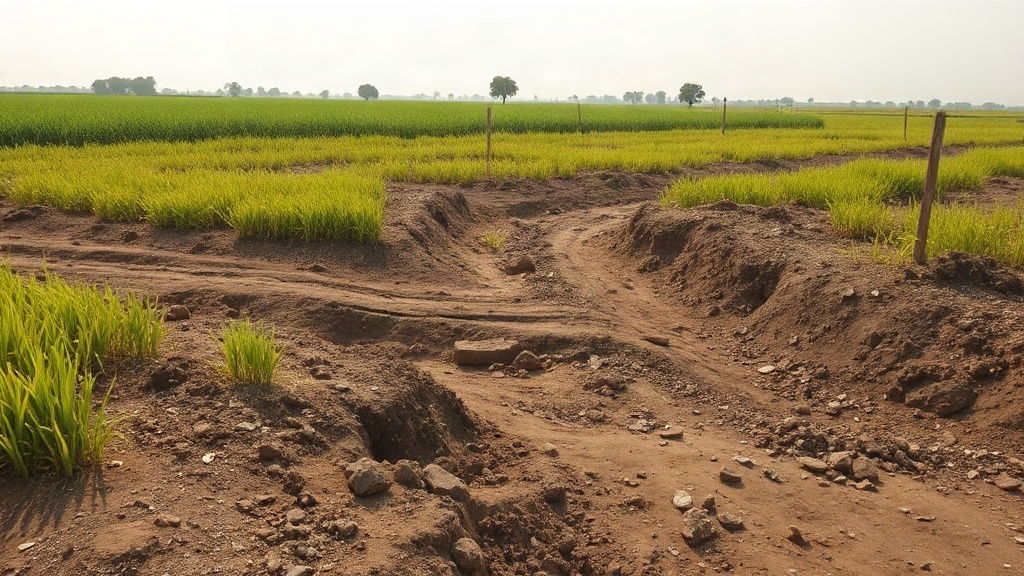
For decades, standard historical narratives traced the birth of agriculture across South Asia back to a single early center: the wheat and barley fields of Mehrgarh in the Kacchi Plain, or to the much later arrival of fully domesticated rice from East Asia. That tidy diffusion model began to fall apart when excavators sank their trenches into a low earthen mound beside a oxbow lake in Uttar Pradesh.
The site is Lahuradewa, located in the Sant Kabir Nagar district of the Middle Ganga Plain. Between 2001 and 2006, excavations led by Rakesh Tewari for the Uttar Pradesh State Department of Archaeology uncovered something unexpected: a continuous record of human occupation and plant management stretching deep into the early Holocene.
Instead of imported crops, the earliest trench levels, designated Period IA, contained coarse cord-impressed pottery and carbonized plant remains. Mixed in the soil were microscopic plant remnants—carbonized seeds, husks, and phytoliths (rigid, microscopic silica structures formed inside plant tissues). Accelerator Mass Spectrometry (AMS) radiocarbon dating on a husk-clot and charcoal samples placed these early levels in the seventh millennium BCE, with some lake core charcoal signals extending even earlier.
The discovery immediately forced a recalibration of how sedentary communities formed along the Ganga. It showed that long before the arrival of complex agricultural grids, local populations were clearing vegetation and living alongside lake margins.
To reconstruct what those early gatherers were eating, archaeobotanists turned to two distinct lines of micro-botanical evidence: plant micro-remains extracted through water flotation and microscopic impressions trapped inside burnt clay. When ancient potters shaped coarse storage jars, they tempered the wet clay with organic chaff to prevent cracking during firing. As the pots were baked, the plant tissue burned away, leaving precise negative casts of husks and spikelets (the flowering unit of a grass) permanently frozen in the ceramic matrix.
Floating the soil samples yielded charred seeds of Setaria (foxtail millet), wild grasses, and Oryza (rice). Alongside these macro-botanical seeds, soil cores from the adjacent lake basin revealed a steady concentration of micro-charcoal and fan-shaped bulliform phytoliths. Bulliform phytoliths are specialized water-storing cells found in grass leaves. By analyzing the scale-like ornamentations along the edges of these phytoliths, botanists can distinguish wild rice species like Oryza rufipogon from domesticated varieties.
The phytolith sequence from the lake bed showed that around 10,000 years ago, local human groups were setting seasonal fires to clear lake margin vegetation. This burning encouraged the growth of wild stands of annual rice. The people of Lahuradewa were not merely opportunistic foragers wandering through the marshland; they were manipulating their local ecology to maximize wild grain harvests.
This ecological footprint challenges the older assumption that farming in northern India was an imported technology that arrived fully formed. Instead, the evidence shows a long, indigenous trajectory of wild harvesting that operated on its own logic.
⚖ Scholarly debate: Wild gathering versus early domestication
While there is consensus that the Lahuradewa plant remains represent some of the earliest evidence of human-rice interaction in South Asia, scholars remain sharply divided over whether the grains represent true agriculture or intensive wild gathering.
Evidence shows that excavator Rakesh Tewari and archaeobotanist K.S. Saraswat interpreted the Period IA carbonized grains and husk impressions as early forms of domesticated Oryza sativa. They argued that the presence of non-shattering spikelet bases—the physical joint where the grain attaches to the stem, which breaks easily in wild plants but remains intact in domesticated crops—indicates that early Ganga Plain communities had already begun the process of plant domestication by the seventh millennium BCE.
Scholarship presents a different view. Archaeobotanist Dorian Fuller argues that the morphological characteristics of the early Lahuradewa grains, including their overall size ratios, fall neatly within the expected variance of wild Oryza nivara or Oryza rufipogon rather than fully domesticated crops. Fuller suggests that the early occupants of Lahuradewa were engaged in intensive wild gathering and low-intensity cultivation of indigenous proto-indica populations. Under this interpretation, fully non-shattering domesticated rice did not take hold in northern India until much later, when local proto-indica cultivation merged with introduced japonica rice varieties.
Historian Irfan Habib raised separate stratigraphic concerns regarding the site’s chronological interpretation, pointing out that several radiocarbon dates from the lower levels span later millennia and noting the presence of steatite beads in early layers.
What the ceramic imprints and charred seeds of Lahuradewa ultimately reveal is a human landscape far more complex than simple migration maps suggest. Long before dense urban centers rose along the riverbanks, early communities in the Middle Ganga Plain were intimately tied to their local wetlands, systematically harvesting wild grains and leaving their mark in the burnt clay of their cooking pots.