Nagari, the city Patanjali mentioned
A 1920 ASI excavation in Rajasthan turned up the earliest Sanskrit inscription anyone had seen, evidence of Vasudeva worship in the 4th century BCE, and a fortified town that an Indo-Greek king once besieged.
SwavedaApril 29, 2026
Eight miles north of Chittorgarh, on the right bank of the Berach river in southern Rajasthan, sits a long ridge of accumulated rubble. The villagers there call the place Nagari. By the time D.R. Bhandarkar walked across it in 1915 with a measuring tape and a notebook, the site had already been visited twice — once in 1872 by Carlleyle of the British archaeological survey, and shortly after by the Udaipur court historian Kavi Raj Shyamal Das. Both came away with bits and pieces. Bhandarkar came back with a story.
What he excavated, and reported on in 1920 as Memoir No. 4 of the Archaeological Survey, made Nagari one of the more important early-historic sites in north India.
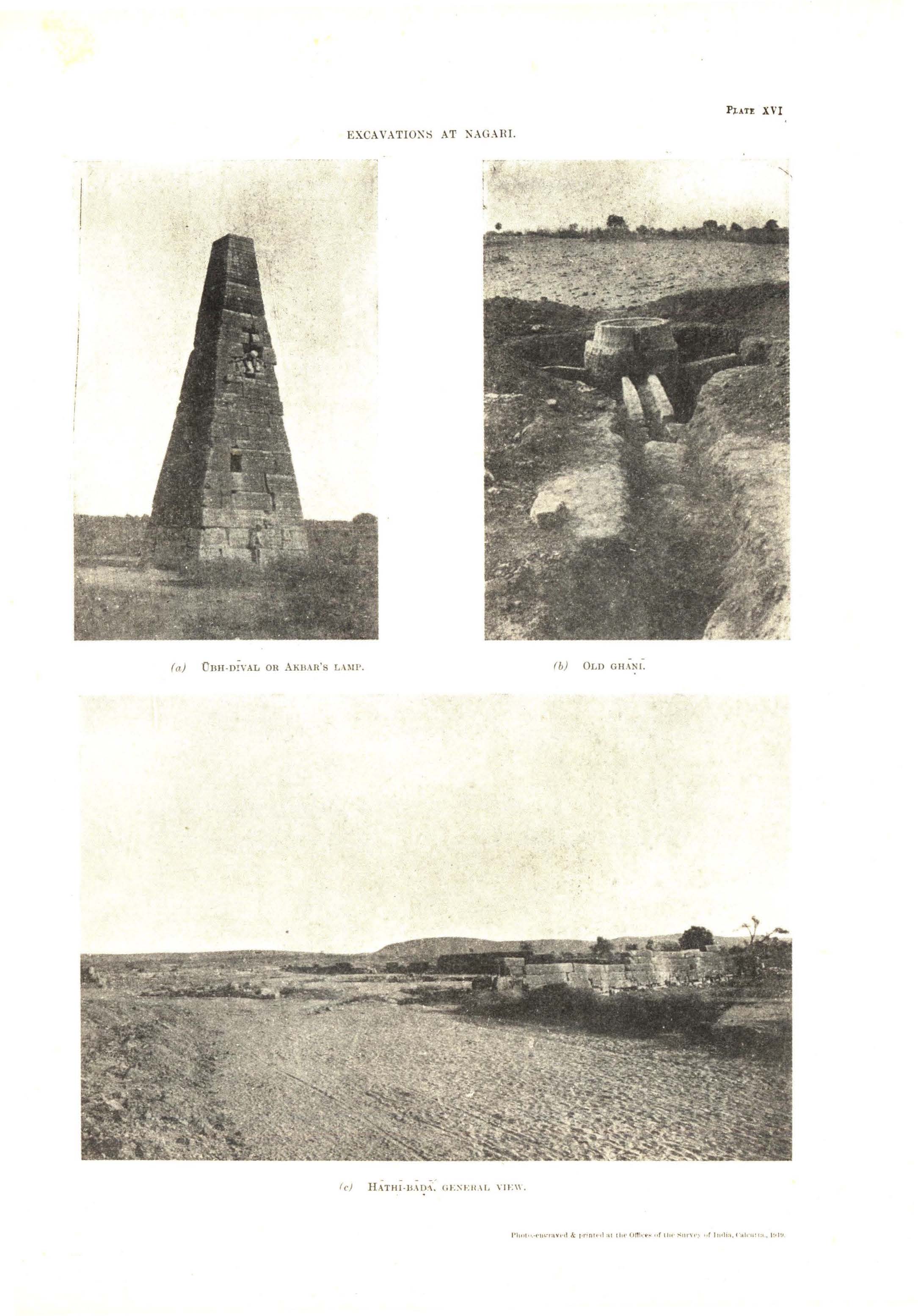
The site is what archaeologists call a citadel — a long, narrow fortified strip running parallel to the river. About 3,500 feet north to south, never more than 700 feet across. The ramparts were built of large blocks of grey laminated limestone packed without mortar, in the dry-stone technique that pre-dates Muslim construction in this region. On three sides there were traces of a moat. The villagers who farmed the surrounding plain in 1915 had no memory of who had built it, and the modern Rajput families who held it as a feudal grant had only acquired it in the 19th century. The town was old.
How old, and which town it was, is what the inscriptions answered.
The earliest Sanskrit anyone had read
The most important inscription Bhandarkar dealt with had actually been found earlier, embedded as a step inside a step-well at the village of Ghosundi, four miles to the north-east. The ruler Sringaradevi had built that step-well in 1499, and like most builders of the period she had used whatever good cut stone the neighbourhood offered her. The slab she had built into her stairway was much, much older.
The inscription, broken on both sides and surviving only as fragments, was three lines long. It recorded the construction of a stone enclosure for worship — a puja-sila-prakara — at a place called Narayana-vata, dedicated to the gods Samkarshana and Vasudeva. The donor was a man named Gajayana, son of Parasari, of the Gajayana lineage.
This was, when Bhandarkar reported it, the earliest known inscription in pure Sanskrit. The script — the early Brahmi letters — placed it in the fourth or third century BCE. The language was already careful classical Sanskrit, with one minor scribal error. Bhandarkar read this as direct evidence that Sanskrit was a living, spoken language at a period when many Sanskritists had assumed it had already been displaced by Prakrit dialects, surviving only in priestly recitation. The Nagari inscription was being used by people to write down what they had built, in stone, for public reading.
It was also the earliest epigraphic evidence anywhere of the worship of Vasudeva. By the time the Bhagavata Purana would be composed, more than a thousand years later, Vasudeva would be one of the central names of Krishna and one of the four vyuhas of Vaishnava theology. Here, in 350 BCE, someone in southern Rajasthan was already building a temple precinct for him.
A second inscribed stone, found nearby on a boundary between Ghosundi and the next village, recorded a single line — that the king Sarvatata had performed an Ashvamedha, a horse sacrifice. The Ashvamedha is described in Vedic literature as the most prestigious of royal rituals. Bhandarkar pointed out that only a paramount sovereign could perform it. Sarvatata, otherwise unknown to history, must have ruled enough country to claim that status. The script, again, places him in the third or second century BCE.
The town with a Greek visitor
The name "Nagari" is the survival of a word that had been more specific. Patanjali, the grammarian who composed the Mahabhashya around 150 BCE, mentioned a town called Madhyamika as one of his examples of how Sanskrit grammar handles certain place-name forms. Greek and Roman sources also mentioned a Madhyamika in the western part of India. Most decisively, Patanjali used Madhyamika in his discussion of how to form the past tense properly: "the Greek besieged Madhyamika." The Greek in question was almost certainly Menander — Milinda in Pali sources — the Indo-Greek king of the second century BCE whose conversations with the Buddhist monk Nagasena are recorded in the Milindapanho.
Bhandarkar's coins fit. He recovered a substantial run of punch-marked silver from the citadel, several Indo-Greek coins of the Menander period, and a continuous sequence into the early centuries CE — coins of the local Sibi tribe, Gupta coins, and so on through the medieval. Madhyamika had been a fortified town when Menander campaigned in northern India, and it remained important enough to be a stop on Patanjali's mental map about a generation later.
The fortification methods, the dry-stone work, the punch-marked coinage, the Brahmi epigraphy, and the Vasudeva temple stone enclosure all line up consistently with a date in the third to first centuries BCE for the most active phase of the site.
The Hathi-bada and what it was
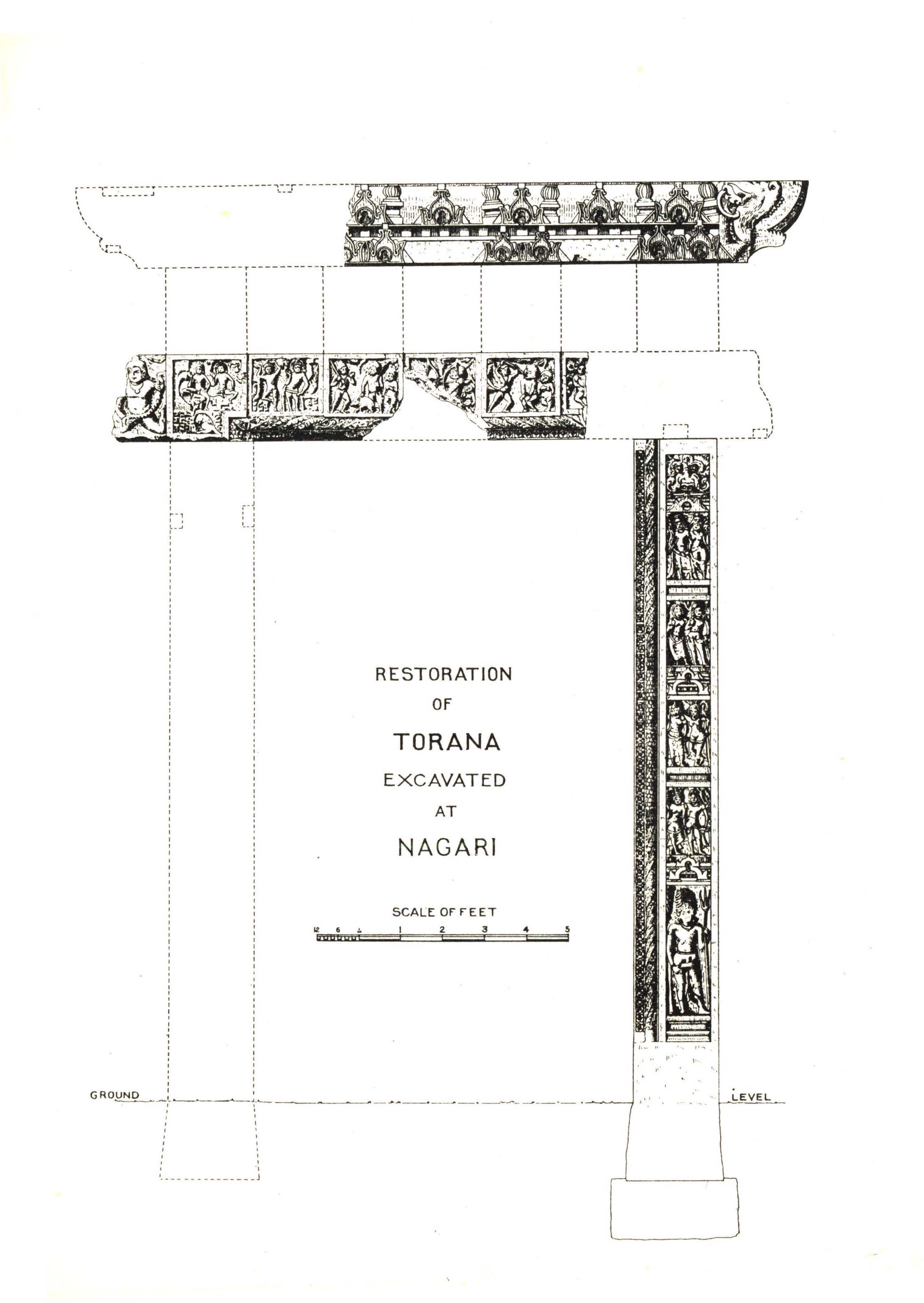
The most peculiar surviving structure at Nagari is the Hathi-bada — locally, "the elephant pen". It is an enormous rectangular stone enclosure, walls only a few feet high now, built of the same dry-laid limestone as the citadel. Bhandarkar excavated inside it. He found foundations consistent with a small shrine, and stone railing pieces stacked at the village like the ones that surround Buddhist stupas at Bharhut and Sanchi.
The Ghosundi inscription is the key. It records the construction of "a stone enclosure for worship" by Gajayana, dedicated to Samkarshana and Vasudeva. The Hathi-bada is most plausibly the surviving wall of that very enclosure. If so, it is one of the oldest dateable Vaishnava temple-precincts in the subcontinent, perhaps the oldest. The Ghosundi slab was probably set into a doorway or shrine inside it, was robbed for stone in some later century, and ended up four miles away holding up Sringaradevi's step-well stair.
Why this still matters
Three of the things Bhandarkar dug up in 1915 are still cited in scholarship every decade. The Ghosundi inscription is a fixed point in the history of Sanskrit and of early Vaishnavism — it predates almost all literary references to Vasudeva worship by centuries, and pushes the date by which classical Sanskrit was being written in stone back into the period when most of the Mauryan inscriptions are in Prakrit. The Sarvatata Ashvamedha record is one of the few epigraphic mentions of an Ashvamedha sacrifice from the early historic period, anchoring the rite in actual royal practice rather than purely textual prescription. And the identification of Nagari with Madhyamika gives a concrete archaeological location to a town that Patanjali cited and that Indo-Greek armies fought their way past.
Most ASI excavation reports vanish into a footnote. Bhandarkar's didn't. The site is still there, mostly unprotected, mostly unread. The next Nagari volume — when one comes — will probably need to be Vol. II, picking up the long history of the place after it stopped being Madhyamika and started being a forgotten ridge above the Berach.