Kalibangan, where every Indus debate sits in one place
An ASI volume on the second-millennium-BCE Mature Harappan town near the dry Ghaggar in Rajasthan reads like a tour of the most contested questions in Indian archaeology.
SwavedaApril 29, 2026
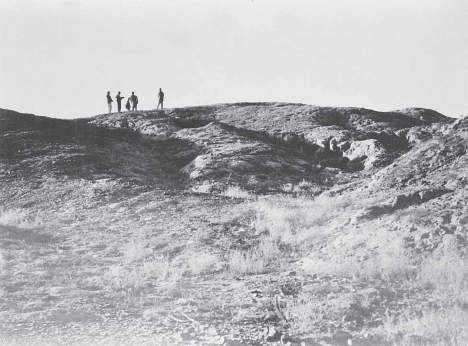
If you wanted to teach the politics of Indian archaeology in one site, you would teach Kalibangan. The mounds at Kalibangan, in Hanumangarh district, Rajasthan, sit on the dry left bank of the Ghaggar — a river that carries no water for most of the year. The town there flourished between roughly 2600 and 1900 BCE. The questions Kalibangan raises do not.
The site was excavated by the Archaeological Survey of India between 1961 and 1969, under the leadership of B.B. Lal and B.K. Thapar. The full report came out in three volumes; this article looks at Part II — Excavations at Kalibangan: The Harappans, ASI Memoir No. 110 — published in 2020 from a manuscript Lal completed in 2007. It is a 900-page material-culture catalogue: pottery, copper, gold, ivory, beads, bangles, weights, ploughs, pipes, the cemetery.
What Kalibangan is famous for
Three discoveries from the 1960s digs have appeared in every textbook on the Indus Valley civilisation since.
First, the ploughed field. In the layer immediately below the Mature Harappan town — the Early Harappan or Sothi-Siswal phase, roughly 2900–2600 BCE — Lal and Thapar exposed a patch of ground criss-crossed by furrow marks running in two perpendicular directions. The interpretation was that this was a horticultural grid: a tall crop in the north-south rows, a shorter crop in the east-west ones, planted at right angles so the tall one wouldn't shade the short one. Calling it "the world's oldest known ploughed field" is technically accurate; ploughed fields elsewhere (Egyptian, Mesopotamian) come from later periods, and although the underlying technique must be older, Kalibangan is where one was actually preserved and excavated.
Second, the fire altars. Inside ordinary houses on the lower town and on a row of platforms on the citadel mound, the excavators found small rectangular pits with ash, charcoal, and characteristic terracotta cake fragments. Lal interpreted these as ritual fire altars — the same word, yajna-vedi, that the Vedic literature uses for the altar around which the most important Hindu rituals are performed. A separate, smaller mound east of the main town (KLB-3) seemed to be entirely ritual: nothing but altars, no domestic occupation.
Third, the trephined skull. In the cemetery (KLB-8), one of the burials was a child whose skull showed a deliberate, healed surgical opening. Trephination — cutting a hole in the skull while the patient is alive — is one of the oldest known surgical procedures, attested across multiple ancient cultures. The Kalibangan trephination is one of the earliest documented from South Asia.
Why this volume matters even if you've heard of Kalibangan before
The 2020 publication is a careful catalogue of what came out of the dig that didn't make the textbook. Lal and his colleagues describe a working town's worth of objects:
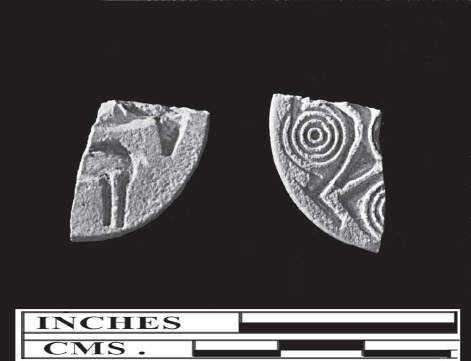
- Metrology: a working terracotta hour-glass, a graduated 9.2-cm linear scale, plumb-bobs, two series of cubic and conical weights. The Harappans were famously precise about measurement; the Kalibangan finds put the tools of that precision in the reader's hands.
- Pottery: the standard Mature Harappan repertoire — black-on-red painted jars, dish-on-stands, S-profile bowls, perforated jars — alongside a smaller body of regional Sothi-Siswal pottery from the underlying Early Harappan layers.
- Copper and gold: the catalogue runs to small ornaments, blades, fish-hooks, bangles. Quantities are modest, consistent with a regional centre rather than a major metallurgical site.
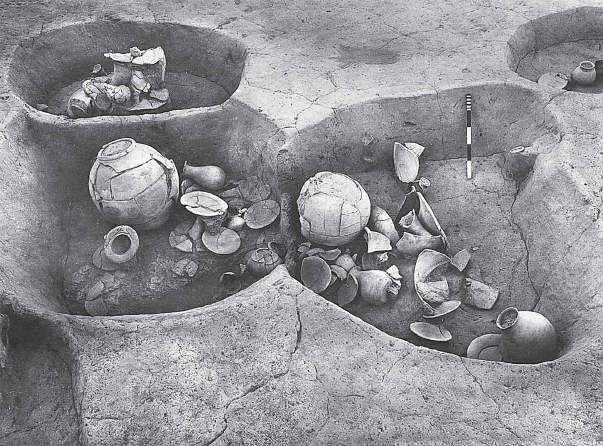
- The cemetery: fewer than a hundred extended burials over what was probably six centuries of occupation. Some pot burials with no human bones, which the report reads as cenotaphs. One adult man with a copper-axe wound to the skull — the only direct osteological evidence of violent death from the Mature Harappan that the volume reports. Several individuals with disabilities or the visible aftermath of disease.
The ratio of recovered burials to estimated population is a striking number on its own. A town of perhaps several thousand people, lived in for six centuries, generating in any reasonable estimate tens of thousands of deaths, has left fewer than a hundred extended skeletons. Whatever the Harappans were doing with most of their dead, it wasn't burying them in cemeteries. Cremation and immersion in flowing water — the modern South Asian Hindu rites — are the most plausible candidates the report leaves on the table without committing to.
The framing that needs flagging
The 2020 report consistently uses the name Sarasvati for the Ghaggar river, and reads several of the ritual finds — fire altars, terracotta cakes interpreted as offerings, a small object the volume calls a Shiva linga — as continuous with later Vedic and Hindu practice. Lal's separately published Sarasvati Flows On (2002) makes the case explicitly: the Indus Valley Civilisation should be renamed the "Sindhu-Sarasvati Civilisation," and its religious life is essentially proto-Vedic.
Each piece of this argument is genuinely contested in the wider literature, and the report does not present that contestation. The reader should know:
- The Ghaggar–Hakra river system was, on hydrological evidence, a substantial river in the early Holocene, fed by the Sutlej and possibly the Yamuna through palaeochannels that switched away to their present courses by roughly 2000 BCE. That part is widely accepted.
- Whether this river was the Sarasvati of the Rigveda is a different question. The Rigvedic Sarasvati is described as a "mighty stream from the mountains to the sea," which is a poor fit for the Ghaggar in the period of Rigvedic composition (roughly 1500–1000 BCE), by which time the Sutlej and Yamuna captures had already reduced it to a seasonal stream. The identification has supporters and critics, and the case isn't closed.
- Whether the fire altars at Kalibangan are evidence of Vedic ritual specifically, or of a more general altar-based ritual practice the Vedic tradition later inherited, is also genuinely open. The Mature Harappan period (2600–1900 BCE) precedes the conventional dating of the Rigveda by half a millennium or more. Religious practices that resemble each other across that gap could indicate cultural continuity, parallel development, or coincidence.
We are not endorsing one reading over another. We are saying: when an ASI report calls a feature a yajna-vedi without saying that the inference is contested, and a river Sarasvati without saying that the identification is contested, a careful reader needs to add the qualification themselves.
What it actually was
What Kalibangan was, on the catalogue evidence in this volume, is a Mature Harappan regional centre — smaller than Mohenjo-daro, smaller than Harappa, larger than the village sites — sited on a river that was already drying out, occupied for roughly six hundred years, abandoned around 1900 BCE in step with the broader urban collapse of the Indus civilisation. It produced the same standardised material culture as the other Harappan towns: the same weights, the same painted pottery types, the same drilled carnelian. It had local features too — the fire altars, the ploughed field, the small ritual mound — that don't have direct parallels at Mohenjo-daro or Harappa.
Whatever you make of the bigger arguments those local features are pulled into, the site itself is a small masterpiece of mid-third-millennium urbanism on the eastern fringe of the Harappan world.