Kurukshetra: Excavations vs. the Mahabharata — What the Ground Actually Shows
The Mahabharata describes Kurukshetra as the site of an ancient war. Archaeologists have excavated there for decades. What does the evidence actually show?

Dr. Anil Patel for SwavedaAugust 27, 2026
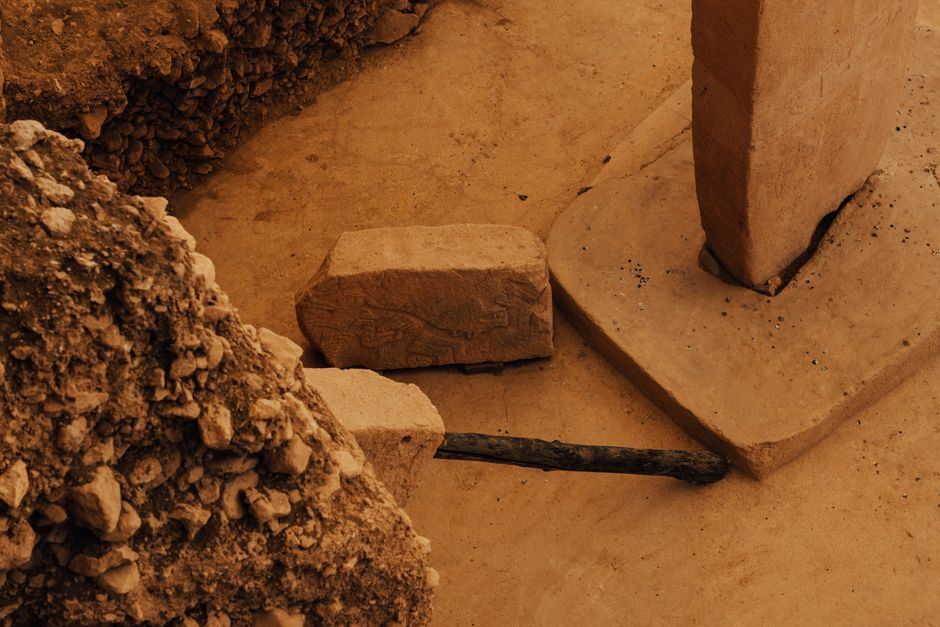
Excavators at Kurukshetra, located in modern Haryana, found pottery. They found mounds of settlement debris, iron arrowheads, and traces of fortification walls. They did not find a battlefield.
No mass grave has been uncovered. No chariot wheels fused into ash have been recovered. No single, catastrophic destruction layer exists to show that a great war happened here on a specific day. Four decades of fieldwork by the Archaeological Survey of India and regional institutes have turned up plenty of iron and pottery at Kurukshetra and nearby sites. They have not turned up a war.
That gap between what the soil gives up and what the epic insists happened is worth sitting with.
What Came Out of the Ground
Excavators recovered iron arrowheads and spearheads alongside pottery shards and ash layers at Kurukshetra. Labs ran thermoluminescence (a technique that measures trapped electrons in heated minerals to estimate when an object was last fired) tests on the iron pieces. The results spread across a 2,300-year window. Some samples date near 3100 BCE, while others date near 800 BCE. That is not a narrow range scholars are quibbling over at the margins. That is most of recorded Indian antiquity in a single dataset.
Separately, excavations at Hastinapur, led in the 1950s by archaeologist B.B. Lal, uncovered Painted Grey Ware (a distinctive gray pottery style with black painted designs). Archaeologists treat this pottery as a marker of the Late Vedic period (the historical era following the composition of the Rigveda, characterized by agricultural settlement and early iron use) in North India, roughly 1200–800 BCE. This pottery style shows up at dozens of sites across the region the Mahabharata names as its setting. This includes a layer at Hastinapur that Lal connected to a flood mentioned in the text. A pottery style lining up with textual geography is a real, useful data point. It is not a date for a war.
What the Epic Claims
The epic tradition holds that the Kurukshetra War took place at a precise moment: 3102 BCE, marking the start of the Kali Yuga (the fourth and final age in Hindu cosmology, described in tradition as a period of moral decline). That number traces back to later calculations built on the 6th-century astronomer Aryabhata's system for computing the Kali Yuga epoch—not to any historical dating Aryabhata himself made of the war.
Other textual traditions and commentators have proposed dates anywhere from 1500 to 1000 BCE. The logic behind 3102 BCE is straightforward: a memory this carefully preserved, the argument goes, should carry precision. The tradition does not hedge. Archaeology, however, has to.
Why the Dates Diverge
Thermoluminescence works well on fired clay, but iron is a harder case. An arrowhead can carry trapped electrons from several separate heating events: the forge that shaped it, a later forest fire, or even years of sun exposure before burial. The method cannot always tell which event it is actually measuring. Local soil chemistry, moisture, and burial depth all affect how much radiation an object absorbs over centuries, and small errors in those variables compound into centuries of uncertainty in the final date.
Scholars debate whether Lal's later work shifted his own position toward an earlier date for the epic; there is no settled consensus on exactly how his thinking evolved over his career. A separate group of researchers has tried reading the Mahabharata's astronomical references—planetary positions, eclipses, star alignments—and running them through modern simulation software to back-calculate a date.
Those efforts produce results ranging from roughly 3000 BCE to 1200 BCE, depending entirely on which verses get treated as genuine sky observations and which get treated as later poetic additions. Scholars debate that distinction too, and it matters. The Mahabharata is not a single text frozen at one moment. Its oldest layers read like Vedic Sanskrit, suggesting composition before 1000 BCE, but the epic kept growing—revised, expanded, reworked—probably into the 4th century CE.
What the Evidence Actually Supports
Evidence shows iron weapons and Painted Grey Ware pottery in circulation at Kurukshetra and nearby sites during the Late Vedic period, roughly 1200–800 BCE. That is a real, dated cultural horizon.
What the evidence does not show is whether those weapons belonged to one catastrophic 18-day war or to generations of smaller, recurring conflicts fought over the same ground. This kind of low-grade, repeated warfare is something archaeology is genuinely bad at telling apart from a single legendary battle.
Tradition preserves a story with names, a date, and a shape. Archaeology confirms that people lived here, fought here, and worked iron here, roughly where and when the epic says. It does not confirm the specific narrative wrapped around those facts. Mistaking one for the other is the mistake worth watching for, in either direction.