Hunza's Walls of Rock: Does Geography Alone Explain Burushaski's Survival?
Burushaski, a language with no known relatives, survives in Pakistan's Karakoram valleys. Geography helped — but genetics and history suggest the story is more tangled than "isolation did it."

Vikram Joshi for SwavedaJuly 31, 2026
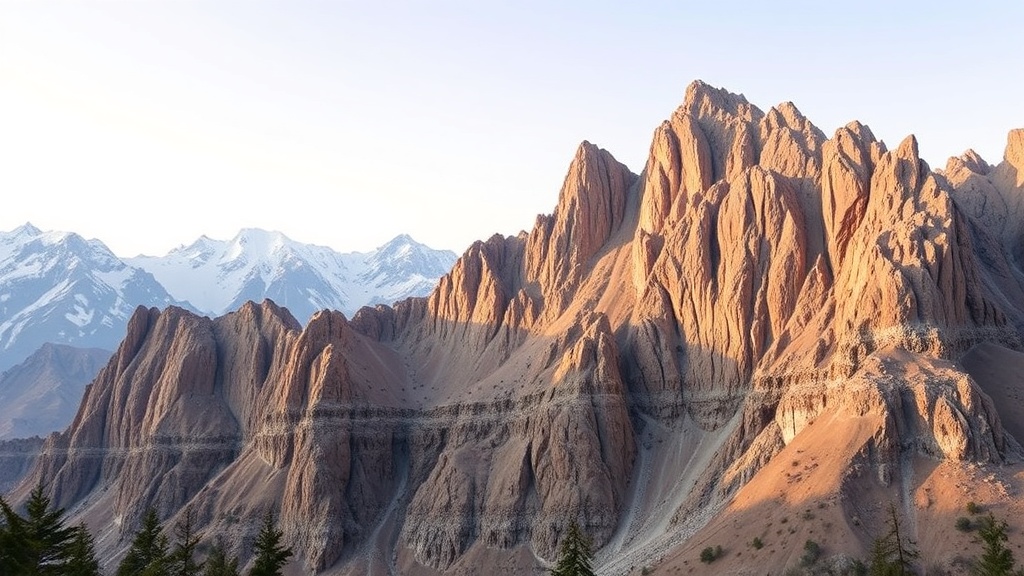
Drive up the Karakoram Highway from Gilgit and the Hunza valley opens like a crack in a wall — terraced fields clinging to slopes below peaks that clear 7,000 meters, a river gorge narrow enough that villages on opposite banks sometimes shout across it rather than walk the long way round. It looks like the kind of place a language could hide in for a thousand years. And one did.
Burushaski is spoken by communities in Hunza, Nagar, and the Yasin valley of Gilgit-Baltistan. Linguists classify it as a language isolate — a language with no demonstrated relationship to any other known language family, living or dead — which makes it a genuine oddity in a region otherwise carved up between Indo-Aryan tongues like Shina, the Iranian language Wakhi, and Tibetic Balti (Wikipedia). Every neighboring valley speaks something with cousins elsewhere on the map. Burushaski has none.
The obvious explanation is the mountains themselves. A recent breakdown circulating on r/IndianHistory lays out exactly this case in layers — geographic isolation, followed by genetic distinctiveness, followed by linguistic survival — treating the Karakoram terrain as the load-bearing wall of the whole argument. It's a tidy story. It's also only partly the one the evidence supports.
A Crossroads, Not a Cave
The trouble with "isolation did it" is that Hunza was never actually cut off from the world. The valley sits on branch routes of trans-Himalayan trade networks that carried goods and travelers between Central Asia, Kashmir, and Tibet for centuries — this was a corridor, not a hermit's cell. Until 1974, Hunza was also a princely state in its own right, ruled by a hereditary Mir (a local title for ruler) with its own court and administration, absorbed into Pakistan only in the last quarter of the twentieth century (Wikipedia). That political self-containment — a small polity running its own affairs for generations — plausibly did more to protect Burushaski than the mountains alone, by keeping a compact speech community administratively distinct rather than physically unreachable.
If terrain alone explained the survival, the same peaks should have preserved every language that ever passed through these valleys. They didn't. Domaaki, a language once spoken by musician and blacksmith communities in the same district, is now down to a handful of elderly speakers, hemmed in by the exact same rock walls that supposedly protected Burushaski (Wikipedia). Geography set the stage; it didn't write the whole script.
What the Genes Actually Show
Population genetics adds a real, separate data point — and it doesn't map neatly onto the language story. The Burusho people were among the Pakistani populations sampled for the Human Genome Diversity Project, and they turn up as a genetically distinctive cluster in the landmark 2002 study of global population structure led by Noah Rosenberg and colleagues, published in Science (Rosenberg et al., 2002). That paper and subsequent work on the region describe the Burusho as showing detectable differentiation from surrounding South and Central Asian groups, consistent with a long history of relative reproductive isolation — plausibly reinforced by endogamy (marriage within one's own community) — rather than total genetic isolation (Wikipedia).
That is a meaningful finding, but it answers a different question than the language one. Genetic isolation measures who had children with whom. Linguistic isolation measures what people spoke while doing it. The two can travel together, or they can split apart entirely — populations swap languages without swapping genes all the time, and vice versa. The Reddit thread's "iceberg" framing stacks the genetic evidence and the linguistic evidence as though they're the same phenomenon confirming each other twice over. Scholars of language contact would treat that as a hypothesis worth testing, not a conclusion already reached.
Tradition, Terrain, and What's Actually Settled
What can be said without much argument: Burushaski's isolate status is not seriously disputed among linguists working on South Asian languages. What remains genuinely debated is why it, specifically, survived where comparably old languages in the same mountains did not. The honest answer braids several threads — a defensible, food-secure valley system; a self-governing local state that lasted into living memory; a population with documented genetic distinctiveness suggesting long-standing social separateness; and, plausibly, simple demographic luck. Terrain explains why outside languages struggled to flood in. It doesn't by itself explain why Burushaski, alone among the valley's older tongues, held its ground.
Local tradition in Hunza holds its own accounts of the community's origins and distinctiveness, passed down independent of any genetic or archival record — a separate register from what the DNA and the historical documents show, and one this piece isn't set up to adjudicate. What the combined record supports is narrower and more interesting: geography was necessary but not sufficient, and a valley that looks like isolation from a satellite photo was, for most of its history, a working political and trade address with a very particular set of survival conditions attached to it.