Hulas: a village at the edge of the Indus world
Six seasons of digging at a small mound in western Uttar Pradesh found a Late Harappan village whose inhabitants still used the script, still wore carnelian, and were already growing rice.
SwavedaApril 29, 2026
Most of what people picture when they hear "Indus Valley Civilisation" comes from a handful of large, well-excavated sites: Mohenjo-daro, Harappa, Dholavira, Lothal. Wide streets, brick-built houses, drainage, a citadel mound. The big cities. By 1900 BCE, those big cities were emptying out. What came next is much harder to picture, because it didn't look like a city.
It looked like Hulas.
Hulas is a small mound — about five and a half hectares, only 330 metres long and 170 wide — in Saharanpur district, western Uttar Pradesh. It sits beside a tributary of the Yamuna, well east of where the famous Indus cities had been. The ASI's K.N. Dikshit dug there over six seasons between 1978 and 1983. The full report, Excavations at Hulas (1978–1983), finally appeared in 2020 as Memoir No. 113 of the Archaeological Survey of India.
What it describes is a hinterland farming village that lived through, and after, the breakdown of the cities upstream.
What was here before
The earliest occupation at Hulas — Period I, the Late Harappan layer — is about 2.4 metres thick. It sits directly on the natural soil. There was no settlement here before; whoever arrived around 1900 or 1800 BCE were the first.
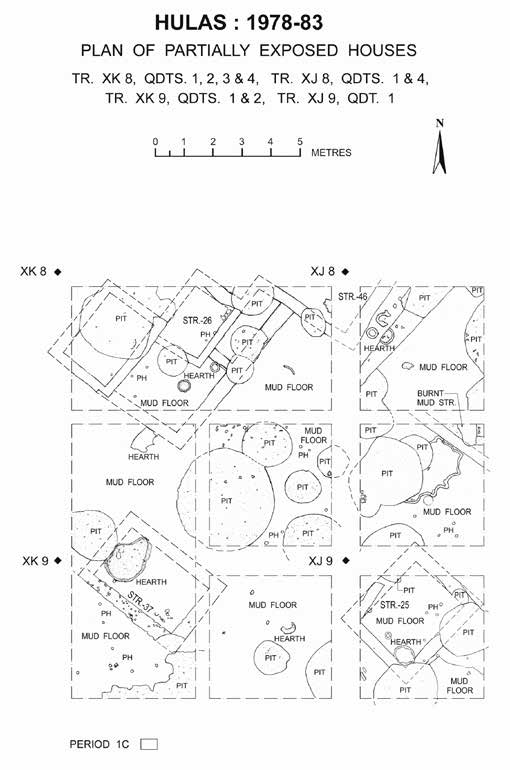
The buildings were not the brick-and-mortar ones of Harappa. They were post-and-daub huts on mud floors, with hearths in the corners and shallow refuse pits behind. There was no city wall. There was no street grid. There was nothing that resembled a citadel.
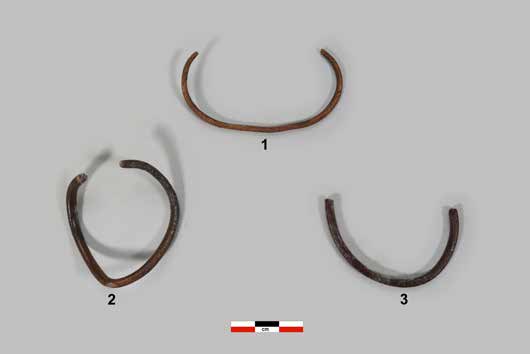
But there were objects in those huts that a Mature Harappan would have recognised. Copper bangles. Carnelian and agate beads, drilled in the long-bored Harappan style. Faience and steatite seals. Humped-bull figurines and squat female figurines in terracotta. And, on the floor of one house, a small terracotta sealing impressed with three signs of the Mature Harappan script.
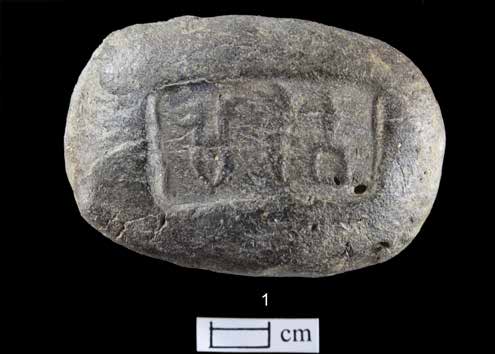
The script is the headline find. The Indus script was already a dying tradition by the time someone at Hulas pressed this seal into a piece of clay. We don't know if the local user could still read it, or whether they were copying a sign-set their parents and grandparents had used, the way a stamped logo can persist long after the original brand is gone. Either way, literate Harappan administrative practice had reached this small village in the upper Yamuna basin, and was still being practised, in some form, when the cities had already declined.
What people ate
The most surprising part of the Hulas report — surprising, anyway, if you've absorbed the usual story — is the agronomy. K.S. Saraswat ran the palaeobotany. Out of the Late Harappan layer came barley. Bread wheat and the smaller dwarf wheat, both Harappan staples. But also, in the same layer:
— Rice. Both cultivated Oryza sativa and grains of the wild rice O. rufipogon, suggesting the cultivated rice was being grown but possibly in fields where the wild relative still volunteered.
— Jowar (sorghum) and ragi (finger millet). Two African-origin millets that had reached India by the second millennium BCE and would dominate the dryland farming of north India for the next three thousand years.
— Lentils, chickpeas, field peas, grass peas, horse gram, green gram, cow peas. Six different pulses, all the staples of Indian dal-making, all already on the menu.
— Cotton. Castor, for oil.
— And, more unexpectedly: walnuts and almonds. Neither grows on the Yamuna plain. Both are at home in the Himalayan foothills 200 km north. Either Hulas had links to highland traders, or some highland traders had links to Hulas.
This was a mixed kharif-rabi farming village — winter wheat-barley-pulses laid over summer rice and millets — already in place a thousand years before the Painted Grey Ware culture, and with imports coming down from the hills. It is essentially the agricultural package of the Gangetic plain, established centuries earlier than the textbook chronology often implies.
What came after
Above Period I at Hulas, on a different part of the same mound, sits the Painted Grey Ware (PGW) layer. The PGW culture is conventionally associated with the early Iron Age of north India and, in some readings, with the early Vedic communities. The Hulas Late Harappan and the Hulas PGW occupations are not on the same spot. They are on different parts of the mound, with no direct stratigraphic overlap. There may even be a chronological gap.
This matters for one of the long-running debates in Indian archaeology. At a few sites — Bhagwanpura in Haryana, Dadheri in Punjab — Late Harappan and PGW pottery have been found in the same levels, suggesting overlap and continuity. Hulas is the opposite case: spatial succession rather than overlap. Same mound, different periods, no convincing handover.
What conclusions you draw from that depend on which sites you weight. The honest answer, as Dikshit himself notes in the report, is that the picture is uneven across the region. Continuity at some sites, replacement at others, almost certainly different local trajectories.
A village, on its own terms
The temptation with a site like Hulas is to read it as evidence for one side of a bigger argument: continuity from Harappan to Vedic, or rupture; cultural unity, or replacement; the survival of a tradition, or its end. The site is good evidence for none of those grand stories.
What it is is a small village, lived in for maybe four hundred years by people who farmed wheat and rice, herded cattle, wore copper, traded a little, and used at least the visual conventions of a writing system whose readers were already getting harder to find. It tells us what the post-urban Harappan world actually looked like in its hinterland — much smaller, much quieter, but technically continuous with what had come before. Not a collapse into illiteracy. Not the wholesale arrival of someone else. Just a village, getting on with it.
That, on the evidence at Hulas, is the answer that the ground gives.