How Scholars Date an Inscribed Blade: Script, Metallurgy, and the Limits of Guesswork
An inside look at the precise forensic methods historians and metallurgists use to date undocumented Indian weapons, from script evolution to the microscopic structure of wootz steel.

Devika Menon for SwavedaJuly 27, 2026
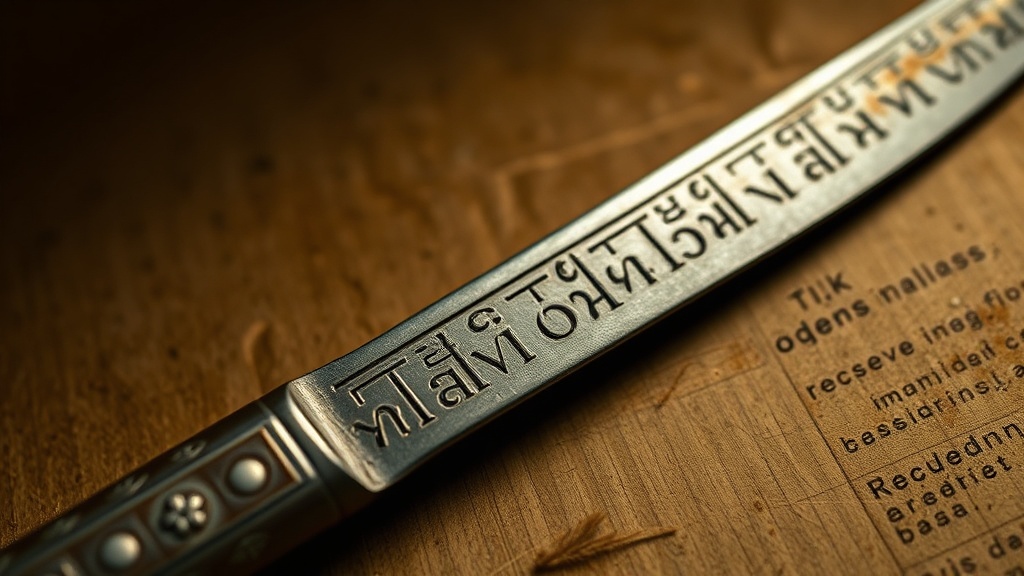
An anonymous collector recently posted images on social media seeking to identify an unusual find: a rusted, curved dagger featuring an inscription along the flat of its blade. The post on the r/IndianHistory subreddit sparked immediate debate. Commenters offered various guesses, pointing to scripts ranging from early Grantha (a South Indian script used for writing Sanskrit) to medieval variants, and speculating on its origin.
For historians and archaeometallurgists—scientists who study ancient metals—dating such an object is not a matter of intuition. When a weapon emerges from a private collection without a documented archaeological context, scholars cannot rely on the soil layers where it was found. Instead, they must treat the physical object as a composite document.
To determine when and where an inscribed blade was forged, researchers use three distinct disciplines: paleography (the study of ancient writing systems), metallurgy (the study of metallic properties), and typology (the classification of physical forms).
Reading the Steel: Paleography and Script Evolution
The first clue on an inscribed weapon is the writing itself. Scripts do not change overnight, but they evolve in highly predictable, sequential patterns. In India, almost all indigenous scripts derive from Brahmi, an ancient writing system that diverged into northern and southern regional families over centuries.
To date an inscription, epigraphists (scholars who study inscriptions) compare the shapes of individual characters to a master chronology of securely dated records, such as kingly land grants on copper plates or stone temple inscriptions. For example, if a blade features an early form of the Tamil-Brahmi script, a scholar will compare the shape of the letters ma or ra to known inscriptions from the trading ports of Arikamedu or Alagankulam.
If the script matches characters found on Roman coin hoards from the region—such as the copper coinages of the early Pandyan kingdom—scholars can narrow the date to a specific century.
However, script alone can be misleading. A later blacksmith or collector could have etched an archaic-looking inscription onto an old blade, or conversely, added a modern dedication to a genuine medieval weapon. This is why paleographic analysis must be verified by examining the physical cuts under a microscope.
If the grooved cuts of the letters show the same microscopic corrosion, rust patina (the green or brown film produced by oxidation over time), and wear as the rest of the blade, the inscription is likely original to the manufacture of the weapon. If the cuts are clean, sharp, and cut through existing rust layers, the writing was added later.
Inside the Metal: Wootz and Alloys
The second line of inquiry lies within the metal itself. India was renowned in antiquity for producing wootz steel, a high-carbon steel characterized by a distinctive pattern of wavy bands. This steel was produced using a crucible method, where iron ore and carbon sources like wood and leaves were sealed in clay pots and heated to extreme temperatures.
To analyze a blade without destroying it, metallurgists use non-destructive testing techniques. One common method is X-ray fluorescence (XRF), which directs X-rays at the metal to measure the secondary X-rays emitted. This reveals the exact elemental recipe of the alloy.
Scholars look for specific trace elements. Early Indian iron objects often contain minor impurities of titanium, vanadium, or chromium, depending on the specific ore mines used, such as those in present-day Telangana or Tamil Nadu.
Additionally, metallographers can polish a tiny fraction of the blade and view it under an optical microscope to analyze its crystalline structure. True wootz steel exhibits a network of iron carbides (hard chemical compounds of iron and carbon) that tells a story of intense heating, folding, and cooling.
If a blade claimed to be ancient lacks these specific carbide patterns, or if it contains modern industrial alloys like manganese steel, the weapon is quickly revealed as a modern reproduction.
Typology: Hilts, Pommels, and Proportions
The final pillar of identification is typology, which is the study of how the physical shape of an object changes over time. Just as modern car designs change by decade, weapon designs evolved to meet changing military tactics and aesthetic tastes.
Scholars map the geometric proportions of the blade, the style of the hilt (the handle), and the shape of the pommel (the counterweight at the end of the hilt). They compare these measurements to weapons depicted in dated temple carvings, hero stones (memorial stones commemorating fallen warriors), and court paintings.
For instance, daggers from the Vijayanagara Empire often feature distinct, ornate guard designs shaped like mythical creatures, whereas Maratha weapons from later centuries feature different grip guard configurations designed for mounted cavalry combat.
The Limits of Guesswork
When an object like the Reddit dagger is evaluated online, amateur historians often rush to identify the script based on visual similarity alone. However, academic consensus requires all three lines of evidence—script evolution, metallurgical composition, and physical typology—to align.
Without a laboratory analysis of the steel and a professional epigraphical reading of the inscription, any attribution remains a hypothesis. For scholars, a blade is not just a weapon; it is an archive of ancient chemical engineering and literacy, waiting for the right tools to unlock its date.