How ancient-DNA family reconstruction works—and what it can (and can't) tell us about burial practice
A new Pacific coast ossuary study shows how geneticists infer kinship from degraded bone—and why 'family burial' headlines often overreach on migration claims.
Rohan Bhattacharya for SwavedaMay 31, 2026
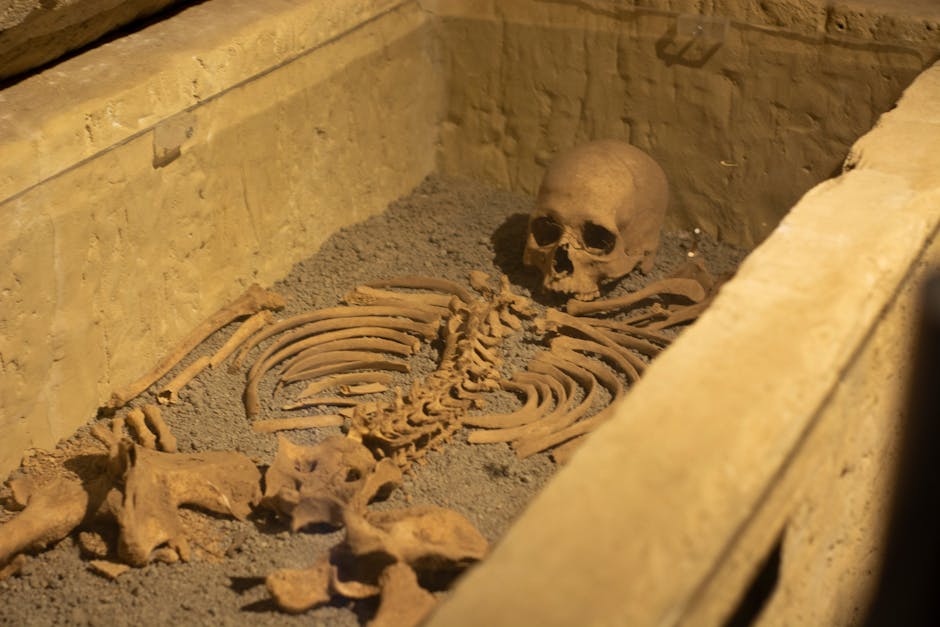
A team working on a pre-Columbian ossuary on Peru's north coast recently published genetic relatedness data for seventeen individuals buried together. The headlines wrote themselves: "Family tomb reveals ancient kinship networks." But the paper's methods section tells a more cautious story, one that South Asian bioarchaeologists should read closely. The study, published in Proceedings of the Royal Society B, used what geneticists call IBD—identity by descent—to estimate relatedness. IBD measures how much of two genomes comes from a recent shared ancestor. Above a threshold around 10% shared segments, you can call two skeletons first- or second-degree relatives with confidence. Below that, the math gets noisy.
This threshold matters. If you excavate twenty individuals from a single pit and find three parent-child pairs, you have evidence of family burial. If you find twenty individuals sharing 2-5% IBD with one another—plausible third or fourth cousins, or unrelated members of a small endogamous group—you have something murkier. This is a critical distinction, one often blurred in popular accounts.
What the thresholds mean
First-degree relatives—parents, children, full siblings—share roughly 50% of their genome by descent. Half-siblings and grandparent-grandchild pairs share about 25%. First cousins share around 12.5%. By the time you reach second cousins (roughly 3%), you are in the zone where population structure, endogamy, and ancient DNA damage all blur the signal. These figures are well-established in population genetics literature, with detailed breakdowns found in works like those published in American Journal of Human Genetics.
Ancient DNA adds its own problems. Thermal age—how hot the burial context was, for how many centuries—degrades the long DNA fragments that IBD analysis depends on. A skeleton from a waterlogged, cool site in northern Europe might yield fragments several hundred base pairs long. A skeleton from a Deccan Plateau cairn-circle, baked by three thousand monsoons, might yield fragments under sixty base pairs. Short fragments make relatedness calls harder. This differential degradation is a consistent challenge in bioarchaeology, as noted in numerous papers in journals like Antiquity.
Coverage matters too. If you sequence a skeleton to 0.5× genome coverage—meaning you sample, on average, half of each position in the genome once—you will miss segments. Low coverage plus short fragments equals high error bars on kinship. Accurate kinship inference, according to leading ancient DNA labs, requires coverage of at least 1× and ideally much higher.
Endogamy is not kinship
Here is where many ossuary studies overreach. If a population practices endogamy—marriage within the group for dozens of generations—everyone becomes a distant cousin of everyone else. You might calculate that two skeletons share 4% IBD and call them third cousins. But in a small endogamous population, 4% might be the baseline for any two random individuals. This phenomenon is a significant challenge when interpreting skeletal assemblages, especially in societies with long histories of localized marriage patterns.
Geneticists try to control for this by comparing the ossuary sample to a broader regional reference panel. If everyone in the region shares elevated background IBD, you can subtract it. But ancient South Asia rarely offers those reference panels. We have genetic data from a few dozen Harappan-period individuals, scattered across two thousand kilometers and a thousand years. We do not have the dense regional sampling to model what baseline endogamy looked like in, say, the Malwa plateau in 1500 BCE. The sparsity of data for ancient South Asia is a recurring theme in genetic studies of the subcontinent.
This is a practical constraint, not a theoretical one. Ancient-DNA labs now routinely publish relatedness networks for Bronze Age cemeteries in Europe, where sampling is dense and thermal age is kind to DNA. Those studies work because the data exist. Applying the same methods in the Deccan or the Ganga plain means working half-blind. As detailed in comparative studies published in Man and Environment, the arid and colder climates of parts of Europe preserve DNA far better than the humid tropics of South Asia.
What family burial actually tells us
Suppose you excavate a megalithic cist and find six skeletons. Ancient DNA shows three parent-child pairs. You have confirmed that this tomb held biological families. That is useful. It tells you something about commemoration, about who was buried together and why. This speaks to mortuary practices—customary ways of treating the dead—which archaeologists have long studied through grave goods and tomb architecture.
It does not tell you much about migration. If all six individuals share similar ancestry—similar proportions of Harappan-related, steppe-related, and Austroasiatic-related genetic components—you know the family had already mixed those ancestries for generations. You cannot assign them to a migration event. You have a snapshot of a post-mixing population.
Migration shows up clearly in ancient DNA when you find individuals with unadmixed or recently admixed genomes in contexts where the surrounding population looks different. The Rakhigarhi individual, for example, showed a lack of steppe ancestry in a period shortly before steppe ancestry became common in northwest South Asia, as reported in Nature (e.g., Narasimhan et al., 2019). That is a temporal contrast. Family burial within a single cemetery does not give you that contrast.
Lessons for Indian bioarchaeology
The Deccan plateau and the Ganga plain are full of cemeteries that could, in principle, yield this kind of data. Megalithic cist-clusters in Karnataka, urn-burial fields in Maharashtra, Black-and-Red Ware necropolises in Uttar Pradesh. The Anthropological Survey of India and university departments have curated skeletal collections for decades. These collections represent vast potential, but the preservation challenges remain significant.
But DNA preservation in tropical South Asia is poor. The few published studies—Rakhigarhi, Roopkund, scattered Harappan-period samples—required extraordinary effort to extract usable genetic material. Kinship analysis demands higher coverage and better fragment lengths than simple ancestry estimation. The thermal damage that makes South Asian ancient DNA hard to sequence will make relatedness inference harder still. Studies in Puratattva often highlight the archaeological richness of these sites, while acknowledging the limitations for paleogenetic work.
When those studies do arrive, the Peru ossuary offers a checklist. Did the authors report coverage and fragment length? Did they test for endogamy using a regional reference panel? Did they distinguish first-degree relatedness (clear) from third-degree (noisy)? Did they separate "family burial" (a mortuary claim) from "evidence of migration" (a population-history claim)? These are the questions that separate careful analysis from sensational interpretation.
The stratigraphy of DNA is pickier than the stratigraphy of soil. You can dig around a missing layer. You cannot sequence around a degraded molecule. This analogy, drawing on the fundamental principles of archaeological fieldwork, underscores the precise and often unforgiving nature of paleogenetic research.