Harsha's Eastern Campaign: Vengeance, Diplomacy, and the Fall of Gauda
King Harsha's early 7th-century invasion of Gauda was driven by personal tragedy and political necessity, aiming to avenge his brother and secure his sister's safety.

Meera Iyer for SwavedaJuly 14, 2026
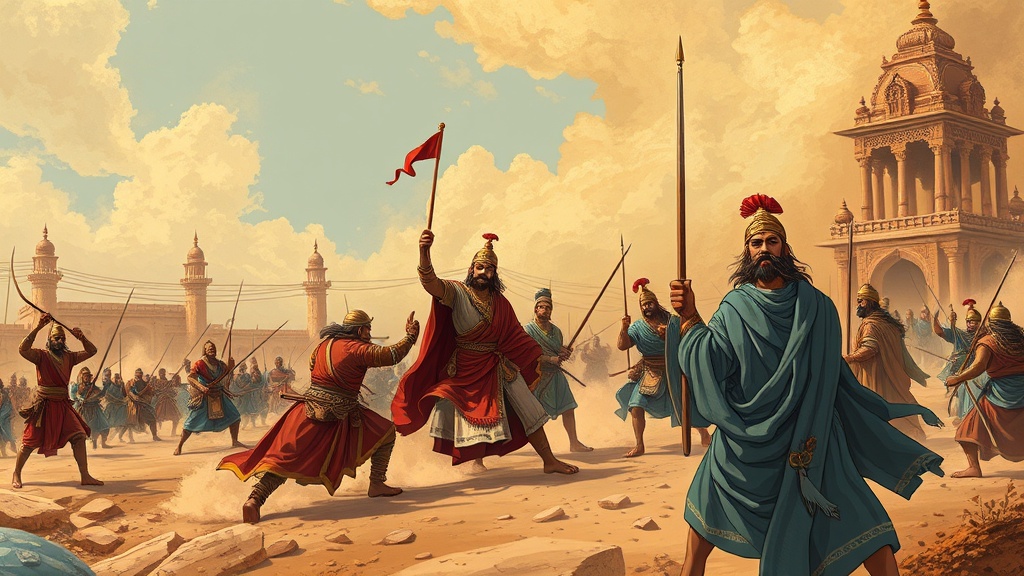
The early seventh century CE witnessed a dramatic upheaval in North India, orchestrated in large part by the ambitious king Harsha-vardhana. His military campaigns, particularly the extended engagement with the kingdom of Gauda in the east, were not merely acts of imperial expansion. Evidence suggests these actions were deeply intertwined with personal loss and the imperative to restore familial honor and safety. The narrative of Harsha's rise is inseparable from his brother Rajyavardhana's demise and his sister Rajyashri's peril, events that fueled his relentless pursuit of Shashanka, the ruler of Gauda.
Harsha ascended to the throne of Thanesar around 606 CE. His elder brother, Rajyavardhana, had taken the throne upon the assassination of their father, Prabhakara-vardhana. However, Rajyavardhana himself met a violent end shortly thereafter. The Harsacharita, a Sanskrit biographical epic by the court poet Bana, attributes Rajyavardhana's death to Shashanka of Gauda. According to Bana, Rajyavardhana had been lured into a deceptive peace negotiation by Shashanka and then assassinated. This act of treachery set the stage for Harsha's subsequent actions.
The Harsacharita details the dire circumstances surrounding Rajyashri, Harsha's sister and Rajyavardhana's wife. Following her husband's death, she was imprisoned or forced into hiding by Shashanka. Bana vividly describes Harsha's anguish upon learning of his brother's murder and his sister's endangered status. He portrays Harsha as vowing to avenge his brother and rescue his sister, declaring that he would not rest until he had subjugated all who opposed him and had brought Shashanka to justice. This personal vendetta became a significant driving force behind Harsha's early military policies.
The kingdom of Gauda, located in the Bengal region, was a powerful entity under Shashanka. The conflict between Harsha and Shashanka was protracted and complex, involving multiple military engagements over several years. Inscriptions and textual references suggest that Harsha's initial campaigns were focused on punishing Shashanka and recovering Rajyashri. The Harsacharita states that Harsha, after raising an army, marched eastward, "destroying the states that were hostile to his brother." This suggests a punitive expedition aimed at destabilizing and conquering Shashanka's territories.
While personal vengeance was a primary motivator, Harsha's actions also served broader political objectives. Subduing Gauda would remove a significant rival and threat from his eastern flank, allowing for greater consolidation of power in North India. The empire Harsha sought to build required him to assert dominance over recalcitrant rulers. Shashanka's alliance with Devagupta of Malwa, who had reportedly played a role in Rajyavardhana's assassination, further complicated the political landscape and provided Harsha with additional justification for his campaign.
The Harsacharita describes a complex diplomatic and military maneuvering. Harsha's forces engaged with Shashanka's armies, and while the precise details of every battle are not available, it is clear that the conflict was significant. The accounts suggest that Shashanka eventually fled his capital and that Harsha succeeded in locating and rescuing his sister, Rajyashri, who was on the verge of performing self-immolation, i.e., committing jauhar. Bana portrays a dramatic reunion between the siblings, emphasizing the fulfillment of Harsha's vow.
However, the fall of Gauda to Harsha appears to have been temporary. After Shashanka's death, which occurred sometime around 637-638 CE according to Tibetan sources, the kingdom of Gauda fragmented. While Harsha may have established suzerainty over parts of the region for a period, Gauda likely reasserted its independence or splintered into smaller states following Shashanka's demise. The political geography of eastern India remained fluid.
The textual evidence, particularly Bana's Harsacharita, is crucial for understanding Harsha's motivations. It frames the conflict not just as a power struggle but as a deeply personal mission driven by the assassination of his brother and the peril of his sister. The narrative emphasizes Harsha's filial piety and his determination to uphold family honor. This blend of personal tragedy and political ambition is a recurring theme in early Indian dynastic histories.
The linguistic structure of the Harsacharita itself is a testament to the literary sophistication of the period. Bana employs elaborate compound words and sophisticated prose to convey the emotional weight of the events. For instance, the compound word bhraatṛghna (brother-killer) appears in contexts that highlight the heinous nature of Shashanka's alleged act. Similarly, terms describing Rajyashri's distress and Harsha's resolve are rendered with great precision.
In conclusion, Harsha's eastern campaigns against Shashanka of Gauda were a defining chapter in his early reign. They were fueled by a potent mix of personal vengeance for his brother's murder and the urgent need to rescue his sister. While these motivations were deeply personal, they were strategically interwoven with the broader political aims of consolidating power and asserting dominance over rivals in North India. The Harsacharita provides a rich, albeit partisan, account of these events, offering insights into the complex interplay of personal honor, familial duty, and statecraft in early 7th-century India. The narrative underscores how personal tragedies could ignite consequential military and political actions that reshaped regional power dynamics.