From Khusan to Khwājā: What Bamiyan's Place-Names and Potsherds Share
A look at how shifting place-names in Afghanistan's Bamiyan valley trace the same layered history that archaeologists find in pottery strata at Khwājā Sabz Push.
Asha Naidu for SwavedaJuly 25, 2026
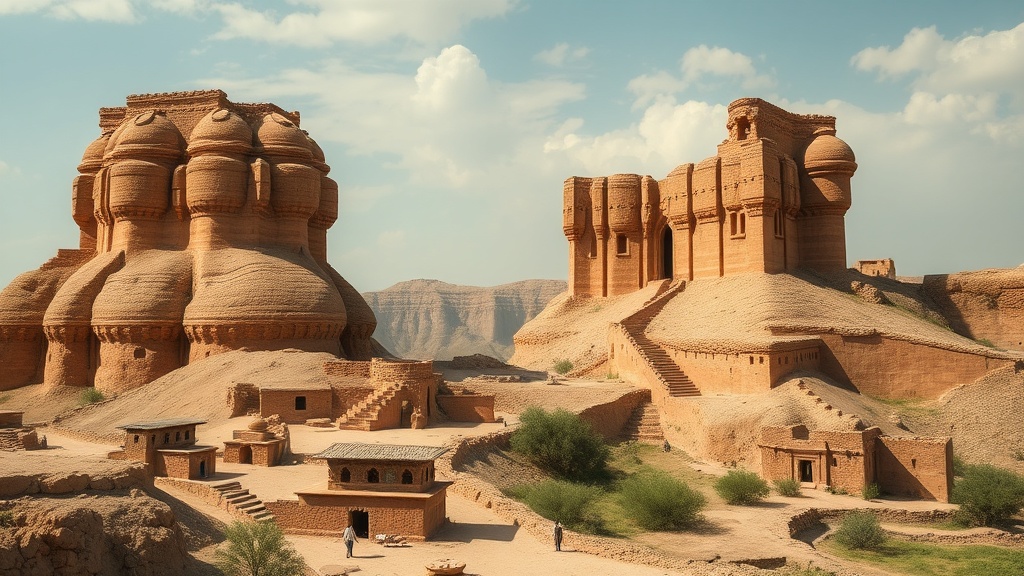
Names outlast the people who give them. Walk through the Bamiyan valley in central Afghanistan today and you will hear place-names that sound Persian, feel Islamic, and carry no obvious trace of the Sanskrit- and Bactrian-speaking world that once dominated the region. But dig — literally — and the ground remembers what the map has half-forgotten.
That is the premise behind a recent study of the site of Khwājā Sabz Push (a name that translates roughly as "the green-clad saint" or "green-robed lord," a common honorific for Sufi shrines across Afghanistan and Iran), published in ScienceDirect. The paper does something unusual: it treats pottery and place-names as two records of the same underlying process, rather than as separate specialties belonging to archaeologists on one side and linguists on the other.
A Valley at the Crossroads
Bamiyan sits on the old routes linking the Iranian plateau, Central Asia, and the Indian subcontinent — the network historians often call, loosely, part of the Silk Roads. Long before it became famous for its giant rock-cut Buddha statues (destroyed by the Taliban in 2001), the valley was a meeting point for Bactrian, an Iranian language once written in a modified Greek script, and Sanskrit, the classical language of Indian religious and administrative texts. Both left marks on the region's vocabulary for land, water, and settlement.
Scholars have long noted that Afghan toponyms often layer one language over another rather than replacing it outright. A river name might keep a Bactrian root while the village beside it takes a Persian descriptive term. An administrative term for a district or a tax boundary might survive from an earlier Sanskritic vocabulary even after the spoken language of daily life has shifted to Persian entirely. This is not unique to Bamiyan — it is a pattern seen wherever conquest and conversion move faster than the words people use for their own hills and streams. What makes Bamiyan a useful case study is that it sits squarely at the linguistic seam between the Iranian and Indic worlds, so both influences are visible in the same small valley rather than spread across a continent.
What the Potsherds Say
The archaeological side of the story comes from stratigraphy — the layering of soil and debris that lets excavators read a site like pages in a book, oldest at the bottom. At Khwājā Sabz Push, the ScienceDirect study documents a transition in pottery styles across the site's occupation layers, moving from wares associated with earlier Buddhist-era Bamiyan toward styles that align with later Islamic-period ceramic traditions found elsewhere in the region.
This matters because pottery, unlike language, does not care what people call themselves. A community can keep speaking Bactrian while adopting new cooking vessels, or keep an old place-name while its material culture changes completely. When the two records — words and wares — shift in tandem, it suggests something more than fashion: a broader realignment of trade networks, religious institutions, and possibly population, all moving in the same direction at roughly the same time.
Reading Two Records Together
The value of pairing linguistic and archaeological evidence is that each corrects the other's blind spots. Place-names can survive administrative upheavals by centuries — a Sanskritic term for a district boundary can outlive the empire that coined it, because tax collectors and farmers alike find it easier to keep using a familiar word than invent a new one. Pottery, by contrast, tends to track more immediate shifts in trade routes, kiln technology, and everyday habit.
Neither record alone tells you when a language died out in daily speech, or when a Buddhist monastic economy gave way to an Islamic one. But read together, a toponym that survives a pottery-style change becomes a kind of dated fossil: linguists know the term predates the ceramic shift; archaeologists get a rough peg for how long the older nomenclature lingered after the material culture around it had already moved on.
This is why Swaveda finds the Khwājā Sabz Push case useful beyond Bamiyan itself. It is a small, well-documented demonstration of a method — cross-referencing stratigraphy with historical linguistics — that could, in principle, be applied to other multilingual frontier zones across South and Central Asia, from Gandhara to the Indus delta, wherever names have outlived the languages that made them.
What Remains Unsettled
It should be said plainly: the precise chronology connecting specific place-name layers to specific pottery phases at Khwājā Sabz Push is a matter of ongoing archaeological interpretation, not settled fact. Stratigraphic dating always carries margins of error, and toponymic history is notoriously difficult to pin to exact centuries — names get borrowed, reborrowed, and reinterpreted by later speakers who no longer know the original meaning. The ScienceDirect paper itself frames its findings as part of a developing picture rather than a final word.
What the Bamiyan evidence does offer is a reminder that language change in this part of the world was rarely a clean handover from one tongue to the next. It was closer to sediment — one layer settling over another, with the older one still visible if you know where to dig.