Coins of the Konkan: What Changed in the Market After Vasai Fell to the Marathas
When the Marathas took Vasai from the Portuguese in 1739, the fort changed hands fast. The coins in people's pockets took longer to catch up.

Devika Menon for SwavedaJuly 31, 2026
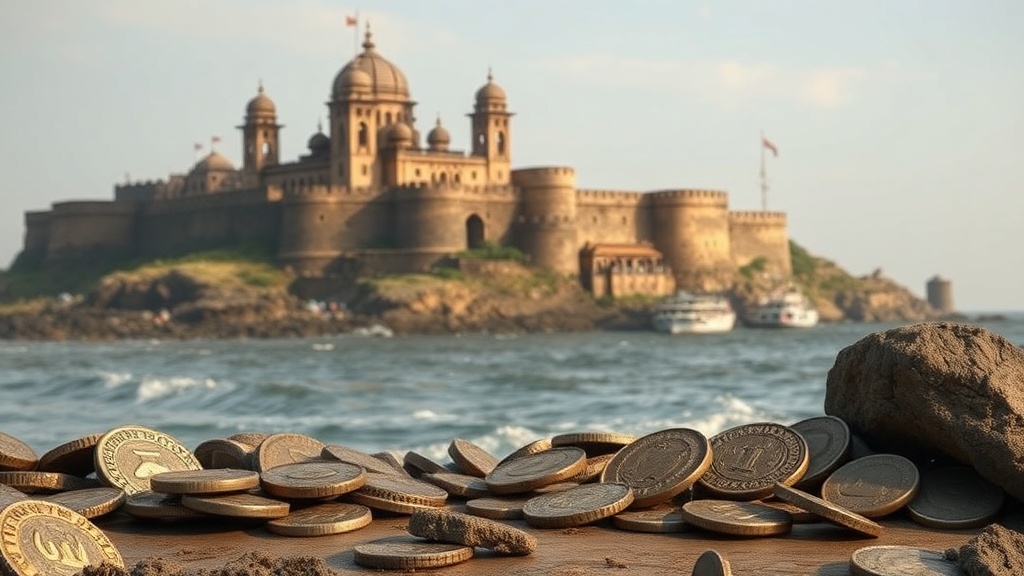
Vasai fort sits on a spit of land north of present-day Mumbai, and its walls still carry the scars of a siege that ran from 1737 to 1739. Photographs of those walls circulate today on history forums, including a thread on r/IndianHistory showing the fort as it stands now, hemmed in by the city that grew up around it. The forum post is a reminder of how close this battlefield now sits to daily life in Mumbai's northern suburbs. What's less visible in any photograph is what happened to the money.
Vasai — the Portuguese called it Bassein — was one of the wealthiest ports on the western Indian coast, part of the Estado da Índia (the Portuguese state in India, administered from Goa). When Chimaji Appa, brother of the Peshwa (the chief minister who led the Maratha state's military and civil affairs) Bajirao I, took the fort, he ended more than two centuries of Portuguese control over the northern Konkan. That much is settled history. What's murkier, and more interesting to anyone who studies coins rather than treaties, is how long it took for Portuguese money to disappear from local hands.
What Portuguese Coins Looked Like on This Coast
Portuguese India ran its own monetary system, distinct from Lisbon's. The base unit for everyday transactions was the tanga, a small silver coin struck at the Goa mint and circulated across Bassein, Chaul, and Daman. Higher-value trade used the cruzado, a gold coin whose weight and purity tracked the broader Iberian gold standard of the period. Both coins carried Portuguese royal arms and crosses, and both were struck to specifications set in Lisbon and adjusted locally in Goa.
These coins moved through a trading network that had linked the Konkan coast to the wider Indian Ocean for centuries before the Portuguese ever arrived — the same coast described by unnamed Greek merchants in the Periplus of the Erythraean Sea, and the same waters where Roman aurei and denarii turn up in hoards further south. Portuguese tangas and cruzados were simply the newest layer in a coastline that had absorbed foreign coinage before, and had usually kept using it long after the political map changed.
The Maratha Coins That Followed
The Maratha state issued two main forms of coin under the Peshwas: the Shivrai (a copper coin, named for Shivaji, used for small daily transactions) and the silver rupee, struck at various mints under Maratha control. Neither coin looked anything like Portuguese currency. There was no cross, no Latin legend, no Iberian weight standard. A Shivrai carried Devanagari or Persian-influenced legends tied to Maratha or Mughal-derived minting conventions, depending on the mint.
Conquest of a fort does not automatically mean conquest of a market. Coins are trusted because merchants agree to trust them, not because a flag changes on a rampart. In practice, newly conquered territories across early modern India tended to keep using the coin already in people's hands for some stretch of time after a change in rulership, simply because merchants, moneylenders, and tax collectors had no reason to distrust silver and gold that still weighed what it always had. Whether Vasai's markets kept tangas and cruzados moving for months or years after 1739, or whether Maratha administrators moved quickly to demonetize Portuguese coin and push Shivrai and rupees into circulation, is not something that can be answered from the fort's walls or from a single forum thread. It is a question for the mint records and treasury correspondence of the Peshwa administration, and for hoard evidence from sites in the northern Konkan — evidence that, as far as public numismatic literature currently shows, has not been assembled into a clear picture for this specific transition.
Why the Coast Matters More Than the Fort
The value of Vasai was never really about a single fortress. It was about what the fortress controlled: customs revenue on ships moving between Surat, Chaul, and points south, and access to a coastline that had been minting or absorbing foreign coin since the Sangam era (the early historic period of Tamil-speaking South India, roughly the last centuries BCE through the early centuries CE) further down the peninsula. Every power that took this coast — Chera and Chola-era chiefdoms, the Vijayanagara empire, the Portuguese, and then the Marathas — inherited a market already fluent in handling multiple currencies at once.
That fluency is probably the real story behind Vasai's coinage after 1739. Rather than a clean swap of Portuguese silver for Maratha copper, the more likely pattern — consistent with how other conquered ports on this coast behaved before and after — is an overlap period in which tangas, cruzados, Shivrai, and rupees all changed hands together, sorted by weight and trust rather than by whichever ruler's name sat on top.