Carving the Deccan: How Basalt and Sandstone Shaped Ravana Phadi's Rock-Cut Sculpture
Aihole's Ravana Phadi cave shows how seventh-century artisans worked within the hard limits of Deccan basalt and softer sandstone — and why geology, not just style, shaped what got carved.

Dr. Anil Patel for SwavedaJuly 25, 2026
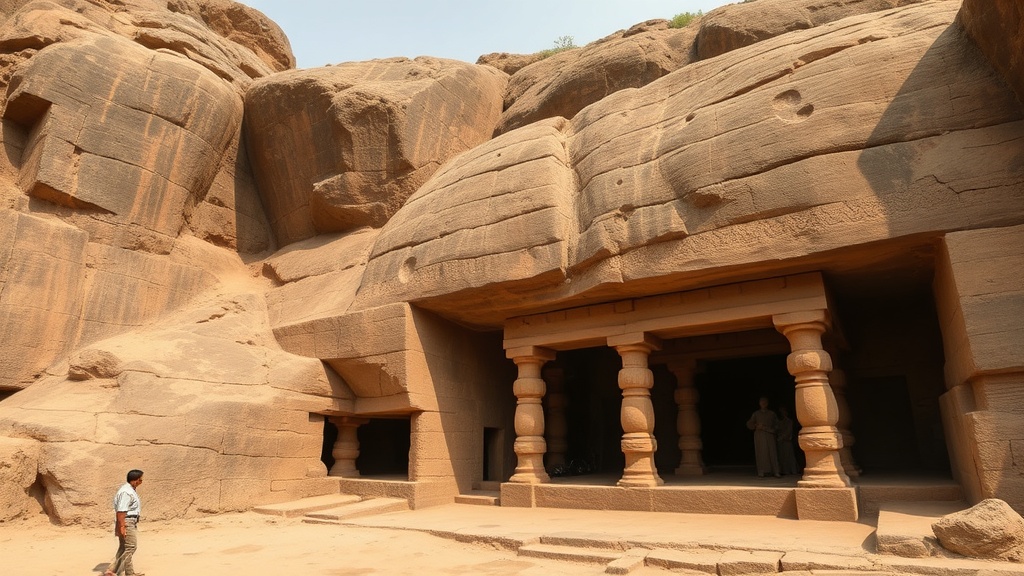
Cut into a low outcrop at Aihole, in Karnataka's Bagalkot district, is a cave that never had the luxury of forgiving stone. Ravana Phadi, a rock-cut shrine usually dated to the sixth or seventh century, was hollowed out of rock that fights back at every chisel stroke — and that fight, more than any aesthetic program, decided what the carvers could and could not do.
A recent thread on r/IndianHistory walking through the cave's carved panels is a useful starting point for a question that gets less attention than it deserves: how much of Indian rock-cut sculpture's style was a choice, and how much was simply what the rock allowed. Answering it properly means turning from the panels themselves to the rock they're cut from — and, admittedly, to sources further afield than a single Reddit post, since the thread itself doesn't cite geological literature.
Two very different rocks
The Deccan plateau, where Aihole sits, is built largely from the Deccan Traps — a stack of basalt lava flows that the U.S. Geological Survey's summary of large igneous provinces and related volcanology literature place at roughly 66 million years old, erupted near the end of the Cretaceous period. Basalt of this kind is fine-grained and hard, and — unlike sedimentary rocks — it generally lacks the kind of internal bedding planes that give a carver a natural line to work along. That's a well-established distinction in basic structural geology and petrology teaching materials, not a niche claim: igneous rocks cool as a more or less homogeneous mass, while sedimentary rocks like sandstone are built up in layers, or beds, that show as visible planes of weakness running through the stone.
That homogeneity in basalt is a double-edged advantage for a carver. Basalt does not flake unpredictably along weak seams the way some sedimentary rocks do, so once a form is roughed out, it tends to hold sharp edges well — one reason basalt and related hard volcanic rock were also prized for grinding stones and tools in far older contexts. But getting to that roughed-out form takes more labor, because there's no shortcut: no natural fracture plane to exploit, no soft layer to strip away quickly before finer work begins.
Sandstone, by contrast, is a sedimentary rock built from compacted, cemented grains, usually with visible bedding. It's softer and easier to remove in bulk. That property is part of why sandstone became a favored building material for many of North India's freestanding, structurally built temples, where blocks needed to be quarried, dressed, transported, and assembled rather than carved in place — a construction logic described in general terms in ASI's own material on temple architecture and conservation practice for sites built from cut and stacked stone rather than excavated rock. The same softness that makes sandstone quicker to shape also makes it more prone to weathering and to splitting along its bedding lines over centuries, a vulnerability visible at many sandstone monuments across North India.
What this meant for the sculptor's hand
The difference between rock-cut and structural temple architecture isn't just a matter of construction method. It's a matter of what the material will tolerate. A structural temple assembled from separately cut sandstone blocks can, at least in principle, be adjusted or repaired block by block. A rock-cut cave, carved from a single mass of living rock, offers no such correction — every cut is permanent the moment it's made. In basalt, where the material barely forgives a wrong stroke, that constraint plausibly pushed carvers at sites like Ravana Phadi toward compact, deeply modeled panels rather than the soaring, filigreed exteriors seen on structural sandstone temples.
This is a plausible engineering explanation for a pattern art historians have long noted about the Deccan's rock-cut sculpture — Ravana Phadi among the earlier examples, and the larger excavations at Ellora further north — which tends to favor high relief carved into the wall plane over freestanding, deeply undercut ornamentation. It should be said clearly: the specific claim that basalt's fracture behavior is the reason for this stylistic pattern, rather than one contributing factor among several, is my own inference from general rock-mechanics principles rather than a documented conclusion from a peer-reviewed study of Ravana Phadi specifically. I haven't found a published geological or conservation study of this particular outcrop, and none of the claims here should be read as more precise than that gap allows.
Reading the cave, not just the myth
The Reddit discussion of Ravana Phadi understandably focuses on the cave's carved narrative panels and its long-standing popular association with the Ramayana figure that gives the site its name — a connection that belongs to local tradition rather than to any inscriptional or textual evidence tying the cave's patronage to that story. What geology adds, tentatively, is a separate layer worth weighing alongside the art-historical reading: the panels' proportions, the depth of the relief, and the compact scale of the shrine chamber are consistent with what basalt at a similar outcrop would permit an artisan working with iron tools to achieve, even if no site-specific engineering survey confirms exactly how much that constraint drove the final design.
That distinction matters for how the site gets discussed. Ravana Phadi is often mentioned in the same breath as the grander structural temples that rose later at Aihole and Pattadakal, built largely in sandstone with more elaborate exterior ornamentation. The gap in scale and ornament between those later structural temples and this earlier rock-cut shrine isn't necessarily proof of a linear "improvement" in skill or ambition. It's at least as plausibly a story about what each rock formation would tolerate — and what a seventh-century mason, chisel in hand, already understood about the stone in front of him.