Why Neolithic Burzahom Families Lived in Pits—And What Archaeologists Found Inside
Pit dwellings weren't caves. They were deliberate structures—postholes, hearths, and storage pits—dug into earth floors. See what Burzahom's archaeology reveals about early Neolithic shelter design.

Rohan Bhattacharya for SwavedaSeptember 4, 2026
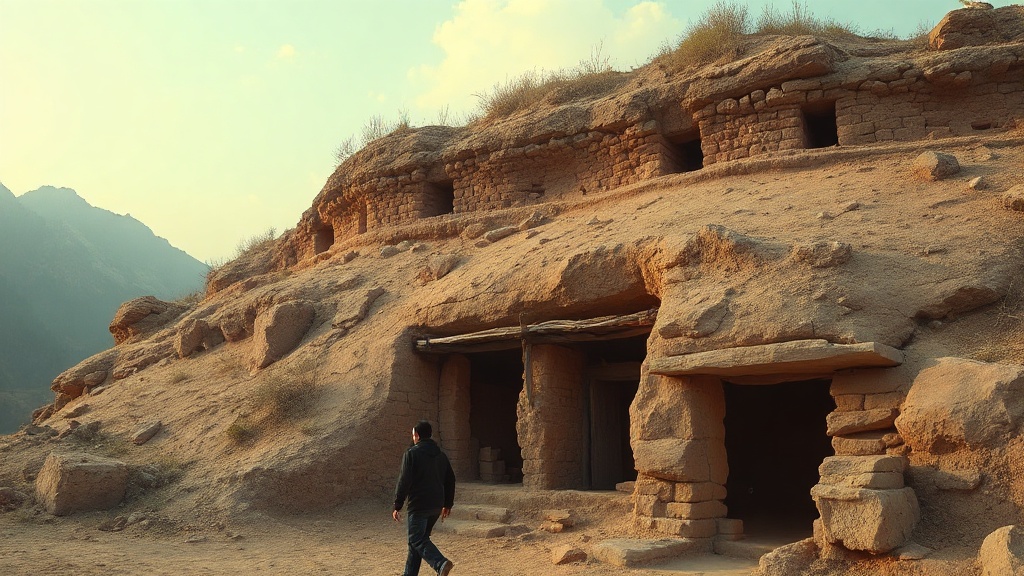
To understand why early farmers dug their homes into the earth, one must first look at the physics of soil. A pit dwelling—or semi-subterranean house—is not a primitive cave. It is a highly deliberate engineering response to extreme seasonal climates. Because earth has a high thermal mass (the ability of a material to absorb, store, and release heat), it absorbs and releases heat slowly. This means that a room dug even two meters below the surface remains significantly warmer than the ambient air during freezing winters and cooler during intense summers.
Constructing below ground also offered distinct structural advantages for early communities. In regions with high winds and limited timber, building a deep pit reduced the surface area exposed to the elements, requiring far less wood for load-bearing walls. Instead of erecting complex vertical frames, builders used the natural, compacted soil walls of the pit as the main support, needing only enough timber to construct a pitched roof. It was a low-cost, high-efficiency method of climate control and crop storage.
This architectural strategy was not unique to the sub-Himalayan hills. While contemporary Neolithic (New Stone Age) farmers at Lahuradewa in the middle Ganges basin constructed wattle-and-daub (interwoven twigs plastered with clay) homes on flat, humid plains, and early Chinese farmers along the Yellow River built semi-subterranean yaodongs (house caves), the communities of the Kashmir Valley faced a unique montane (mountainous) environment. For them, digging into the soft, wind-blown silt was the most logical path to survival.
Rough-cut footholds descend four meters into the hard loess—the fine, wind-blown silt that blankets the Kashmir Valley. At the bottom of these circular and oval shafts lies a distinct cultural signature: layers of ash, animal bones, and fragments of a thick, hand-built ceramic known as coarse grey ware.
This is Burzahom, a key Neolithic settlement located near Srinagar. While popular narratives often focus on the novelty of "underground living," the physical materials recovered from the soil tell a more precise story of human adaptation. The Archaeological Survey of India (ASI) began systematic excavations here in the 1960s under T.N. Khazanchi, uncovering a sequence that reshaped our understanding of early farming in the sub-Himalayan region. Today, the site remains protected, and though many excavated pits have been backfilled to preserve them from weathering, the dramatic lakeside terrace and the physical setting of this ancient settlement are still visible to visitors just north of Srinagar.
The Material Record: Coarse Grey Ware and Bone Tools
The earliest occupational layer at Burzahom, classified as Period I, is defined by what the inhabitants left behind on their subterranean floors. Chief among these diagnostic artifacts is coarse grey pottery. Unlike the contemporary, wheel-turned, and highly decorated wares of the Indus Valley Civilization to the southwest, Burzahom’s early ceramic tradition is strictly hand-formed.
The pottery is thick-walled, low-fired, and finished with a dull grey or brownish slip (a liquid clay mixture applied to pottery before firing). Mat impressions on the flat bases of these vessels show they were built on woven grass mats while the clay was still wet. This coarse grey ware was utilitarian, built for storage and cooking directly over open hearths. The fabric of the clay contains coarse sand and organic tempers (materials added to clay to prevent shrinkage and cracking), which made the vessels thermal-shock resistant but structurally crude compared to the fine, painted red wares of the lowlands.
Alongside this pottery, archaeologists recovered a remarkably dense assemblage of bone tools. These include polished bone needles, harpoons, awls (small pointed tools for piercing holes), and scrapers made from the long bones of local deer species. Polished stone axes, celts (prehistoric stone axe heads), and ring-stones also litter the occupational floors, pointing to a community that relied heavily on local forest resources, fishing, and agriculture.
Building Below the Frost Line
The physical layout of the Burzahom pits explains how these early farmers navigated Kashmir's climate. The loess soil of the valley floor cuts easily with stone or antler tools when moist, yet hardens into a durable wall when exposed to air.
Excavation profiles reveal bowl-shaped or inverted-cone shafts, narrower at the top than at the base. Depths range from shallow, one-meter storage pits to large, four-meter-deep living chambers. The walls of many living pits were plastered with a thin layer of lime or fine mud to prevent crumbling. Post-holes ring the outer rims of these pits. Evidence shows these holes supported a timber framework that carried a thatch-and-branch roof above ground level.
This detail is critical: only the living floor was below ground. The roof sat above it, meaning these were not completely subterranean bunkers but rather semi-subterranean houses.
Earth is a poor conductor of heat. By digging their living quarters below the frost line, Burzahom's families created a natural thermal buffer against Kashmir’s freezing winters. Inside the pits, hearths appear singly or in pairs, with ash built up in layers thick enough to suggest years of repeated, seasonal use. While defense against wild animals is a plausible motive for living below ground, the lack of weapons or skeletal trauma in Period I suggests this was a climatic adaptation rather than a defensive strategy.
Stratigraphy: Reading the Shift to the Surface
Archaeologists reconstruct the sequence of a site through stratigraphy—the physical layers of soil deposited over centuries. At Burzahom, this sequence is divided into distinct periods, showing a clear technological shift over time.
In Period I, the pit dwellings, coarse grey ware, and bone tools dominate the lowest stratigraphic layer. In Period II, which begins in the mid-second millennium BCE, the pits are completely filled with rubbish and sealed over. The stratigraphic drawings show a clean, horizontal line where digging stopped and surface construction began.
During Period II, the inhabitants built above-ground structures of mud-brick and packed earth. They also paved their outdoor living spaces with flat stone slabs. Their pottery evolved, introducing burnished black ware (pottery polished to a high sheen before firing) and finer wheel-made vessels, though the traditional coarse grey ware persisted in modified forms.
The absolute dating of these periods remains a subject of ongoing debate in Indian archaeology. Period I is generally placed between 3000 BCE and 1500 BCE. Scholars writing in journals like Antiquity and Puratattva have pointed out that radiocarbon dates from organic samples at the site show significant variations. This suggests that the transition from pit dwellings to surface homes did not happen overnight but occurred gradually over several centuries.
Regional Patterns and Social Questions
Burzahom does not stand alone. Other sites in the Kashmir Valley, most notably Gufkral, show an identical sequence: early pit dwellings associated with coarse grey ware, followed by a transition to surface-level mud-brick housing. This regional pattern confirms that pit-dwelling was a localized, valley-wide response to the montane environment, rather than an isolated experiment.
This regional tradition contrasts sharply with other Neolithic horizons in South Asia. At Mehrgarh in Balochistan, builders used sun-dried mud-brick from the very beginning of the settlement. In the Ganges Valley, early farmers constructed wattle-and-daub houses on flat ground.
While the physical remains at Burzahom are well-documented in reports by the Archaeological Survey of India, the social organization of the pit dwellers remains a subject of debate. Scholars debate whether individual pits housed single-family units or if clusters of pits served as connected domestic hubs, with some designated for living and others for cold-storage. What the material record in Man and Environment does confirm is a highly successful, sedentary (settled) lifestyle—evidenced by domestic dog burials alongside humans and thick deposits of hearth ash—that laid the groundwork for permanent settlement in the Kashmir Valley.