The pit-dwellers of Burzahom
On a karewa terrace near Srinagar, Kashmir Valley farmers spent winters in plastered loess pits, ate wheat and barley with the same crops their Indus contemporaries grew, and left behind one carved slab that has been argued about for fifty years.
SwavedaApril 29, 2026
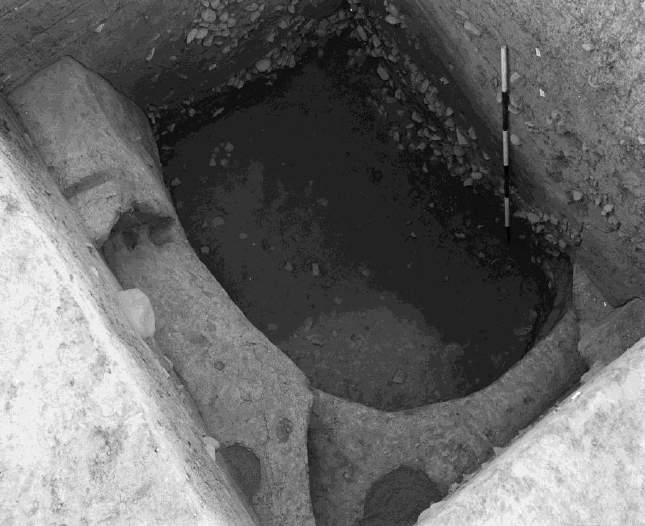
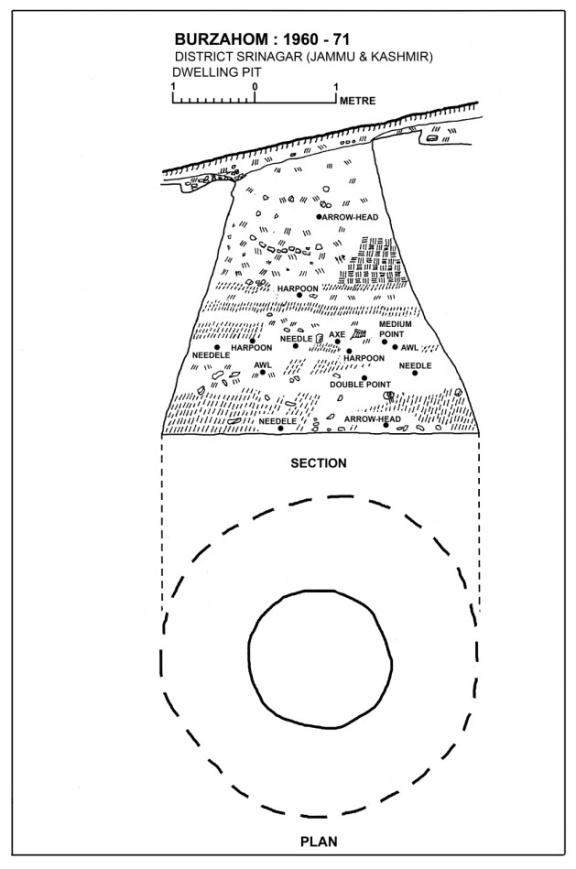
On a flat terrace of yellow karewa loess about 16 kilometres north-east of Srinagar, sometime around 3000 BCE, a small group of farmers picked up long polished stone celts and started digging holes in the ground. The holes weren't meant to be storage pits. They were meant to be the houses themselves — circular or oval at the surface, narrowing as they went down, then opening up at the bottom into a flat-floored, plastered chamber large enough for a family to live in. The largest excavated example at the site is 3.96 metres deep and 4.57 metres across at the base.
The site is Burzahom. It is one of the most distinctive Neolithic sites in South Asia, and its pit-dwellings are one of the few places in the subcontinent where the architecture of an early farming community survives well enough to walk around inside.
ASI's T.N. Khazanchi excavated Burzahom across eleven seasons between 1960 and 1971. Khazanchi was a careful field excavator trained in the Wheeler tradition, but he never published a final report. The volume that exists, Excavations at Burzahom (1960–1971), was compiled decades later by R.S. Fonia from Khazanchi's site notebooks and unpublished notes.
The cultural sequence
Eight radiocarbon dates from TIFR Bombay (run on charcoal in 1965–66) anchor the chronology. With MASCA calibration:
- Period IA (Aceramic Neolithic): roughly 3000–2850 BCE. The earliest occupation. People are already farming, already living in pit-dwellings, but pottery has not yet entered the assemblage.
- Period IIA (Early Ceramic Neolithic): 2850–2550 BCE. Handmade coarse pottery appears, alongside fine and burnished grey wares and a gritty red ware. Some pots have mat impressions on the base — they were set on woven mats while the clay was still wet.
- Period IIB (Late Ceramic Neolithic): 2550–1700 BCE. Wheel-thrown pottery enters. One of the diagnostic finds from this period is an intrusive Pre-Harappan painted pot in the Kot-Diji style, the kind of thing made in the Indus zone several hundred kilometres south. Someone was carrying pots over the mountains.
- Period III (Megalithic): 1500–1000 BCE. Menhirs and rubble masonry appear. The Neolithic pottery and bone tools persist.
- Period IV (Early Historic): running into the 3rd–4th centuries CE.
The site is broadly contemporary with Mature Harappan urbanism in the Indus plain. While the Indus cities ran their bricks-and-drains civilisation, the Burzahom farmers were three metres underground in plastered pits.
What they ate, who they were
The crops at Burzahom are striking precisely because they are not striking. Wheat (Triticum compactum and T. sphaerococcum), barley (Hordeum vulgare), and lentil (Lens culinaris). The same Western and South-West Asian Neolithic package that turns up at Mehrgarh in Balochistan around 7000 BCE and at Indus Valley sites a millennium and a half later. Burzahom is a wheat-and-barley culture, not a rice culture — aligned with the western half of the South Asian Neolithic crop map, even though it sits geographically closer to the eastern Asian rice zone.
Domesticated dog, sheep, and goat appear by Period IIA. Charcoal samples are mostly pine and birch — the local hill-zone fuel.
The burials are unusual. Ten human burials and eleven animal burials at the site, dug into pits below the floors of houses. Bodies are crouched or extended, mostly oriented north, often dusted with red ochre. The grave-goods are sparse — a miniature pot, a few carnelian beads, a soapstone disc — but two stand out:
- Skeleton 7, from the Megalithic period: a 26–30-year-old female with a trephined skull. The opening was deliberate, the survival of which is unclear from the bone evidence alone but the surgery had been performed. Burial accompaniments included a soapstone disc, an animal jaw, and antlers.
- Skeleton 3, also Megalithic: a woman buried with a dog's skull placed in her grave.
Another pit, separate from the human burials, contained the bones of wild dogs alongside two barasingha (swamp deer) antlers. Burzahom's people had complicated relationships with their animals, including their dogs, and those relationships extended to the grave.
The slab
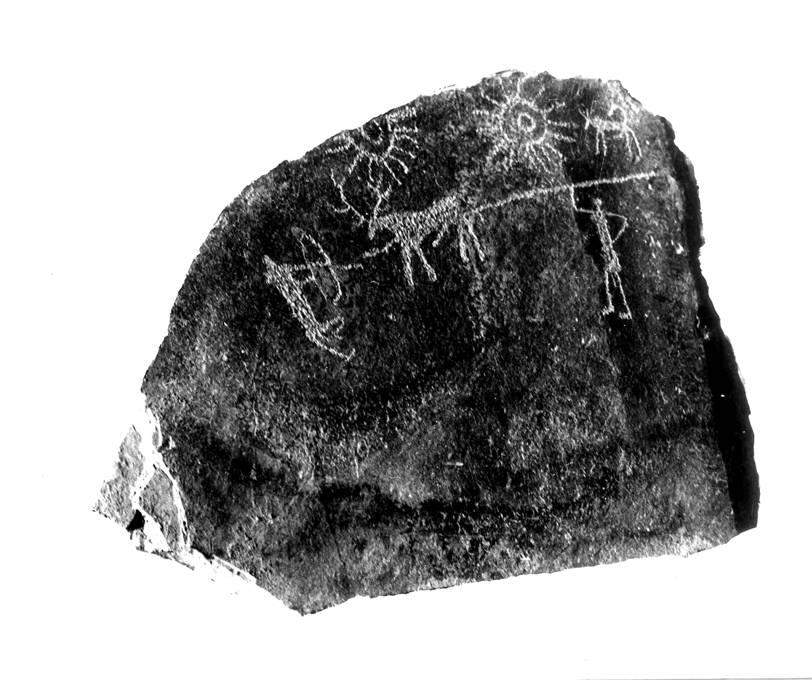
The artefact that has generated more outside-the-report scholarship than any other from Burzahom is a single engraved limestone slab, found face-down inside a Period IIB rectangular structure that originally seems to have been the lining of a small stone tank.
The carving on the slab shows: a large stag, pierced by a long spear from behind and an arrow from the front; two human figures, identified in the report as one male and one female on the basis of attributes; a dog above the stag; and — distinctively — two solar discs in the upper register.
The Fonia report reads the scene through Joseph Campbell's "primitive mythology" framework: the two discs as sun-on-departure and sun-on-return in a hunting ritual, the male and female figures as a pair, the slab as the only confirmed Neolithic narrative art from a stratified Indian context.
A separate strand of literature, post-2010 — particularly by Mayank Vahia, Mrinmoy Joglekar, and others — has proposed that the two discs are not a stylistic doubling but a record of an astronomical event. The two readings most often offered are: a supernova (HB9, possibly the Vela supernova around 4500 BCE), or a meteor flying past the sun. Either reading would make the slab one of the earliest astronomical observations preserved in the archaeological record anywhere.
The supernova hypothesis is interesting. It also runs straight into a chronology problem: the slab is from Period IIB, c. 2550–1700 BCE. Ancient supernovae bright enough to be daytime-visible — which is what would justify the depiction — are rare events; HB9 is dated by stellar remnant-radius arguments, not by archaeological cross-reference, and the date range extends much earlier than the slab's archaeological context. The simpler reading is the Fonia/Campbell one: two stylised solar/celestial symbols in a hunting ritual scene, drawn by Neolithic farmers for whom the sun and the moon and the major celestial events were the everyday rhythm of life.
We are not endorsing one reading over another. The slab is what it is — small, weathered, hard to photograph well — and the multiple readings are what they are. The popular version of the story tends to overstate the supernova case; the careful archaeological version, including the report's own discussion, treats it as one possibility.
A cousin of the Northern Neolithic
The Burzahom assemblage doesn't fit cleanly into the South Asian archaeological narrative, and the report is clear about that. The pit-dwellings have parallels at Loebanr (Swat valley), Karuo (eastern Tibet), and across northern China and Mongolia. The polished rectangular harvester knife — there are 57 stone and 2 bone examples in the Burzahom assemblage, with hourglass-section perforations drilled from both faces — has its closest stylistic parallels in Chinese Neolithic harvesters. Khazanchi himself, in field notes incorporated into the Fonia volume, suggested Burzahom belonged to what Stacul and Fairservis later called the "Inner Asia Complex" — a network of high-altitude Neolithic farming communities running from the Himalayan foothills across into Tibet and China, sharing pit-dwelling architecture and certain tool forms.
That network is real but loose. The Burzahom farmers were eating an Indus crop package and using inner-Asian-style architecture and tools, while occasionally trading for Indus-style painted pots. Cranial-morphometric work on the burial sample, published in the 1960s, suggested a resemblance to mature Harappan Cemetery R-37 skulls — but old morphometrics are weak evidence for population history, and modern aDNA work has not yet been done on the Burzahom collections.
What it means to read this site honestly
Burzahom is the kind of site where it is easy to want a tidy story. The pit-dwellings invite a romance of "the ancient houses of Kashmir." The slab invites either an astronomy-discovery or a Vedic-ritual reading. The skeletal collections invite a population-continuity claim.
The honest version, supported by the archaeology and largely by the report itself, is more careful. People at Burzahom dug houses into the ground and lived in them for at least a thousand years. They grew wheat and barley. They buried their dead, and sometimes their dogs, beneath their floors. They made beautiful polished stone tools. They had contact with the Indus zone, with the Tibetan plateau, and with a wider Inner-Asian Neolithic network whose full extent we are still mapping. They left a carved limestone slab whose meaning is genuinely unsettled fifty years after it was excavated.
That is a real and interesting story without any of the romance. Most archaeology is.