Bullion or Currency? Re-evaluating Roman Coins in the Eyyal Hoard
Archaeological analysis of the Eyyal hoard suggests Roman denarii circulating in ancient Kerala were treated as raw metal rather than legal tender for daily transactions.

Devika Menon for SwavedaJuly 19, 2026
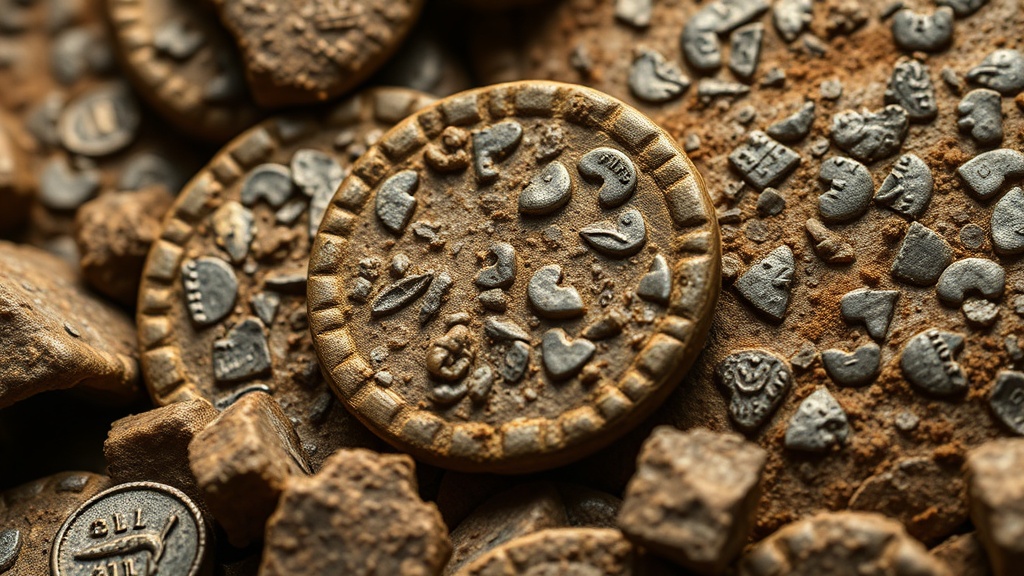
The Eyyal hoard, discovered in 1946 in the Thrissur district of Kerala, remains a centerpiece of discussions regarding early Indian maritime trade. The discovery contained a significant collection of Roman denarii (silver coins used in the Roman Republic and Empire), gold coins, and local punch-marked currency. While early interpretations assumed these coins functioned as standard money for everyday market exchanges in Sangam-era ports, recent scrutiny of the site’s stratigraphic context and the physical condition of the metal suggests a different reality.
The Physical Evidence of the Eyyal Hoard
The coins recovered from Eyyal—documented in official reports by the Archaeological Survey of India—include specimens ranging from the Republic period to the early Roman Empire. When numismatists examine these pieces, they observe a peculiar pattern: many coins exhibit deep scratches, intentional "banker's marks," and in some cases, deliberate clipping or shearing.
Tradition holds that these coins served as proof of direct commercial interaction between Rome and the Chera dynasty. However, archaeological evidence shows that by the time these Roman silver pieces reached the southwestern coast, their value as standardized legal tender had largely evaporated. Instead, the physical modifications on the coins suggest they were treated as bullion—raw precious metal valued by weight rather than the face value issued by a Roman mint.
Defining Currency in a Maritime Context
To understand why a Roman denarius would be treated as metal, we must look at the nature of the Periplus of the Erythraean Sea (an anonymous Greek logbook describing navigation and trade in the Indian Ocean). The text details the import of high-value goods into ports like Muziris, located on the Malabar coast. Merchants brought gold and silver not necessarily to circulate as currency, but to facilitate high-volume trade.
In the context of the Eyyal hoard, scholars debate whether these coins ever left the sphere of elite exchange. If a merchant arrived at a port, they required a medium of exchange that was universally recognized by goldsmiths. A Roman coin, regardless of its origin, possessed a consistent fineness of metal. By clipping or marking these coins, local silversmiths could verify the purity of the silver before re-melting the metal for local jewelry production or the creation of regional coinage.
Stratigraphy and Site Context
The challenge in interpreting the Eyyal find lies in the site's stratification. Stratigraphy is the study of rock or soil layers to determine the age and sequence of archaeological materials. Because the hoard was not recovered under modern, controlled excavation conditions, tracking the precise relationship between the Roman coins and the associated local pottery or punch-marked coins is difficult.
The association of Roman denarii with indigenous punch-marked coins indicates a "mixed-currency" environment. Evidence shows that the Roman imports functioned alongside local systems, but there is no proof that Roman denominations were used for small-scale retail. A laborer in the 1st or 2nd century CE in Kerala would likely have relied on barter or local copper/lead issues. The Eyyal denarii were almost certainly held by a wealthy merchant or a local chieftain, used for hoarding wealth or funding large-scale maritime ventures.
Beyond the Roman Narrative
Modern analysis encourages moving away from the assumption that the presence of Roman coins equates to the Romanization of the local economy. Instead, these artifacts reflect a pragmatic approach to material wealth. When Indian traders accepted Roman silver, they were participating in a global commodity market where gold and silver were the ultimate standards of value.
The wear patterns on the Eyyal coins confirm that their utility was not in the marketplace of the common citizen, but in the workshop of the artisan and the vault of the elite. The coins were essentially a portable form of stored capital. This perspective aligns with findings from other coastal sites in the region where Roman coins are found in caches rather than scattered across diverse habitation layers.
When we view these objects not as lost money, but as repurposed raw material, the history of the Kerala coast becomes clearer. It was not a province of Rome, but a sophisticated partner in a trade network that understood the value of precious metals regardless of whose face was stamped on the surface. The Eyyal hoard serves as a physical record of this transition—from the official currency of a distant empire to the foundational material of a local economy. Future excavations, conducted with the rigor demanded by modern archaeology, will likely continue to verify that Roman coins in India were valued more for their substance than their political symbolism.