Indus Valley Board Games: What Tokens and Dice Reveal About Recreation and Rules
Archaeologists have found tokens, dice, and carved gaming boards at Harappan sites. What do these objects tell us about leisure, strategy, and daily life in the ancient Indus cities?

Rohan Bhattacharya for SwavedaAugust 27, 2026
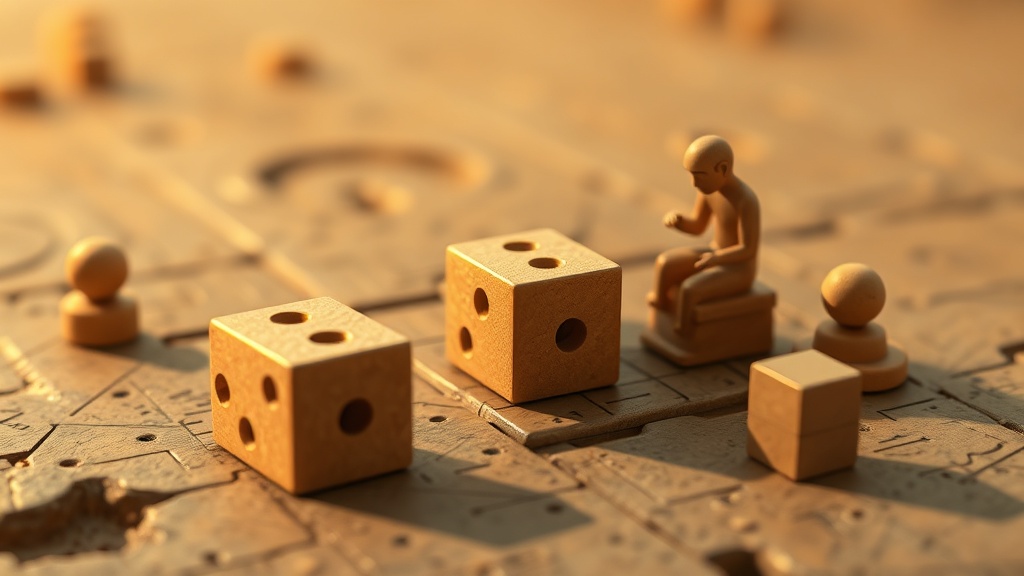
Field archaeology is often a study of frustrating abundance. At Indus Valley Civilisation (IVC) sites, excavations routinely yield small, highly polished artifacts that demand classification. Among the structural foundations, refuse pits, and drainage channels of ancient urban centers, excavators frequently recover terracotta cubes, drilled shell strips, and small, tapered stone pieces. These objects are almost universally cataloged as "gaming pieces" or "dice" in official excavation inventories.
From the brick-lined streets of Mohenjo-daro in Sindh to the massive water reservoirs of Dholavira in Gujarat, the sheer volume of these small finds points to a widespread culture of leisure. At Mohenjo-daro, early excavators cataloged dozens of cubical stone dice made of banded chert and clay, alongside stylized conical counters. At Dholavira, archaeologists recovered flat, incised stone slabs that appear to have served as game boards, marked with gridded lines.
Yet, as any excavator working through Harappan stratigraphy knows, recovering the physical fragments of play is not the same as recovering the game itself. While we can weigh a stone counter, measure a terracotta die, and map their find-spots within a residential block, the rules that governed their movement remain buried. In the absence of written manuals or clear iconographic depictions of play, archaeologists are left with a fundamental methodological puzzle: how to reconstruct the cognitive and social rules of a society using only its discarded playthings.
The Stratigraphy of Play
In the excavation reports of the Archaeological Survey of India (ASI) and early monographs on Mohenjo-daro, lists of small finds are packed with cubical dice and tetrahedral counters. Unlike the elite, monumental tombs of ancient Egypt, which preserved intact wooden gaming boards like Senet (a passing game) alongside their players, the domestic contexts of the Indus Valley present a more fragmented record.
According to research published by Elke Rogersdotter on Harappa.com, gaming artifacts at Mohenjo-daro are not concentrated in specialized civic spaces or elite precincts. Instead, they are found scattered across ordinary domestic quarters. This distribution suggests that play was an integrated, everyday activity rather than a highly restricted ritual.
However, this domestic distribution complicates our understanding of how these objects were used. When an archaeologist uncovers a single terracotta cube with shallow drilled dots representing numbers, it is often found in isolation, separated from any recognizable board or associated counters. The organic materials that likely formed the boards—wood, cloth, or leather—have decayed in the acidic, saline soils of the Indus floodplain.
What remains are the non-perishable components. We find ceramic shards incised with crude grids, stone boards carved with parallel lines, and small clay cones. In many cases, these objects are highly fragmented. A single grid scratched into a broken floor tile might be a gaming board, a merchant's tally sheet, or simply idle graffiti.
The Material Typology of Counters and Dice
To understand the structure of Indus play, researchers must look closely at the design of the surviving pieces. The variety of materials used to manufacture counters indicates a wide social reach. Simple terracotta cones, hand-pinched and hastily baked, appear alongside meticulously carved shell pieces, polished jasper, and glazed faience (a quartz-based ceramic glaze).
The dice themselves are particularly revealing. The classic six-sided cubical die is common at Mohenjo-daro, but its numbering system differs from modern standards. On many Indus dice, opposite sides do not consistently add up to seven. Instead, the placement of the circular dots, or pips, varies, indicating that different regional centers—or perhaps different games—followed distinct numerical conventions.
Other finds include long, four-sided bar dice made of clay, terracotta, or bone. These sticks, incised with parallel lines or concentric circles on each face, would be rolled along their longitudinal axis. The presence of both cubical and bar dice suggests that Indus games utilized different methods of generating random numbers, much like the modern distinction between using standard dice and using casting sticks in traditional South Asian games like Pachisi (a cross-and-circle board game).
Speculation Versus Evidence
In the pages of journals like Puratattva and Man and Environment, scholars have long debated how to bridge the gap between artifact typology and actual gameplay. Without bilingual texts or clear murals showing people in the act of play, any reconstruction of Indus game rules remains speculative. Evidence shows that Harappans possessed the mathematical and material capacity to design complex games, but tradition holds that many modern Indian games are direct descendants of these ancient pastimes—a claim that scholars debate.
Archaeological analysis of these play fragments must navigate two opposing analytical traps. The first is "anachronistic projection"—the assumption that because an ancient board looks like a modern game, it must have been played with the same rules. For decades, researchers have compared Indus grid carvings to historical Indian games like Chaupar (a cross-and-circle game) or Ashtapada (an eight-by-eight board game played with dice). While these comparisons are useful for generating hypotheses, they cannot serve as proof. Rules are highly mutable; even today, the same physical board can support multiple entirely unrelated games.
The second trap is "functional reductionism," where every unidentified small object is classified as a religious or ritual item. When early excavators found small, stylized stone cones, they were occasionally labeled as miniature lingas (symbolic representations of the deity Shiva). Later typological studies, however, grouped these same objects with flat-bottomed gaming counters because they are frequently found in association with dice and marked surfaces.
According to the analysis by Rogersdotter, the spatial distribution of these finds at Mohenjo-daro reveals a pattern of "patchy and coherent" features. The scatter of play-related items across specific households indicates that while the materials themselves were common, the actual occasions of play may have been highly localized and episodic.
The Missing Rules
For the field archaeologist, the search for Indus board games is a reminder of the limits of material culture. We can reconstruct the trade networks that brought chert and shell to the workshops of Mohenjo-daro and Dholavira. We can use microscopic analysis to show wear patterns on the base of a clay counter, proving it was slid across a rough surface hundreds of times. We can even date the stratigraphic layer in which a die was lost.
Yet, the social agreement that made those objects meaningful—the rules of the game—remains invisible. A game board is not merely a physical object; it is a spatial representation of a shared cognitive system. It represents boundaries, safe zones, obstacles, and victory conditions. When we hold an Indus gaming piece, we are holding half of a conversation. The physical half is preserved in clay and stone; the intellectual half has vanished, leaving us to study the silent instruments of a forgotten pastime.