Aihole: The Cradle of Early Chalukyan Temple Design
Aihole's hundreds of temples reveal a crucial period of architectural innovation that shaped South Indian temple design during the Early Chalukya era.

Rohan Bhattacharya for SwavedaJuly 14, 2026
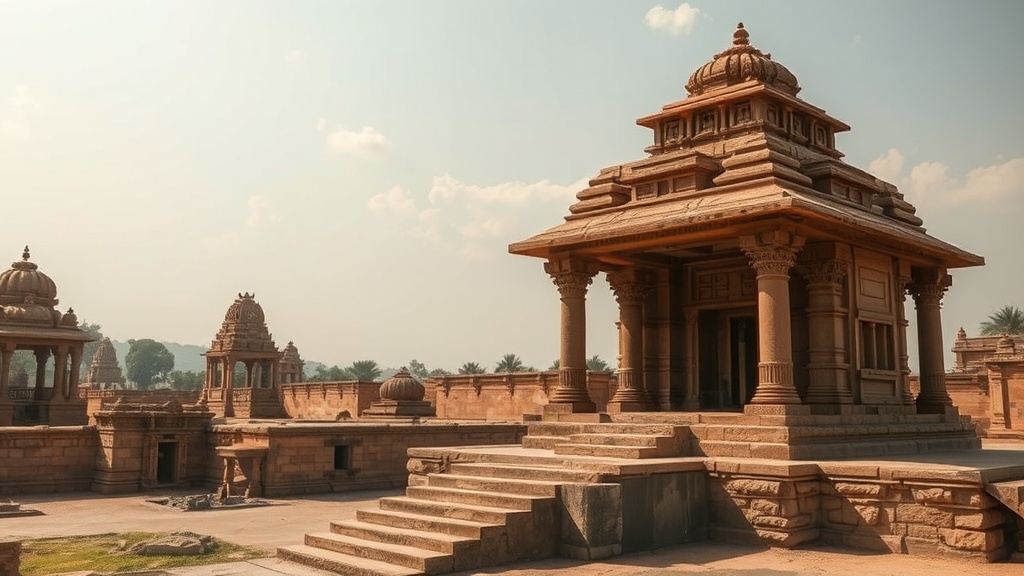
Aihole, situated in Karnataka, presents a remarkable archaeological site. It is not merely a collection of ancient structures, but a deep stratigraphy of architectural experimentation. For a significant period, this locale served as a veritable crucible for the nascent Early Chalukya dynasty’s temple building. The sheer density and variety of its temples, numbering over 120, speak volumes about a period of intense artistic and technical development. These structures are not isolated monuments but form a layered narrative, illustrating the evolutionary path of South Indian temple architecture.
The Early Chalukya period, roughly spanning the 6th to 8th centuries CE, was a time when the foundational elements of Dravidian temple architecture were being explored and refined. Aihole, often referred to as the "cradle of Indian temple architecture," offers a unique window into this formative stage. Unlike later, more standardized temple complexes, Aihole's temples showcase a range of styles, from early experiments in stone construction to more sophisticated rock-cut and structural designs. This diversity allows scholars to trace the gradual adoption and adaptation of architectural principles.
Archaeological investigation and epigraphic evidence at Aihole point to its prominence as a royal and religious center. Inscriptions found at the site, some dating back to the 6th century CE, provide crucial context for the patronage and development of these temples. For instance, the Aihole inscription, dated to the reign of Pulakeshin II (c. 610-642 CE), hails the prowess of the Chalukyan king and mentions the architect Ravikīrti, who designed the famous Meguti Jain temple. While this inscription is from a later phase of the Early Chalukyas, it highlights the longevity of Aihole's importance.
The architectural evolution at Aihole can be observed in the progression of its temples. Early structures often exhibit simpler forms, reflecting the transition from timber or brick construction to stone. These can be seen in the simpler layouts and less elaborate carvings. As the period progressed, there was a clear move towards more complex designs, incorporating elements like the garbhagriha (sanctum sanctorum), mandapa (hall), and shikhara (tower). The rock-cut temples, such as the Ravanaphadi cave, demonstrate an early mastery of carving directly from the living rock, a technique that would be further developed in later periods.
Structural temples at Aihole reveal a fascinating process of innovation. The Huchimalligudi temple and the Lad Khan temple, for example, showcase early attempts at freestanding stone structures. The Lad Khan temple, with its large, flat-roofed hall and simple pillars, is often cited as an example of an early structural temple, possibly adapted from a pre-existing structure. The Huchimalligudi temple, with its distinct vimana (temple tower), hints at the burgeoning development of spire forms.
A significant aspect of Aihole's architectural legacy is the experimentation with different temple typologies. While the fully developed Dravidian style with its towering gopurams (gateway towers) and elaborate vimanas would come to define later periods, Aihole’s temples represent a foundational stage. Scholars note the exploration of various roof forms, pillar designs, and decorative motifs. This period was not about rigid adherence to a finalized style, but rather a dynamic period of exploration and adaptation. The presence of both Jain and Hindu temples underscores the syncretic religious landscape of the time and the shared architectural vocabulary employed.
The careful layering of architectural styles at Aihole allows for a nuanced understanding of how new ideas were integrated into existing traditions. The challenges faced by early builders in working with stone, and their gradual mastery of techniques, are palpable in the surviving structures. Evidence shows a clear trajectory from simpler, more basic forms to increasingly complex and aesthetically refined designs. This process was not linear; some structures show adaptations and modifications over time, reflecting ongoing development and perhaps even regional variations within the Chalukyan domain.
The significance of Aihole extends beyond its architectural merit. It stands as a testament to the cultural and religious dynamism of the Early Chalukya kingdom. The temples were not merely places of worship but also centers of artistic patronage and technical skill development. The skilled artisans and architects of this era laid the groundwork for the grander temple traditions that would follow in South India.
Distinguishing between stylistic phases and dating disputes remains a key concern for archaeologists and art historians working at sites like Aihole. While general timelines are established, the precise dating of individual temples and the attribution of specific innovations can be complex. Such careful scrutiny, akin to examining the stratigraphy of a dig site, is crucial to avoid broad generalizations and to appreciate the subtle, yet significant, transformations in architectural practice. The ongoing work of institutions like the Archaeological Survey of India (ASI) continues to refine our understanding of these invaluable sites.
Aihole’s legacy is that of a fertile ground for architectural ideas. It is a place where the fundamental principles of South Indian temple design were tested, refined, and ultimately codified. The hundreds of temples, each with its own story etched in stone, collectively form a critical chapter in the history of Indian architecture, demonstrating a pivotal stage in the evolution of temple building.