The town under the urns at Adichchanallur
Two seasons of careful re-excavation in 2004–05 finally found the people who had been making the giant burial urns of southern Tamil Nadu for at least three centuries, somewhere between 850 and 540 BCE.
SwavedaApril 29, 2026
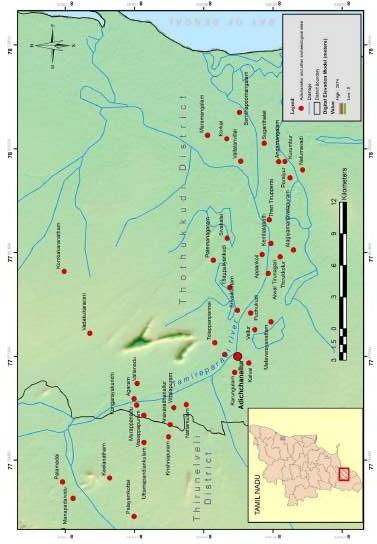
On a low rise above the Tambiraparani river in southern Tamil Nadu, nine kilometres north of the ancient port of Korkai, archaeologists have known about a burial ground for 150 years. F. Jagor of Berlin saw it first, in 1876. The sailor and antiquarian Alexander Rea spent six years there between 1899 and 1905, and walked away with thousands of objects — gold diadems, high-tin bronze vessels, iron weapons, miniature pots. The collections went into the Government Museum at Egmore in Madras and the British Museum in London. The site got a name, Adichchanallur, and a reputation: the most spectacular Iron Age cemetery in South India.
For most of the 20th century, that was where things stood. Rea had reported burial after burial, urn after urn. He had not asked, and his methods at the time would not really have allowed him to ask, where the living had been. Were the urns dropped into pits in someone's back garden? Was Adichchanallur a settlement that buried its own dead? Or was it a regional cemetery, where families brought the body of a dead aunt to the place reserved for the dead?
In 2004 and 2005, the ASI's Chennai Circle, under T. Satyamurthy, opened six small trenches across the site. Six trenches isn't very much — only 600 square metres in a 114-acre cemetery. But it was enough.
What was buried, and how
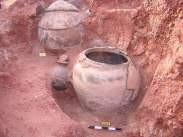
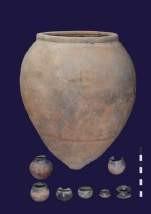
The 178 burials documented across the small dig fell into three groups. The earliest urns were red-ware globular jars, sealed with a flat stone or a shallow inverted bowl. Inside, the dead person had been laid in full body, knees drawn up to the chest — a primary burial. Iron objects were placed beside them: spearheads, axes, chisels, occasionally a sword.
A second, slightly later phase added a new pottery type — Black-and-Red ware, the South Indian Iron Age signature ceramic, fired so the inside and rim are black and the body is red. At Adichchanallur the team found Black-and-Red ware urns, not just lids — a first for the typology. By this phase the burial practice was mixed: some primary, some secondary (where the body had been exposed elsewhere first and only the bones were collected and placed inside the urn).
The latest phase was secondary burials only. Bones, sometimes belonging to more than one person — a man and a woman in the same urn, in one case a mother and an infant — placed inside the jar with a few pots and ornaments.
Carbon-14 dates from the 2004–05 dig, run on rice husk found inside the urns, set the dated burials between roughly 905 and 540 BCE — the report condenses this to "850–650 BCE" as the active range. The site as a whole was probably used for longer at both ends of that window, but those are the centuries we have direct dates for.
The settlement no one had previously found
What the Chennai Circle's trenches exposed below the burial layer changed the story. There was a potter's kiln. There were postholes — clear evidence of huts. There was a long stone-and-mud wall, preserved over several metres, of the right scale and orientation to be a settlement boundary. There was a small workshop where someone had been making beads out of coix seeds — Job's-tears, a hard-shelled grain that has been used as a bead since the Neolithic.
And there were grains. Rice and green gram, both cultivated, both consistent with the 850–650 BCE dating window.
Adichchanallur, in other words, had been a working town. The cemetery wasn't somewhere people came from a distance to bury their dead; it was the burial ground of a settled community that had its own potters, its own bead-makers, its own farmers, its own kiln. Whether the burial area and the habitation area were physically separate or interleaved is something the small 2004–05 dig couldn't resolve. The report is candid about that. But the existence of a settlement is now beyond reasonable doubt.
What we can and can't say
The maritime trade angle is real but limited. Some of the skeletons show ear-bone changes — exostoses — consistent with regular cold-water diving. The Tambiraparani drains into the Gulf of Mannar, which is the world's most famous historical pearl-fishing zone. People living at Adichchanallur 2,700 years ago were almost certainly diving for pearls.
What follows from that is harder. The early historic Tamil literary tradition, the Sangam poetry, describes urn burial with extraordinary care — there is a poem that simply describes a potter making a giant urn for a king. But the earliest Sangam poems are usually placed at around 300 BCE; the latest, around 300 CE. The Adichchanallur burials we have dated end before the earliest Sangam poem was likely composed. The poems describe a practice, urn burial, that survived into the period of literary memory; they don't describe the people in these specific urns.
The 2004–05 report itself, in its preface and discussion, leans on Sangam as direct evidence for what was happening at Adichchanallur. That's not quite right. The two windows do not overlap. The poetry is a window onto a later phase of the same regional culture, not a description of these particular urn-burying farmers.
The other claim that recurs in popular discussion of Adichchanallur is about civilisational antiquity — that the gold diadems and high-tin bronze that Rea recovered in the 1900s push the origins of Tamil culture deeper into prehistory than the standard chronology allows. The dates are genuinely early. 850 BCE is older than the earliest Tamil-Brahmi inscriptions by several centuries. But it is not older than Painted Grey Ware in north India, not older than Mature Harappan, and not evidence of a separate parallel civilisation. What it is evidence of is a widespread, technologically sophisticated, Iron Age culture in the southern peninsula — peer to and contemporary with the cultures of the Gangetic plain, with its own metallurgy, its own pottery, its own burial customs, and its own way of buying and selling pearls along the coast.
That, on its own terms, is interesting enough to make Adichchanallur one of the most important excavations of the early 21st century.