Tuljapur Garhi: a frontier village that didn't quite empty out
On the dry banks of the Purna in eastern Maharashtra, an ASI dig found a Chalcolithic farming village that bridged the Jorwe collapse and the early Iron Age — and the burial of a small child wearing a red jasper necklace.
SwavedaApril 29, 2026
Most Maharashtra Chalcolithic sites are well-behaved. Inamgaon, Daimabad, Nevasa, Walki — they start in the early second millennium BCE, run through the Malwa and Jorwe pottery phases, and by roughly 1000 BCE they empty out. The standard explanation is climate. The summer monsoon weakened, the rivers ran lower, the harvests got smaller, and the western Deccan villages people had farmed for several centuries became too marginal to live in. People moved away.
Tuljapur Garhi did not quite get the message.
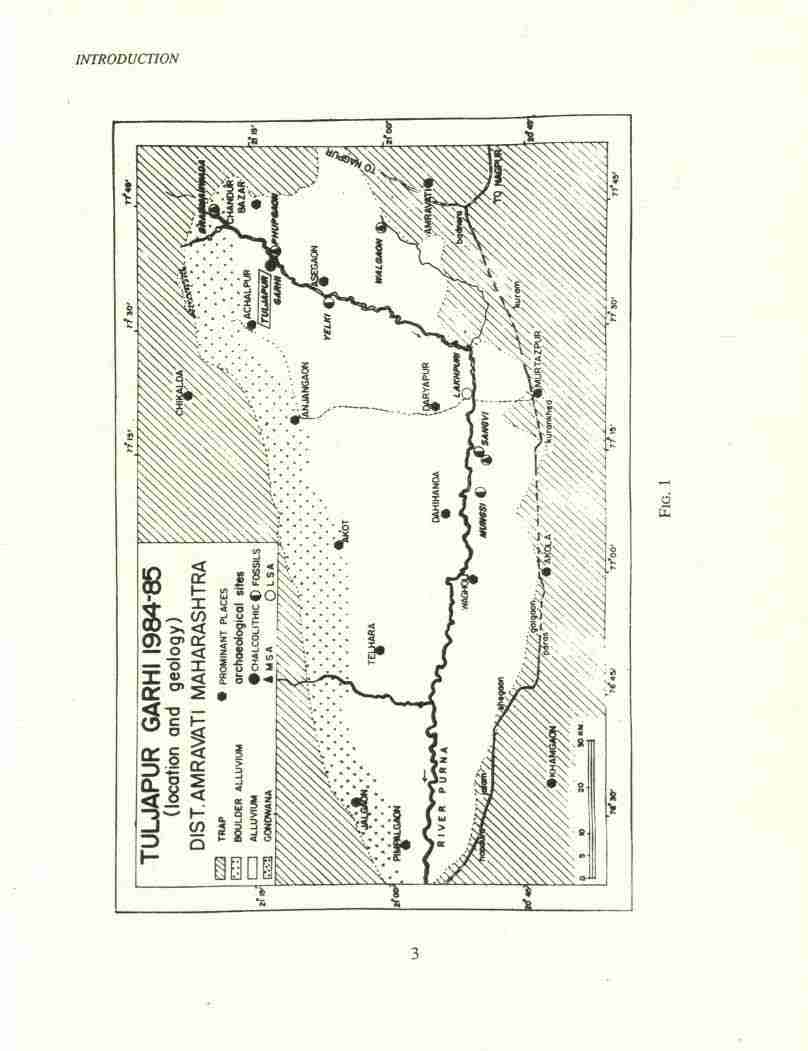
The site sits on the right bank of the Purna river, in Amraoti district of Vidarbha — the eastern part of Maharashtra, well past the Wardha-Wainganga divide that marks the edge of the well-known Chalcolithic farming zone. ASI's Excavation Branch-I, Nagpur, dug it in a single 1984-85 season under B.P. Bopardikar; the report appeared as Memoir No. 95 of the Archaeological Survey of India in 1996, with appendices on the human skeleton (S.R. Walimbe), plant remains (M.D. Kajale), animal bones (P.K. Thomas), and geomorphology (B.C. Deotare).
What they found was a small farming village with a 1.3-metre-thick cultural deposit on top of black cotton soil. Two phases. Phase A had Malwa Red Ware pottery; Phase B had Jorwe Red Ware. So far, perfectly ordinary.
What was not ordinary: iron objects appeared in Phase B, in the same layers as Jorwe pottery, near the top of the deposit. And one of the four radiocarbon dates Dr Rajagopalan ran at the Birbal Sahni Institute came back at the 5th century BCE — late enough that this site was still occupied while the rest of the Maharashtra Chalcolithic was already going dark.
The "Chalcolithic problem in Vidarbha"
The first chapter of Bopardikar's report is titled "Chalcolithic problem in Vidarbha", and the problem is specific. Vidarbha has many megalithic sites — the iron-using burial culture of the early-to-mid first millennium BCE, with stone-circle graves around inhumed dead. What Vidarbha did not have, until the mid-1980s, was much in the way of the painted-pottery Chalcolithic that defines the western Deccan from roughly 1700 BCE onwards.
Painted pottery had turned up at sites like Kaundinyapura, Paunar, and Takalghat–Khapa. But the painted style there was something a little different — different fabric, different forms, not really part of the Malwa-Jorwe family further west. The question that Bopardikar's dig was meant to answer was whether the Malwa-Jorwe complex — which everyone agreed had its heartland in the Godavari basin around Inamgaon and Nevasa — actually pushed eastward into Vidarbha or stopped at the edge.
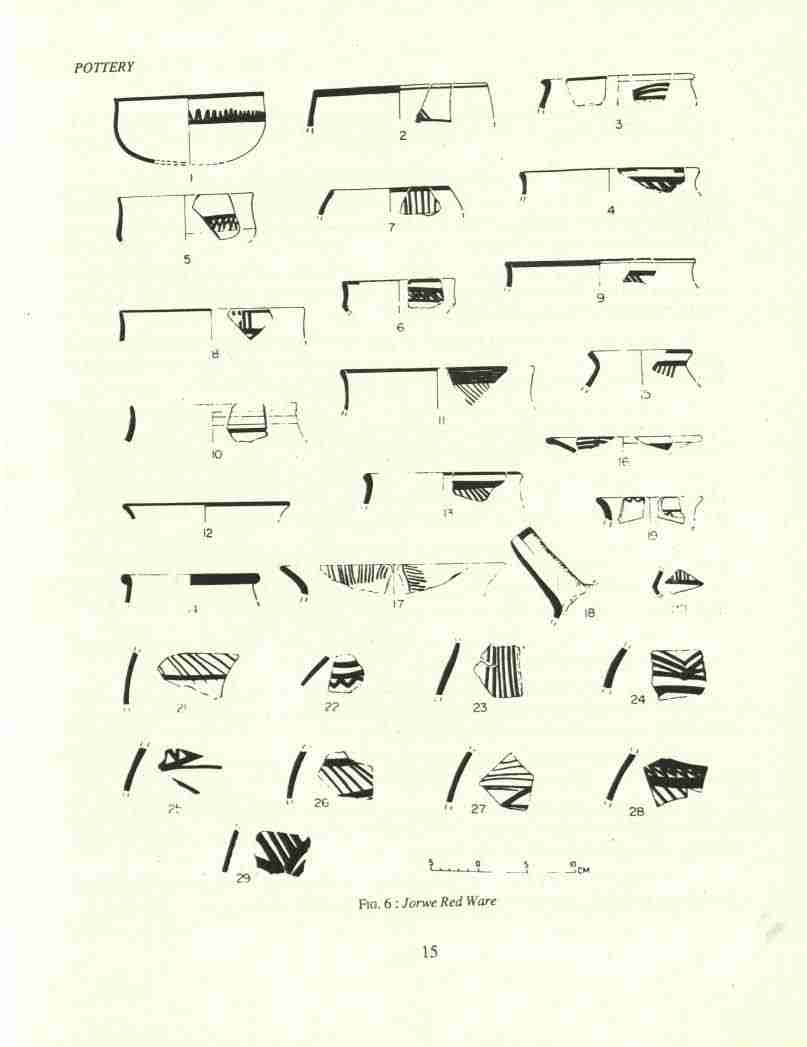
Tuljapur Garhi answered yes, but only just. It is, as far as we know, the easternmost Malwa-Jorwe site in India. Phase A pottery there is properly Malwa: the chocolate-on-buff painted designs, the carinated bowls, the spouted jars. Phase B is properly Jorwe: orange-red surface with black or violet zig-zags, ladders, and concentric circles on convex bowls and tubular-spouted jars. These are diagnostic styles. But Tuljapur Garhi sits alone in eastern Maharashtra — there are no other Jorwe villages in the Purna basin to make a community out of. Bopardikar attributes the thinness of occupation to high soil salinity in the Purna basin and to scarce potable water.
What people ate, who lived in the houses
The mixed-cropping system at Tuljapur Garhi is a near-perfect Chalcolithic catalogue. Kajale identified, in the Phase A and B layers: rabi (winter) crops of wheat, barley, lentils, grass pea and gram; kharif (summer) crops of rice, sorghum (jowar), pigeon pea, black gram, green gram, horse gram, hyacinth bean — and probably Deccan hemp or roselle for fibre. The only thing missing from the modern Indian dryland farming kit, more or less, is finger millet (ragi).
Pigeon pea is interesting in its own right. Kajale notes that western India must have been the centre of Cajanus cajan domestication — the Tuljapur Garhi seeds add to a slowly accumulating set of evidence pointing that way. So the village was both a consumer of the international Chalcolithic agricultural package (wheat and barley from West Asia, sorghum from Africa) and probably a small contributor to South Asia's own pulse-domestication record.
Thomas's faunal report has the bone profile of a cattle-keeping village. Cattle dominate every layer, over 70 percent of the assemblage; goats, dogs, and a long miscellaneous list — chital, hog deer, four-horned antelope, wild pig, mongoose, fowl, the occasional great Indian bustard, river turtles. The river was right there but no fish bones turned up, which Bopardikar flags as a small puzzle. People in this village ate beef, chicken, and venison; they did not eat fish.
The houses were modest. Oval and circular post-hole huts with floors of mud and pebbles, between 2.4 and 3 metres across. There was a 1.65-metre circular potter's kiln. There were beads — over 150 of them, in steatite, shell, jasper, agate, and carnelian, including some etched carnelian beads of the type more usually associated with Vidarbha megalithic burials.
A small grave
Walimbe's skeletal report covers a single body. The team excavated one burial: a child of about two years old, laid east-west in a shallow oval pit, with a small Black-and-Red-ware bowl beside the body and a necklace of eleven red jasper beads.
This is, by Jorwe standards, an unusual burial. Children at Inamgaon — the type-site of the developed Jorwe culture — were typically buried in twin pots placed mouth-to-mouth, oriented north-south, often within or just outside the house floor. The Tuljapur Garhi child was in a single shallow pit, oriented east-west, with grave-goods. Bopardikar describes it as "a freak one" and the report does not draw firm conclusions from a single case.
What the report does report is the bio-anthropology. The child shows dental hypoplasia — bands of incomplete enamel formation that record episodes of nutritional stress or fever during tooth development. There is an early indication of caries. The picture is consistent with marginal nutrition in the early years of life. The villagers of Tuljapur Garhi were getting by, but not always comfortably.
What it tells us
Most ASI reports finish at the description level. Bopardikar's mostly does. But two larger inferences are hard to avoid.
The first is about the Chalcolithic abandonment. If you take the conventional date of 1000 BCE for the end of the Maharashtra Jorwe horizon, Tuljapur Garhi looks like an outlier — a site that didn't empty out on schedule. The radiocarbon evidence is mixed (one of the four dates is rejected, and the others span the early first millennium BCE to roughly the 5th century), but the iron objects in Phase B layers are consistent with continued occupation into the early Iron Age. So one possible reading of Tuljapur Garhi is: the great Chalcolithic emptying was not uniform. Frontier villages on the dry edges of the system — exactly where a climate-driven explanation would predict the first abandonments — sometimes hung on after the more central, productive villages had already been left.
The second is about how prehistoric maps are made. The "Chalcolithic Maharashtra" of textbooks is a tidy zone bordered by the Western Ghats on one side and roughly the Wardha-Wainganga line on the other. Tuljapur Garhi quietly disrupts the eastern edge — the Malwa-Jorwe farmers reached further than the textbook map shows, even if only barely, and only at a single small village in the dry Purna basin. Cultural maps, like all maps, simplify the edges. The actual edges are usually more interesting than the centre.